A journey through natural wine in the Mosel
It’s the day after new year’s and I find myself driving along a dark, windy road, in the Mosel Valley. My best friend and boss, Henna Zinzuwadia occupies the passenger seat, and it’s because of her that we’re here, that we’re starting 2020 on an adventure into Riesling territory. At the beginning, this trip was to fulfil a rather selfish pilgrimage to the Riesling holy land and also celebrate her birthday. What we weren’t expecting was to come face to face with the reality of climate change’s impact on winemaking. A couple months after our trip, the German Wine Institute publicly announced in March that temperatures had not reached the prerequisite low of -7 °C (19 °F) for icewine, in any of the country’s wine regions. A bleak reality that we would come to find out is changing the Mosel viticulture.
Our host for most of the trip was Jan Matthias Klein, owner and winemaker at Weingut Staffelter Hof, one of the oldest vineyards in the world, and arguably the most forward thinking and experimental winery in the Mosel Valley. Staffelter Hof can trace its wine lineage back to the Benedictine Abbey of Stavelot Monastery, over 1,100 years ago. The Klein family took ownership of the vineyards in the 1800s and it has remained in the family ever since. Due to the cult-like status that some of Jan’s wines have amongst the natural wine scene in London, it’s easy to forget that this actually is very much a family-run winery.
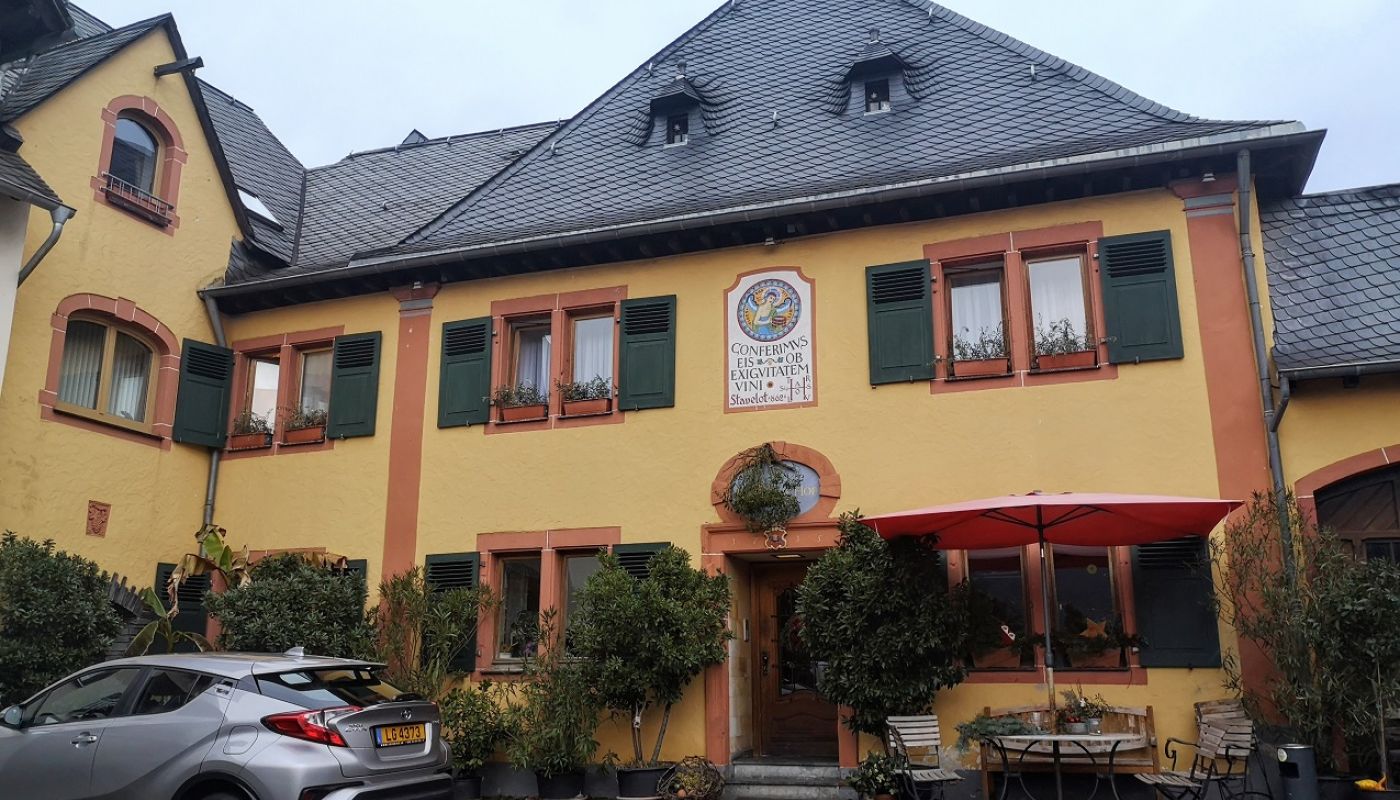
After our first day of driving alongside the banks of the valley, sampling wines at various well known producers, and marvelling at the steepness of the vineyard slopes, we pulled into the driveway to Staffelter Hof, glowing yellow against an inky black sky, and was greeted by Jan, a burly, bespectacled and stoic German who we hurriedly followed into the tasting room. After the first bottle was cracked open via the homemade wine bottle opener attached to the bar top, we were off on a tasting that left us giddy.
The tasting
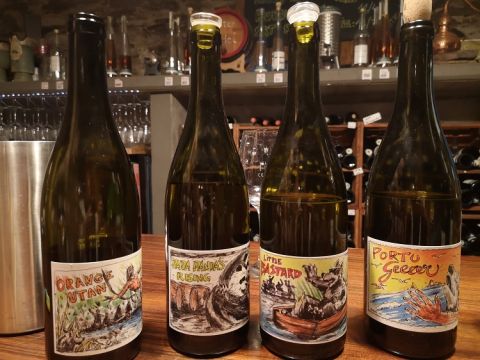
Jan’s winemaking is rooted in tradition and the Staffelter Hof portfolio has several ranges of wine that follow standard techniques. But Jan also has a range of wines that err on the more experimental side, his natural wine portfolio. A collection of seven wines, all produced with little-to-no intervention in the vineyard, fermented with natural yeasts and bottled without any sulphites. With playful names such as Portu Geezer and Orange Utan, these wines are a testament to Jan’s craft as a winemaker. Some of the wines we sampled included the Orange Utan, a Riesling and Muscat blend, whereby the Riesling is left on skins for six weeks and the Muscat for two, before being blended and left to undergo natural malolactic fermentation over the course of a few months in 1,000L old oak barrels. The result is a tangy, dry, and aromatic orange wine, with one euro of every bottle produced going to the Orangutan Project to help protect the Orangutan population from deforestation and habitat loss.
Henna and myself were fortunate to be able to sample a new addition to the range, prior to it being officially available, called Papa Panda. If you’ve ever seen Jan’s natural wines, you’ll notice them by the label artwork. He commissions a friend and local artist to create the labels for each of his natural wines. They’re often full of meaning, colourful and wickedly fun. The label for Papa Panda was no different. This 100% Riesling is a tribute to one of Jan’s favourite cartoons as a child, ‘Pandemonium’. On the label you have three pandas hugging, which is what they did in the cartoon in order to form the giant ‘papa panda’ to fight evil. The Riesling grapes for this wine only stay one day on their skins, keeping the colour light and acidity fresh, with a creamy note from the malolactic fermentation. There’s also a nutty note on the finish due to it’s time in old oak. As with most of Jan’s wine, there’s more than meets the eye. The grapes used to produce this wine were actually bought from one of his friends in a neighbouring village and is the start of his ‘Pandemonium’ project in an effort to support smaller, organic farmers in the area. As we continued tasting Jan’s wines in that tasting room abutting the cellar, and listening to the stories behind them, we started to realise the depth of his support for the community, fellow growers and young winemakers.
A guided tour of the Mosel wine making community
The next morning, Jan offered to take us on a tour of the entire estate. We piled into his van and sped up into the Mosel hills. Rows of vines whipped past us as we bounded up the narrow paths. The higher we went, the more vertical the vines became. We eventually stopped at a parcel of land, which was littered with overgrown shrubbery. The remnants of an abandoned vineyard. It was overlooking this parcel of land, where Jan began to explain his sustainability plans and his work with der Klitzekleine Ring or the ‘steep slope Riesling rescue team.’ He talked about his efforts between 2011 and 2014 to achieve certified organic status for his vineyard, the purchasing of abandoned plots of land in the valley to cultivate them for younger winemakers who are coming up the ranks, as well as to experiment with no human/machine intervention in the vineyard whatsoever, with only sheep to roam the grounds. His passion for maintaining a vineyard that not only produced exceptional wine, but gave something back to the land, was apparent. We asked him what the impacts of climate change have been on his vineyards and the Mosel Valley. The two biggest, noticeable effects he told us, were earlier and earlier harvesting seasons due to the warmer temperatures ripening the grapes faster, and the dwindling of icewine vintages. Oddly, however, climate change is a bit of a double-edged sword here. The warmer temperatures have actually been positive for traditionally slow growing Riesling, balancing out it’s high levels of acidity with more sugar, as the grapes ripen quicker.
However, if there is one thing that Jan can have control over, it is his and other winemakers’ impact on the land. The der Klitzekleine Ring project was founded by a community of wineries, himself included, in the Traben-Trarbach area, with a desire to protect the land for future generations. The group is dedicated to the recovery, maintenance and rescue of plots of some of the world’s steepest sites, which otherwise would fall into disrepair or disuse. And each parcel of land we visited after that initial stop; we could see the workings of this group in action. Various apprentices and up and coming winemakers were on those steep slopes pruning the vines in preparation for spring. Others were in Jan’s winery disgorging pet nat, or cleaning out barrels.
There’s a deep sense of family in Jan’s vineyard, and amongst his group of pioneers in sustainable viticulture, in a land that very much has a reputation for being old school. Time spent there, makes one feel like they’re on the cusp of something spectacular, of a breakthrough that may change the way we make wine, all orchestrated by the godfather of natural wine in the Mosel, Jan Matthias Klein. Not only is he following sustainable practices himself, but encouraging and teaching others on those steep slopes of Riesling, to experiment, follow through on their crazy ideas and figure out a way to survive in this rapidly changing climate.
















