I met Domenico on a cold foggy evening in an almost deserted Biella. He brought with him bright light and sunshine to a place that badly needs it. Despite the big age gap between us, from the onset I got the impression that we had many things in common.
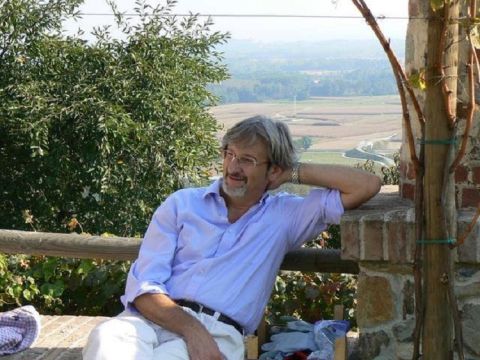
His ambitious mind, the joy of creating beautiful things in a proper manner, his difficult upbringing and the premature loss of his father all contributed to his desire for redemption.
This feeling kept alive his positive mind and seasoned it with a pinch of unconsciousness that contributed to forge his character. Prior to embarking on his journey of discovery into the the world of wines, Domenico was the owner of a computer software company. Then he became a sommelier, a wine taster and eventually a lecturer teaching viticulture in an Italian Sommelier Association, universities and foundations. He managed to leverage his knowledge of computer technology into the wine industry which gave him an advantage.
I especially love that part of his background. I am a sommelier and I believe that sommeliers should work in the vineyard and wineries at some point in their careers because the experience will allow them to understand the tricks of the trade. I also think that wine producers should work for a short period in restaurants comparing different wines and prices. In my judgement, Domenico has quite a lot of advantage on this.
Based on the above, it’s easy to understand why I chose Domenico Tappero Merlo winery when I read about the 2020 Summer writing competition, inspired by my recent visit to Lake Sirio in Chiaverano.
Where is this place? North west of Piedmont, in the Canavese area, the home of Erbaluce di Caluso, a white wine scattered amongst the provinces of Turin (Caluso), Biella and Vercelli, a DOCG recognizing all three styles of wines: Classic Method, still and passito which are the styles of wine Domenico makes.
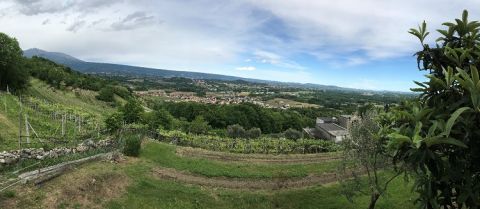
Here it is really evident that vines are planted on terraces and slopes built on the wall of an ancient withdrawn glacier because the shape left behind by the glacier is a visible morainic amphitheatre surrounding the plain. This mixture of pebbles originated from the disintegration of the rocks coming from Mount Rosa, Mount Bianco and Mount Cervino with mainly sand, which results in well-drained soils in an area of heavy rainfall high in mineral content. Viticulture and winemaking are done with the precise aim to bring those elements given from nature to the final wine.
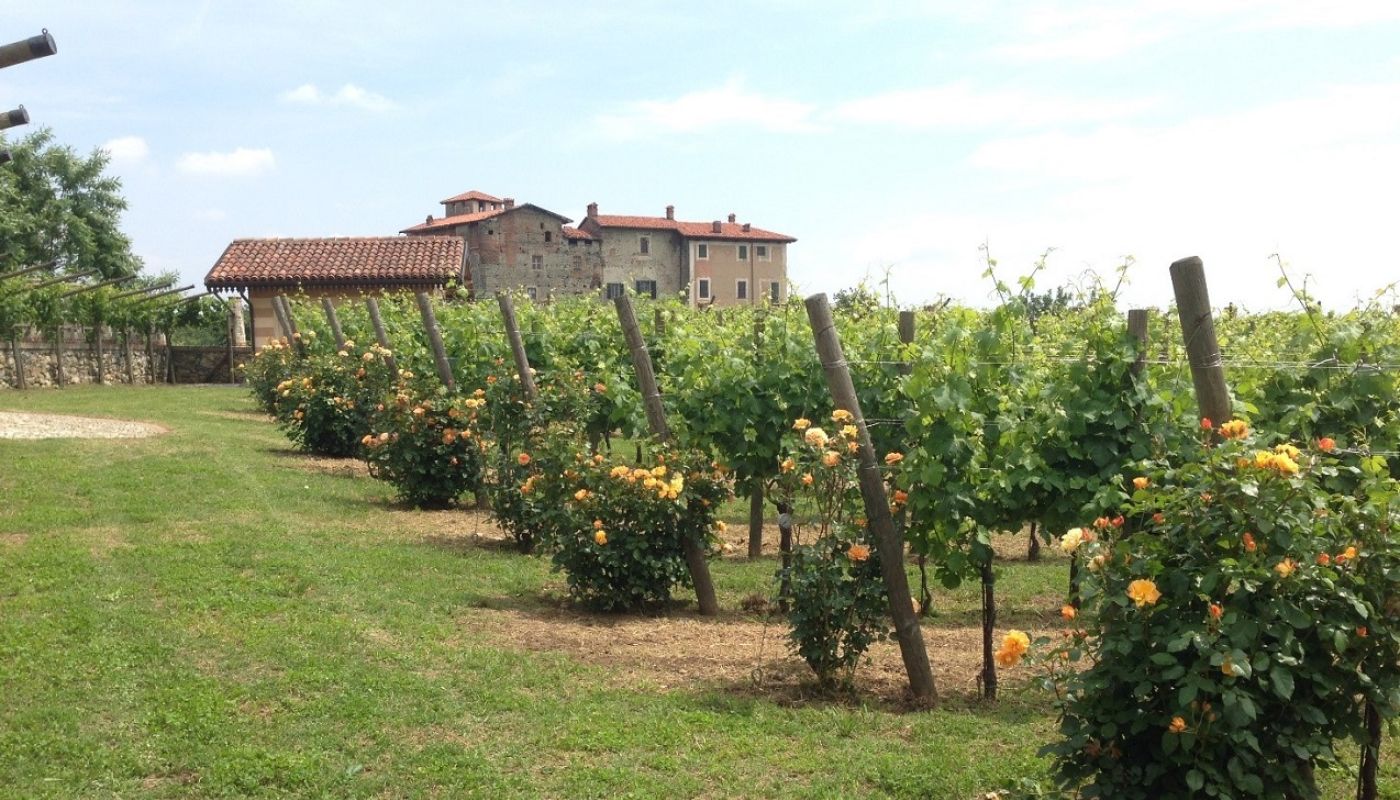
When you enter Domenico's vineyard you have the true feeling of being in a well-kept garden; roses standing in front of vine rows, shrubberies planted on the gradients to prevent erosion alternating small parcels of vines with prickly pears, lavender and broom. I must admit that it took a bit of effort to walk on those steep slopes. Olive trees and fruit trees are present here and there and wild aromatic herbs can be perceived by the nose. The most amusing moment was when I tried to guess some of the many plants used as cover crops, as I am a lover of wild edible herbs which I often collect during the spring. Domenico made me notice that there are mustard and horseradish plants; their roots release an unpleasant smell, useful to turn away nematodes, small undesirable worms that stick on the vine roots. I detected the watercress flowers and I was told that this plant is helpful because it gives nourishment to the soil providing it with nitrogen; but most importantly it is absolutely deliciousness for the bees farmed around the vineyard. The synergic activity of worms and microorganism under the soil with plants and insects like bees and ladybugs create a balanced environment improving the life of any element in a mutual exchange of benefit for the whole system. The synthesis of all the soil nutriments by the earthworms is essential for the creation of substances easy to be absorbed by the vine; I believe this specific uptake makes the difference in the final wine, giving a specific sense of place.
Domenico practices some spraying with a little bit of copper and Cerevisiae Yeast to contrast downy mildew and whole milk and sulfur preventing powdery mildew. He also strengthens the spray mixture with extract and infusions such as nettles infusion, propolis, orange extract, jucca infusion (a local herb) avoiding undesirable rot and the damage made by insects. Of course, these operations have to be done quite often, especially if it rains.
Just to add a little bit of night fun in the vineyard, when the cutworm can be a treat (generally in March) he and his assistants spend the nights hunting this little animal on each plant for 3 hours a night for one week, covering three hectars. I guess this can give a little bit of excitement to their daily job. Interesting to know that this worm in Italian is called ‘nottua’ indeed because he shows up during the night ‘notte’.
The hearth is moved with a ripper, a machinery with a moving pitchfork used for digging and removing weeds with the entire root system, helping to maintain a soft, oxygenated, weed-free and nourished soil. Manure and pelleted manure are used to feed the soil and although the farming is bio certified it is not biodynamic nevertheless the aim of the cultivation is to concentrate the attention more on the soil and the ecosystem rather than on the plant, avoiding the use of any agrochemicals.
Domenico is also experimenting together with the University of Siena, the use of a robot able to detect on each plant nourishment deficiencies and risky diseases. This detailed scan permits winegrowers to work on the singular vines targeting the problem. What a saving on spray, time and money!
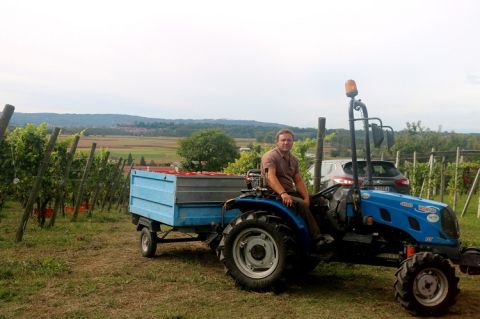
Meanwhile, as I was walking in the Vineyard I met Andrea, a guy from the area who told me he's been working for Domenico since 2004 and he attended many courses such as health and safety, chemical handling, Simonit & Sirch pruning and he proudly underlined he is a sommelier too, as Domenico wanted him do take sommelier classes obtaining his Italian Sommelier Association diploma in 2006. I guess Andrea might occasionally have some fun, as Domenico likes to organize dinner and events in his vineyard with local chefs and artists. But at the same time, he might have to cope with a lot of work due to the fact that he must always keep the vineyard looking like a nice and tidy garden. Some vine terraces are inaccessible for machineries and any operation has to be done by hand. Considering Erbaluce is a vigorous plant that need to be trimmed quite often it is a bit of a challenge to keep those vines nice and shaved manually!
One thing I really care about is the maintenance of the dry wall. It really touched my heart to see those skillful builders who do not use cement to repair this UNESCO heritage walls. Keeping to tradition, as it was done in the past by their forefathers, they put their strength and hard work on manually sizing the local stones, creating this admirable drainage, straight and sturdy walls. And in this winery dry walls are really taken seriously, benefiting from a long local tradition and a not so far school in Val d'Aosta.
Domenico's vineyards are scattered on different places and, moving on a higher ground (just a little bit higher altitude), I saw the touchiest and probably the least profitable part of his project. He is re-planting two literally unknown, rare, local white grape varieties, malvasia moscata and cascarolo, reserving one hectare out of three of his property to these vines destined for his Acini Perduti. Here, in this area, I also noticed he has some reservoirs of raining water for irrigation, although he rarely needs it.
And now I add a little bit of transgression to the story. Walking close to another vineyard I was attract by some large big vines surrounding an uncultivated camp. ‘What's that?’ I asked. Well, this camp has to be entirely planted with cannabis. Cannabis is adept at absorbing heavy metals from the soil and Domenico's aim is to purify the soil by growing cannabis in this camp for one year and replant the Erbaluce and Malvasia Moscata varieties using the old vine clones.
Domenico's wines are made within the Orsolani winery, the oldest winery in Caluso. Here they keep an eye on sustainability purchasing electricity from green companies and using solar panels for hot water.
The wild yeast fermentation takes place in 20 hl used oak barrels and further lees aging with battonnage adds more complexity to the still wine. Moreover, the Erbaluce undergoes three years of bottle aging, gaining some tertiary aromas. Sulphites are not seen as evil but, starting with a good raw material, it happens naturally to keep them at low levels (35–65 mg/l for white wines, 85–90 mg/l for the passito).
For his Acini Perduti Domenico uses biodegradable corks derived from corn by plant-based wine corks maker Nomacorc.
Something I really appreciated, is the innate nature of ambassador of the territory Domenico has. The local history, geography, traditions, craft products of the area are topics of genuine interest for him and the detailed descriptions he gives to the visitors just add more value to the surrounding place. For example, in the Belvedre vineyard (pictured at the top of the article), inside a little tower used for wine tastings, he painted the history of the Alba Luce goddess, narrating the legend of the nativity of the Erbaluce grape.
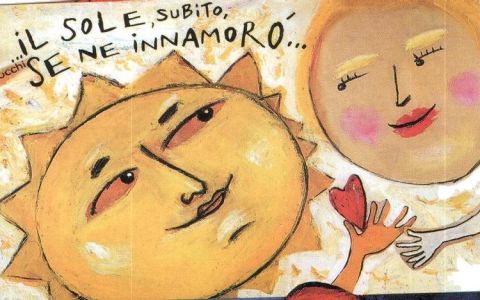
Over time Domenico has woven a wide network of collaboration with many local activities through a contagious enthusiasm, linking together restaurants, cheese affineurs, bakeries, writers of local traditions, artists and many others. A nice treat for his customers is the small earthenware plate from Castellamonte found inside the Domenico Tappero Merlo wooden case, a message that speaks of a long tradition, hand-made vases and pottery made in a local hearth just in front of one of the vineyards.
Domenico is also really involved in organizing many activities focused on the promotion and networking around the area and around the country especially with young people. Some of those are: Fondazione Levi Montalcini offering free conferences to help young students to find their path in the tourism and agriculture fields and Fondazione Banca d'Alba organizing free activities aimed at adding value to the territory helping young start ups. He also teaches on professional schools such as hospitality, tourism and agricultural schools how to set up a business. He was responsible for the Enoteca Regionale in the province of Turin, as well.
I believe the beauty of what he does is the sum of skills on both the production and the sales parts of his business. Domenico has a fond attachment to his grandfather's vineyards but at the same time he has a strong rebel mood about looking towards the future with sensitive and innovative techniques and an open communication. Inevitably, he says, we are going in this direction. Synthetic molecules will be banned by governments or conscious importers more and more. The new generations are far from drinking the three litres bulk wine our grandparents used to drink in the past. Instead, a gaze towards wines with a sense of a place and a real story to tell, a truly humanized consumption rather than a brand philosophy orientation is now prevalent. In order to satisfy these needs a wine producer can rely on countless innovations and technological advancements introduced in recent years.
This is how a small artisanal producer can cope with the international market on making his wine unique, starting from his grand father vineyards and connecting local people, spreading initiatives aimed to promote his area around the globe. It has been the key to arrive as far as Japan and many international markets. Enthusiasm is contagious.
















