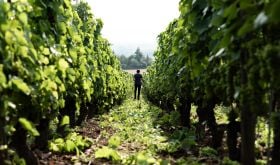
I was sliding uncontrollably between the steep rows of vines. It felt like a rite of passage. As a German-wine-loving London-dweller – enamoured with the crystalline thrill of Riesling but with no concept of appropriate footwear – I was being taught a lesson by nature.
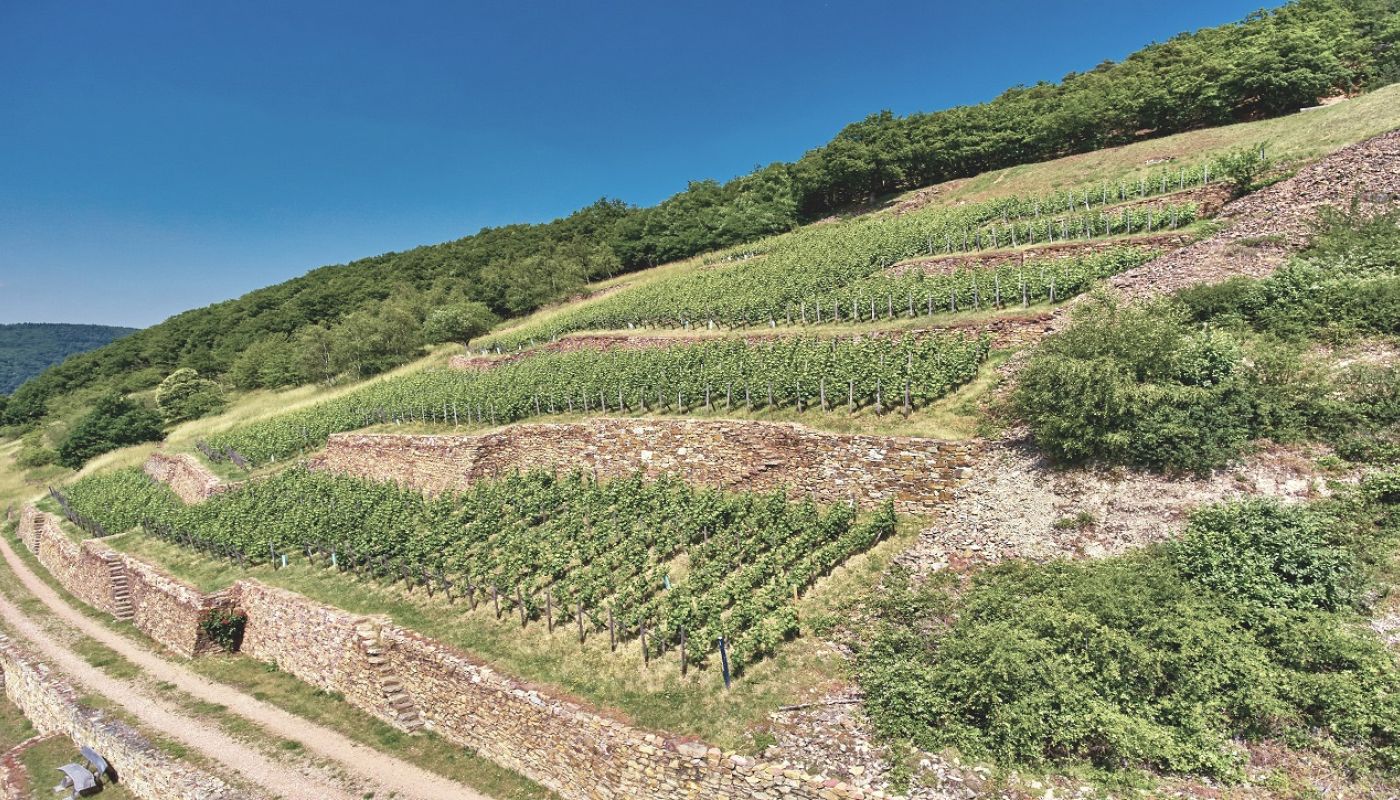
I was in the Berg Kaisersteinfels vineyard (pictured above, gradients of up to 35 degrees), with Johannes Leitz of Weingut Leitz leading the charge (in his suitably sturdy boots). Luckily for me, he did not notice my brief free fall and we continued the whistle-stop tour of his vineyards around the village of Rüdesheim in the Rheingau. All of the vineyards on this imposing mountain, the Rüdesheimer Berg, are impressive to behold. This is the western edge of the Rheingau, just as the Taunus Mountains allow the river Rhein to bend northwards once again, ending its east-west detour that forms the region.
Yet the Kaisersteinfels vineyard felt particularly special to me. Even on this overcast January morning the view from it was impressive. At 280 meters above sea level, nestled next to the forest, it is at the highest elevation of any of the Rheingau’s Grosse Lage vineyards (the equivalent of Grand Cru in the VDP classification system). It is also situated directly opposite the intersection of the rivers Rhein and Nahe, allowing one to stare wistfully down the valley into the long distance. But there was something even greater than the scenery: the sense of the past that the site evoked, with its sections of gnarled old vines and dry stone wall terraces.
Terraces and transformation
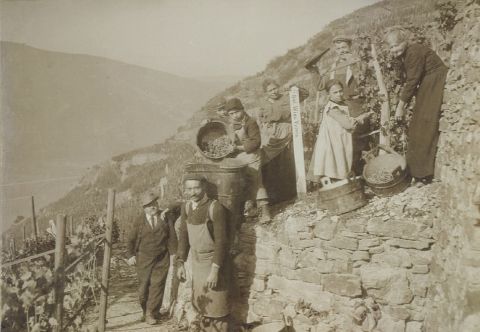
Such terraces used to dominate the landscape of the Rüdesheimer Berg. Striking photographs from the early 20th Century show an intimidating Jacob’s Ladder of stone walls, leading up into the heavens. Under the controversial programme of Flurbereinigung (vineyard reorganisation) in the 1960s-70s, most of these terraces were consolidated into larger contiguous pieces of land, making them easier and much more efficient to work.
Today it is perhaps easy for us (especially this London kid) to bemoan losing the majesty of the old terraces. But as Johannes says, ‘my grandfather was so proud and happy that the Flurbereinigung happened’. It undoubtedly saved hours of back-breaking manual labour in the pursuit of a basic living. While the resulting vineyards (such as the highly-regarded Berg Schlossberg and Berg Roseneck) still produce world-class wines, Johannes recognises ‘it destroyed a little bit of the microclimate and the 700-year-old surface of the vineyard’.
The name Kaisersteinfels itself evokes this history: Kaiser refers to Charlemagne, the Holy Roman Emperor who is said to have instructed vines to be planted here in the 14th Century (though the variety was Orléans, not Riesling as it is today). It also references the geology: Steinfels translates roughly to stone-rock, referring to the bare, meagre rocky soils of slate and quartzite holding the vines.
The vineyard survived Flurbereinigung largely unscathed; it was too high up the mountain and too steep for the bulldozers to bother with. Yet despite the vines surviving, its terraces were neglected and fell into disrepair over the decades.
Survival of the vines, revival of the terraces
As Johannes tells it, a large portion of the vineyard was owned by an eccentric old man, perhaps bearing mental scars from his experiences serving under General Rommel in the Second World War. (Johannes says there were stories of the man chasing government officials away from the vines with his shotgun, and, even more unnervingly, continuing to sign off his correspondence with the decidedly illegal phrase ‘Heil Hitler’.) This lack of commercial attention could be one of the reasons why the old vines were not pulled up to be replaced by younger, more productive vine material.
‘I was practically born in the vineyards,’ says Johannes. ‘As a child I was scared of the huge stone walls [built in the reorganisation]. I was always impressed by the remaining smaller terraces and curious about how wine tastes from unorganised vineyards.’ He started managing his family estate at the tender age of 21 and set to work improving the quality of wines, as well as developing its export markets. Johannes was finally in a position to buy Kaisersteinfels in 2002, purchasing the land from the aforementioned local ‘character’ and another owner. He embarked on a labour of love by rebuilding the traditional dry stone walls, investing much time and money into the project, but ultimately succeeding in restoring a suitable home for the precious old vines that remained.
The vines
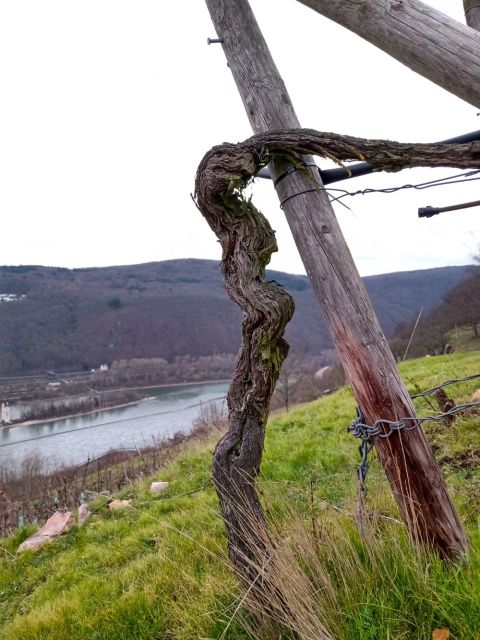
Regrettably, there is little documentary evidence relating to the vines themselves. Vines, however, show their age in appearance, yield and quality. Johannes is sure that there are some vines in the range of 70-100 years old or more, plus some younger plantings, as well as the vines he has planted himself this century. At harvest, the fruit from the old vines is always separated from that of younger vines. The wine from old vines will go into the Grosses Gewächs bottling (‘GG’, a dry wine made solely from a VDP Grosse Lage), whilst a portion from younger vines will likely go towards Leitz’s ‘Magic Mountain’ Riesling, a cross-vineyard blend of the Rüdesheimer Berg.
Johannes likens tasting the wines from the old vines as like listening to the wisdom passed down from a grandparent – or, my preferred analogy, like taking lessons from Yoda, the wizened Jedi Master in Star Wars.
The bottled wisdom of Yoda
Due to its high altitude and its distance away from the ripening effects of the river, the wines from Kaisersteinfels have always had more bracing acidity than those from other vineyards. In previous years, this meant that the wines were balanced out with some residual sugar – only about 12 grams per litre, barely off-dry, but enough to exclude it from qualifying as a Grosses Gewächs under the VDP regulations.
With the impact of global warming, the grapes have been getting riper, softening the acidity. This climate change (combined with the marketing boon of selling it as a prestigious GG wine) means that Leitz now makes this as a dry wine, joining the very top ranks of their portfolio of Rieslings. (Throughout the changes, Leitz’s labels have always carried a depiction of the terraced vineyard, with the subtitle ‘Terrassen’.) The combination of the site’s cooler mesoclimate and the deep roots of the old vines put it in a strong position to cope with a warming world.
The wines from Kaisersteinfels are always tense, linear and (dare I say it) mineral in style. My tasting notes on the 2017 and 2018 (both made as GGs) describe citrus flavours, along with a chalky, stony texture or oyster shell-like salinity, even in the warmer conditions of the latter vintage. For me this stony, saline textural grip is often a calling-card for old vines in white wines, whether it is Sonoma Chardonnay, Sancerre or German Riesling –could this be the wisdom of Yoda making itself known?
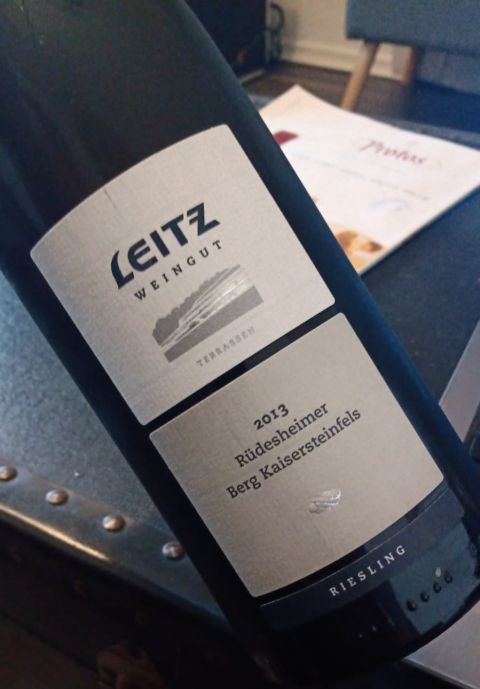
I also tracked down a bottle of the 2013 vintage, made in the previous style with some residual sugar (11.9 grams per litre). It is a stunning wine – concentrated yet lifted and elegant. At 8 years old the wine is at a beautiful stage of maturity. The extra residual sugar is barely perceptible, just adding a sense of harmony between the bracing acidity with the gorgeous flavours of chamomile, baked Bramley apples and honey. And there it is again – an extra level of intensity on the palate, almost salty in its grip, taking the experience to the next level. The wisdom of the old vines coming through, telling the youngsters how things are done properly.
The photos are provided by Richard Lewis.