Why does the idea of old vineyards resonate so much? Is it just for the nebulous concept of “quality”? If we already know that the term “old vines” on a wine label covers a multitude of sins or virtues for what’s in the bottle, then quality alone isn’t resonant enough. But underneath the platitudes for old vines, there remains a mystery, a journey, an endeavour to make wine from old vine fruit in defiance of what we know to be practical, or viable, or immediately accessible. Old vines take us further on a voyage of vinous discovery that all wine drinkers want to take, to find flavours that lure us to drink again, flavours that capture our imagination of time, soil, place, and the obsession overlain with purpose that winemaking so often encompasses.
As in the pursuit of flavour, old vineyards require us to ask questions to uncover answers. Why are these vines still here, in an undistinguished, unknown field? Is there alchemy under the surface that keeps these vines nurtured through the ravages of each passing year? Are these vines “the one” – that vineyard that will become the source of for the next great wine to conquer critical acclaim? Discovery, questions, infrequent answers, with old vines always holding their mystique.
There are some vineyards where the extremes of location and surrealness of an isolated vineyard require almost a suspension of belief. Nowhere has seemed to encompass this more than Henk Laing’s Pinotage that hangs on in the hills of South Africa’s Skurfkop, to the west of Clanwilliam. This is the epitome of an old vineyard: Pinotage, Semillon and Hanepoot (the local synonym for Muscat of Alexandria), three varieties never considered globally mainstream but planted together in a region barely marked on a map. Yet the Skurfkop – also known both as the Skurfberg and as Citrusdal Mountain – isn’t an unknown region anymore, nor is Henk Laing’s vineyard unknown either. The Pinotage was planted there in 1978, but to my knowledge, only Thinus Krüger of Fram Wines and Cerina van Niekerk of Cecilia Wines make wine from the couple of hectares of old Pinotage vines.

It was these Pinotage vines that we travelled to see. At the time, I was visiting Cerina van Niekerk during the 2016 harvest at the large white wine producing co-operative in the Olifants River Valley where she was head winemaker, a region where the nearest town or neighbouring winery of any kind was over ten kilometres away. This wasn’t the more manicured surrounds of Stellenbosch or Franschoek, but a region where the vast expanse and loneliness of Africa became stark. Turning south out of the corrugated winery road onto the N7 highway, we drove at a stately pace in an old diesel Landrover up the narrowing, dusty river valley with the rocky Cederberg Mountains looming away to the east. Swinging off the tarmac after half an hour, we inched higher up a rocky red dirt track that became ever more serpentine, past thickets of cacti, aloes and scrubby bushes, occasional signs of a small house or isolated settlement, and wind-blown Rooibos plantations, the local crop planted all over these dry hills. The Landrover was on a good day – no punctures or broken drive shafts for once, both of which had happened in previous weeks, in places equally remote and bakingly hot.
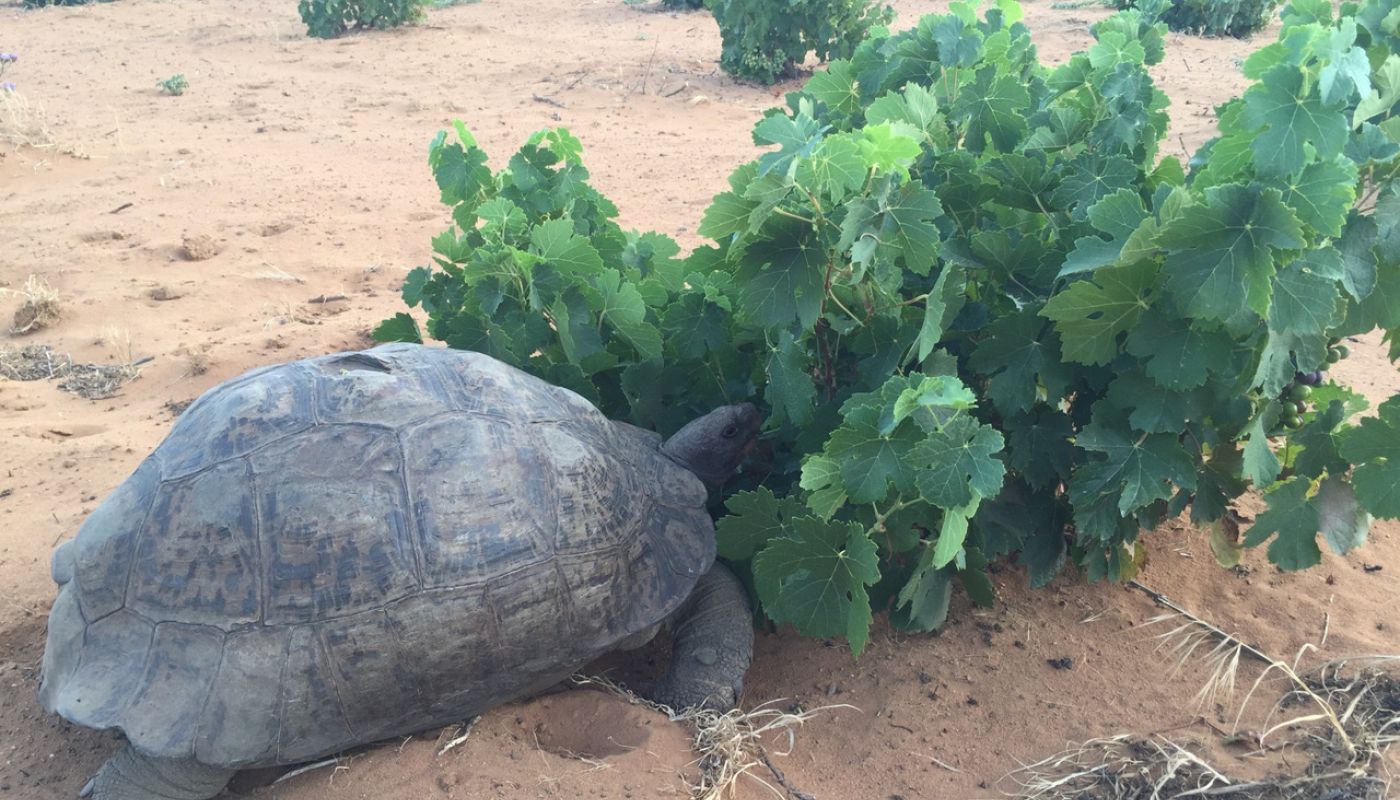
Turning a corner, Henk Laing’s farm came suddenly into view at the foot of a rocky kopje, a collection of small white buildings being slowly tinted red by the dust. We drove along the sandy farm track, past some battered-looking farm equipment and into the gently sloping vineyard. Looking out of the left-hand window, I suddenly exclaimed, with Cerina braking hard and then backing up. Head-first in one of the old Hanepoot vines was a gigantic, dust-covered tortoise, nearly as tall as the vine which it had chosen for an afternoon’s snack of dry-farmed Muscat grapes. We sat there in the stifling Landrover cab, with the background noise of the diesel ticking over, just watching as part of the local wildlife went about their day. The vineyard suddenly seemed even further away from any neighbour.

Leaving the tortoise grazing, the Pinotage vines were a little further on. The soil here had changed colour from where the Hanepoot was sited, but maybe that was also the effect of the sun slowly starting to sink in the expansive African sky. In ruddy, dry, red earth overlain with patches of desiccated grass, the Pinotage stood somewhat apart. Small, widely spaced, free-standing, and more upright than the Hanepoot, this was a vine that evidently retained its natural vigour, even in conditions that by any viticultural standards were extremely challenging – less than 350mm of rainfall a year, even before the savage drought that had enveloped the Western Cape in 2016 had hit. These vines didn’t have the massive spurs or trunks found in other old vines in more vigorous regions of the world, and the struggle to survive in a harsh, stark place was etched into their scrubby appearance, at one with the surrounding landscape. Staring into the sun out to the north, the dry, low ridges of the Skurfberg plateau stretched away under the 360° dome of the sky. This just wasn’t a vineyard or setting that could ever be taken for granted.
The clusters of dark Pinotage grapes were few and protected from the sun under a sparse canopy. Pinotage, like many varietals now being reassessed in part because of the remaining clumps of precious old vines, is a much maligned and misunderstood variety. Up close, the clusters were surprisingly small, even though the dry, harsh environment should have suggested that. Berries were tightly packed and dense, at first glance not dissimilar to varietals like Petite Sirah. As a winemaker, you immediately think of how you’d handle the probable concentration that would result from such robust little clusters, how to retain fresh aromas and tame excessive tannins. After we wandered and weaved across the dusty furrows of the vineyard, Cerina decided the fruit was ready for harvest in the next couple of days – by hand, of course. For the life of me, I couldn’t ever imagine a machine harvester navigating the road to the Laing’s farm.

Henk Laing himself met us after we’d looked at the vines and the fruit. Shorts, trunk-like brown legs and a cheerfulness that belied the evident difficulty of farming crops like grapes and Rooibos, Henk and Cerina struck up an immediate conversation about everything except grapes. The appreciation that Henk showed to Cerina for paying good money for his long-forgotten fruit was plain, and he went on to regale us with his knowledge of the tortoise we’d seen earlier – one of six, who Henk let roam the land and vineyard. Even the appetite of six giant tortoises can’t affect yields that much, he reckoned, so live and let live. That wasn’t the only wildlife the farm encountered – the occasional lion had been sighted, and I wasn’t surprised to hear that the rocky kopjes surrounding the farms were ideal leopard hangouts. And then there was the buffalo that had charged and gored Henk some time ago. Wait, what? Gored by a buffalo…? Even for someone who had been to Southern Africa many times before, where wildlife stories abound, this was farming at the edge of reason.
The journey back to the winery wasn’t memorable, only because I remember talking at length to try to understand more about the varietal, the vines, the remarkable location and the wildlife. I couldn’t help but wonder what those vines had seen. Planted in 1978, they would have witnessed the unpleasant tail end of apartheid and the era of isolation that South Africa endured; then the liberation and emergence of the Rainbow Nation; and finally, the rediscovery of the Skurfkop as a distinct wine district. Even that last fact gave so many questions. Who harvested Henk’s vines? This wasn’t a region where freely available labour seemed possible. The collection of harvest cellarhands that Cerina had at the winery were mostly from the Eastern Cape region, who had travelled for two days across South Africa just to gain seasonal labour that was hard, tiring, and poorly paid by any standard. It wasn’t feasible to think of the local labour that Henk needed to help farm and harvest his vines in an inhospitable and remote corner of an already remote part of the world. How did they even travel to the farm on each harvest day?
Over the next week, Henk brought the harvested Pinotage fruit into the winery in crates on the back of his truck. After destemming into a few upturned puncheons with the barrel heads removed, this became Cerina’s treasured side project and her retreat from the relentlessness of harvest, where she’d go to do a plunge down a couple of times per day in solitude. Maybe this is why old vines and old vine fruit have become so revered by winemakers: they offer a return to genuinely elemental winemaking and challenges away from the standard routine of technical winemaking. There’s a deeply personal connection to the site, perhaps to an unloved or forgotten varietal that deserves more attention, with a yield of remarkable fruit that somehow requires a winemaker to go beyond the usual pound of flesh that winemaking demands at harvest.
Cerina’s wine turned out great, from memory: a simply made Pinotage with no enzymes and no added yeast, but pretty much just grape juice that tasted like a wild Pinot Noir with the bramble fruit rusticity of a Côtes du Rhône - the genetic heritage of Pinotage as liquid. Maybe that fruit quality was the only reason why these vines had survived, having endured eras of social, political and economic turmoil, only to be faced with new challenges in climate change. Despite everything, these vines still represented a small slice of history, a family heirloom to be handed down and even when times were tough, had just enough people who believed in their quality and value, both monetary and social, to keep them alive.
Henk Laing’s Pinotage vines are still just one old vineyard amongst many in South Africa and, of course, the rest of the world too. But all these old vineyards do more to represent the essence of winegrowing and winemaking as we really want it to be than any other part of the wine industry: ancient land, unpredictable weather, enduring plants and man’s skill and perseverance to elevate a simple beverage into something extraordinary. Somehow, the threat to old vineyards the world over is a threat to the soul of the whole wine industry: we’re removing what we actually believe in. Thankfully, the Skurfkop vineyards like Henk Laing’s have survived due to enough winemakers discovering them in their pursuit of authenticity. These are vineyards that give inspiration and hope. I was fortunate enough to travel to Henk Laing’s vineyard – but for any wine lover, in any wine region, spend time to search out and visit the old vineyards there. These are truly the places that our love of wine grows from.
The photos were provided by Rob MacCulloch.
















