Nathalie Spielmann writes I am a Full Professor of Marketing at NEOMA Business School in Reims, France where I created and manage the MSc Wine & Gastronomy. My research interests centre around consumer behaviour and decision making and many of my academic articles focus on terroir, branding, and collaborative strategies between wine firms. I hold the WSET Diploma and am an Italian Wine Ambassador.
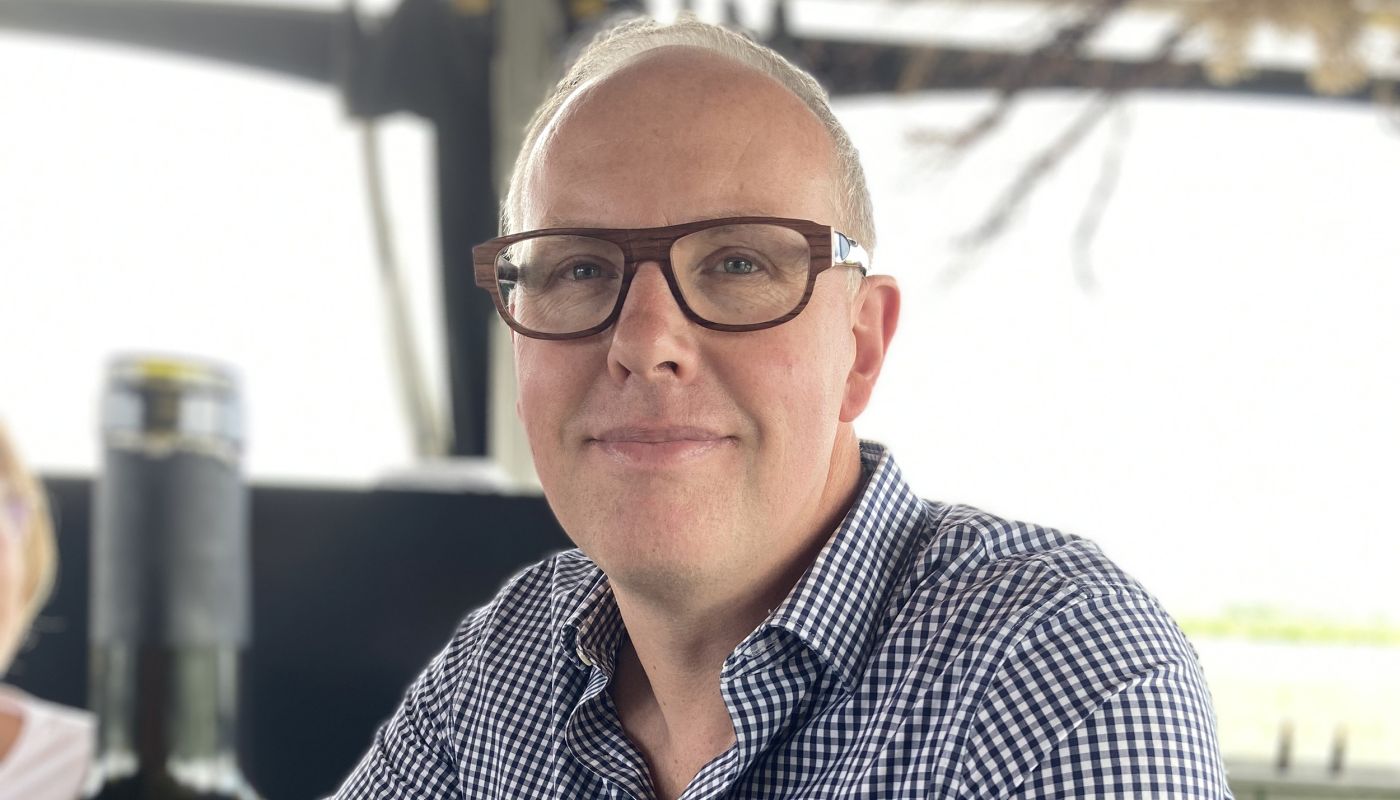
Fabrice Parisot, aka Nostravinus
We pass by unremarkable shops, day after day, failing to realise the hidden gems that lie within. They are either difficult to find, poorly advertised, or perhaps even uninviting. But when finally, something does beckon us in, we are called to discover their splendour. And often, the people tending these stores reveal themselves to be just as phenomenal as the wares they sell, with exceptional qualities and gifts beyond our imagination.
Just off Place du Forum, in the heart of Reims, in the courtyard of what used to be a bourgeois mansion, there is a red arrow pointing down a treacherous set of stairs. There is no storefront, no display window, just that red arrow. One must know where to find Les Caves du Forum. Venture down those stairs and you’ll find yourself in vaulted 16th-century Champagne storage cellars where the lighting is eerily cast, the temperature plummets to 12 degrees Celsius, and the humidity clings at an even 80 percent, mercilessly saturating coats and labels alike. The chalk walls emit a faint musty smell redolent of the history this place has endured. Dust periodically falls loose from the walls, giving the bottles inhabiting the store a uniquely aged appearance. It also gives the customers picking up these bottles the feeling, as if in a treasure hunt, of having unearthed a prize. To the left of the stairs, past the sturdy wood cabinet that houses Palo Cortado sherries and centuries-old Madeira wines, is Fabrice, who stands watchful behind the main counter.
At first sight, he is not what one might consider delicate in appearance or manner with his brawny physique. Yet, the exudes an explicit assurance, an obvious potency, and a careful intent when handling any of his wine bottles. Fabrice can casually hold two magnums in hand, and with something akin to alchemy, reduce them to regular-sized bottles just as he can carry three six-bottle cases of wine as if they were filled with feathers. Six days a week, he lives among the tens of thousands of bottles he has lovingly curated, as if in a cathedral housing precious artefacts, protecting the story behind every label. Together, these wines tell the overarching story of his vision of wine.
Fabrice’s love for wine transcends time; he loves wines that are laborious to grow, demand effort to make, take time to arrive at their apogee, are slow to decant, and unveil their true form after shaking off their notes of bottle reduction. Such wines speak to him on a deeper level. Cerletainly, this is why he loves, lives in, and sells Champagne. It is also why, when asked what and where he would make wine if he could, he answers Vin Jaune in the Jura. He instantly fell in love with the notoriously fickle-to-grow Timorasso and, in his wildest dreams, he is tending to gnarly Grenache vines on the treacherous sea-facing slopes of Banyuls. One could assert that “labour of love” is his preferred style. Even so, his passion for older wines does not preclude an appreciation for recent vintages. What matters to him is finding wines that have an discernible essence and a sense of place because they reveal the truth of how they came to be.
Fabrice’s days are spent juggling the slew of orders, customer inquiries, and staff workloads, entering new stock, and sometimes grappling with the malcontent of suppliers and shippers. But behind the travails of business administration, is a joyful appreciation for his passion which he exercises daily. This ancient store, with its numerous alcoves, represents all the pieces of himself forged over twenty years and whose intricacies have become manifest in his daily work. An undefinable energy courses through him that drives his business acumen but, can also weigh on him. The wrinkles on his forehead have deepened, whether he likes to admit it or not.
When Fabrice recommends a wine, he craves perfection – a trait common to most sensitive beings. He will often ask, “what do you want to feel?” With the answer echoing in his mind, he considers aromas, evolution, texture, emotion, and their critical roles in the experience he wants to harmonize. His mental wine Rolodex comes to life, allowing him to access every detail of every wine he has ever tasted. His taste memory and ability to project the shape and profile of wines with precision and aplomb is so mysterious I’ve taken to calling him “Nostravinus.”
The whirlwind of information suddenly funnels into a specific direction, and he has found what he was looking for: a 20-year-old Montepulciano d’Abruzzo from Emidio Pepe. He estimates that the tannins have softened with time, the fruit is less overtly plump, and the elegant herbaceous notes are akin to a top Cru from the Médoc, concluding with the obvious warm-hearted note of Italian winemaking. He has projected how the aromas of slow-cooked lamb and roasted eggplants will fill the house, as a Spring storm announced on Sunday will churn outside. His goal is to match the subtleties of the meal with the essence of the moment. Once again, he is spot-on.
When it is time to open a bottle of wine, Fabrice’s inner tempo slows down, and much like wine, another layer surfaces. The demeanour of this broad-shouldered man is transformed into one of deep contemplation: he unfurls his brow, and the clear icy blue of his eyes softens. He will gently examine the bottle on the counter, often angling it slightly to study the label, savouring each detail that comes into focus; his curiosity about it grounds him. Fabrice will move to the glass cabinet in his tasting room filled with maps of wine regions of the world. His movements become delicate, and his bear-like hands are precise when selecting often excessively fragile glasses, thin as Tengucho paper. Watching him select glasses, I am reminded of when he refused to sell me a bottle of wine many years ago, convinced that I did not have the appropriate glassware to honour the wine and appropriately revere the experience. Thankfully, he agreed to lend me some glasses (and a decanter) so I could take home a 2005 Volnay, by Hubert de Montille.
The most mysterious facets of Fabrice’s talent reveal themselves in his exchange with the first glass of wine. He has the rare, uncanny ability to read the nameless language of wine. He is not smelling or tasting the wine; he is trying to understand its soul and its origins. The wine begins to transform him as its aromas rise from the glass and his connection with the wine deepens. He is listening to what the wine wants to tell him, understanding when it needs time, when it needs warmth, when it needs to be jostled awake, when it needs to collect itself. He smells the weather patterns of the vintage, the fermentation temperatures, and the yields. His mind matches the wine with aromas captured in the prairies, ponds, and forests that coloured his childhood, liberating sensations like jogging in the warm summer rain, and vibrations knowable only after striding through vineyards around the world and spending endless hours in underground cellars listening to winemakers detail their craft. With every sip, he focuses on the haptics, the flow, the grip, and the swirl in his mouth to deduce blends, wood types, vintages, and soils. He is attentive to the finish, judging the sapidity, and hopeful there is just a touch of mineral bitterness to lift the wine and showcase its potential. Eventually, a three-dimensional image of the wine emerges, never anthropomorphic but abstract, like a Dalì painting, stirringly vibrant as the wine evolves.
Fabrice is mesmerizing yet never performative when he tastes. There is an honesty about his method that leaves those who taste with him in awe, sometimes confused, but never excluded from his world. When he has finished immersing himself in the wine, he comes back to the natural world where most of us are still struggling to list six aromas and define the acidity, and he is ready to share his extraordinary gift. And while his words might not always seem WSET approved (did someone say minerality?!), he will take the time to explain and demonstrate what he so deeply feels. To train my palate to understand acidity versus salinity, he had me taste lemon juice and compare it to salted water. I also suffered through a malic acid (Mencìa) versus tannins (Priorat and Barossa Syrah) comparison for which my tongue still holds a grudge. Yet all these sessions have helped me grow and come into my own as a taster. Fabrice intuitively understands how to verbalise the sensual nature of wine, despite an underlying frustration that most others cannot taste with the same refinement. Seldom are words adequate to express the emotions he experiences when tasting wine. But then again, can one truly describe love, or can it only be felt in the body?
“Do you like the wine? What do you like about it?” he asks.
These are his reminders that wine tasting is not just an intellectual exercise, it is an emotional moment that can move you. And he is right. Wine is an aesthetic experience, like viewing art or listening to opera. But it is too often reduced to the consumption of alcohol or reserved for those who have the means or who are learned. Wine is none of those things. Wine is empathy, it is intimacy, it is affection. Wine is relationships–with winemakers, store owners, friends and family, when we laugh and celebrate, cry and commiserate.
This stalwart man with his determined gaze radiates a deep understanding of the natural, sometimes raw, empathy and intimacy that can be experienced only with wine. Through his wine selection, he not only captures true emotions, he also shares them. Wine is a catalyst for moments and relationships between people. He knows this better than anyone. Without wine, he may have remained an electrician in Northern France and I might still be living in Canada. It was wine that brought us together that fateful Saturday when I decided to venture down those non-descript stairs into Les Caves du Forum. That is why Fabrice, because he taught me the value of wine, is not just my favourite person in wine; he is also my life partner.
The photo is the author's own.
















