Nimmi Malhotra writes Nimmi Malhotra is a wine and drinks writer and a wine judge based in Singapore- the fifth city she calls home. Born in India, she moved to Melbourne, Australia, where she fell in love with the uniformity of vineyard rows. Later, she moved to Hong Kong, where she studied for her WSET Diploma. Now in Singapore, she contributes wine content to the Channel News Asia news network, Drinks Business Asia edition and various other magazines. Her favourite wine person is her uncle, Paramdeep Ghumman, who introduced her to wine culture.
The road to Nazaaray
A tale of two Indian immigrants who found their calling in wine twenty years apart.
The highway to Australia’s Mornington Peninsula turns scenic after the town of Moorooduc. Patches of vineyard mounds come into view, scarce at first, but there’s more to come.
As I turn into the Mornington-Flinders Road, the land changes. The wind-whipped eucalyptus trees stand guard on either side of the narrow meandering roads and invite you to take in the view in short bursts: the farms, the fields covered in shades of green, grazing cows, rolled-up hay barrels and endless rows of vines.
I’ve driven this route more times than I care to remember. In the early days, I sought directions from the bulky Melbourne maps tome, Melways, and now I follow my nose. The redolence of the vines and the sea navigate me down to my destination — Nazaaray Estate.
Nazaaray Estate is the southernmost vineyard on the Mornington Peninsula, the renowned boutique wine region tucked in the Southeast end of Melbourne. It is home to Paramdeep Ghumman, my favourite wine personality.
The Ghummans, Paramdeep and his late wife, Nirmal (who passed away in 2023), migrated to Australia in 1981. He was a promising IT engineer, and Nirmal, was a richly qualified doctor. The two made a winsome couple. Nirmal was lean and statuesque, with long hair often rolled up in a bun which rested at the nape of her neck. She dazzled when she smiled, and that’s how everyone remembers her, even after she’s gone.
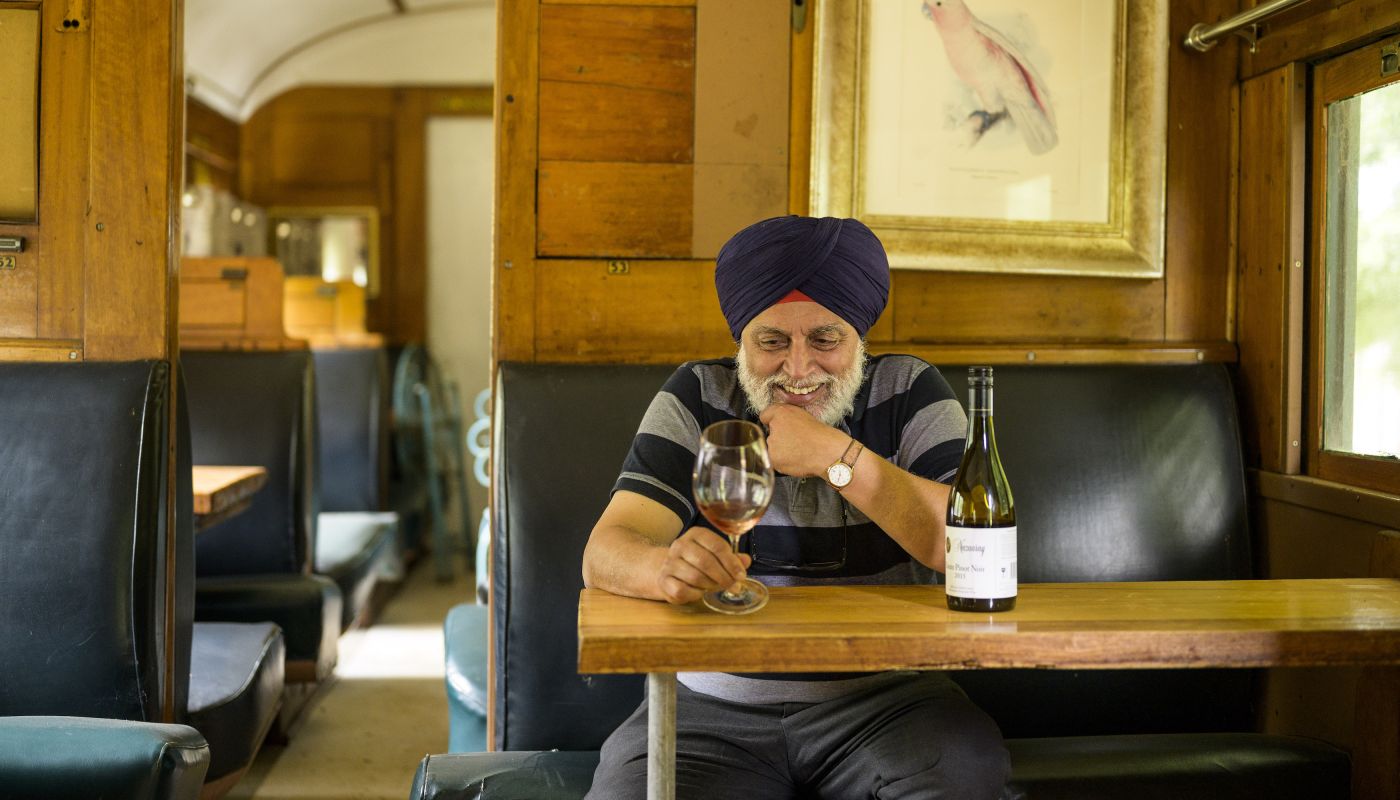
As for Paramdeep, his charm lies in his benevolent, observant eyes. He soaks in knowledge from people and books with equal curiosity. Tall and athletic, he wears a turban, which adds a few extra inches to his tall frame. He was the romantic half of the two.
On the way to Australia, he sipped his first glass of wine — a champagne, no less — and was immediately smitten beginning what would be his lifelong love affair with wine.
After two decades of professional success in Melbourne, the couple bought into an idyllic country life, 50 hectares of undulating land in Flinders, which opened to picture-perfect postcard views of the Green Bush state forest. They named the property ‘nazaaray’, meaning scenic views in Urdu.
The mid-life epiphany
As you enter Nazaaray Estate, or the ‘farm’ as the family calls it, a small signboard greets you in bold, capital letters, PARAM’S FOLLY.
The board is a tad tilted as if dug hastily into the ground in a fit of passion. The story goes that when Paramdeep decided to plant the vineyard, his mid-life epiphany, his pragmatic straight-shooting wife believed it to be a hare-brained idea. Like a madman’s pursuit, it was a folly that had to be named and displayed.
It was 1996, and the Mornington Peninsula was still an undiscovered gem. Justifiably, the Ghummans were weekend farmers, much like their peers. The first vines Paramdeep planted — the MV6 clone of Pinot noir, chardonnay, and sauvignon blanc — took root.
The engineer-turned-winemaker is candid in his retrospections and shared, “I only learnt to make good wine from 2006. The first few years were largely trial and error.” The science of winemaking came easy to him, but wine isn’t just science. To understand the unsaid and unwritten laws of viticulture, he pilgrimed to Burgundy, France and concluded that science needed to adapt.
“I examined the terroir of my farm. I got some things right, but others, I had to modify.” Instead, he turned to low-intervention viticulture, planting cover crops, and essentially let nature do its job. “The results were fantastic,” he added.
But commercial success was elusive for reasons beyond the obvious. Long-time friend Valerie Lloyd Smith shared his challenges of being accepted by his peers simply because he wore a turban.
“In the past, before Paramdeep attained a certain cult status, local folks (particularly over 50s) would not even sample his wine at wine events.” The prevailing sentiment was rooted in ignorance around the Sikh community. Some believed the Sikhs didn’t drink alcohol, and others outright doubted his ability to make a good wine.
“There was definitely a bias,” Paramdeep later told me, “but gradually, people came around.” Not everyone, however, has. Even now, there are restaurants that refuse to list his wines, but he has learnt to take the rejection in stride.
Twenty-seven years on, the Param’s Folly placard is covered in vines that have thrived, industry bias and Nirmal’s early scepticism notwithstanding. The grapevines are now spread over 11 hectares of the 50-hectare property rooted in soft, red volcanic basalt soils. Since the first commercial vintage in 2001, Nirmal fervently championed the wines with her flair for marketing and cajoled Paramdeep, the ex-IBM man, to sign up for various show awards.
His wines have since won multiple national and international awards and are listed at Michelin-starred restaurants across Australia. It is a source of pride not just for the family but the burgeoning Indian diaspora in Australia.
The Ghummans are a persistent lot who managed to turn the Indian bias into their calling card. And in the process, they have attracted the media attention of journalists from Australia and India. Their journey is chronicled in a series of documentaries produced by local TV channels such as SBS and the Australian Broadcasting Commission. “We’ve never hidden the fact that we are from India,” he quickly reminded me. Nazaaray Estate draws in the crowds with its Indian heritage and cuisine, which Paramdeep deftly pairs with his wines.
The House of wine
Years later, I migrated to Australia with my husband in 1999. The Ghummans, who have been friends with our family for 80 years and over three generations, immediately took us under their wing.
I didn’t care for wine then. It felt acerbic and austere to my untrained palate, but every time I walked through the Nazaaray threshold, Paramdeep would find a reason to hand me a glass of his wine to try.
The harvests in the early years were a friendly affair. The Ghummans, who were well established in Australia by this time, called on scores of their friends — Australian, Indian- Australian, and even visiting relatives — to help pick grapes. Nirmal was known for her exceptional cooking and laid out a lavish harvest lunch of rosemary lamb chops and aalo-poori (potatoes curry and puffed Indian bread that I helped fry) on the same table as quiches and Australian lamingtons.
It was the ultimate tribute to her heritage as well as her integration to the land we now call home. We picked crates of grapes in the morning and stuffed our bellies with the Aussie-Indian feast laid out before us. It was fair compensation.
One evening at the farm, he introduced us to pinot’s greatest advertisement, the movie Sideways. I remember him ad-libbing Paul Giammati’s passionate monologue on pinot noir, his eyes lighting up every time a bottle of pinot was uncorked. And on other nights, he would quote lines from poets such as the 13th-century Sufi mystic Rumi or the Indian poet from the early 20th century, Harivansh Rai Bachchan. In particular, the latter’s passionate and soulful Hindi poem Madushala, an ode to wine. It was all part of his long seduction to turn us into pinotphiles. Fortunately for him, it didn’t take long.
Consider the sixth verse of Madhushala, where Bachchan writes:
The drinker leaves his home to find/ The house of wine,
but he does not know/ The way,
and fears achievement must/ Be but for an instructed few;/
And each from whom he asks the way/ Has something new and strange to say;/
In fact, you reach the House of wine/ By any path you may pursue.
I was hooked and duly inducted into the world of wine, with Paramdeep as my guide. He turned into the ‘instructed few’ Bachchan refers to, from whom I could ‘ask the way’. Only that, twenty years ago, he was on a similar path, figuring out his own way to the house of wine, the madhushala.
The paths converge.
My interest deepened over the years, and I studied all the way to a WSET Diploma in 2017 in Hong Kong. I shared every exam result with Paramdeep, and he encouraged me to pursue the next level. Invariably, he had a book recommendation for me from his vast library or an article he read recently in some wine journal.
In time, I was speaking his language. I understood the cryptic vernacular of wine and as a reward, I was granted access to the French oak barrels (I am only allowed to clean them under close supervision) and cellar door.
As my knowledge developed, I earned another distinction. Paramdeep invited to his decades-old Mornington Peninsula tasting fraternity, a community of pioneer winemakers of the region (some of whom had retired, others sold off their lands), for one of their monthly tastings. He proudly introduced me as his niece (I deferentially addressed him as my uncle), an Indian-born oenophile and gave just enough pause before he launched into the lineup for the night.
Now that my family is based in Singapore, our visits to down under are reserved for Australian summers when we spend days at the farm on end. Lost vintages of Nazaaray would be brought out to be compared with any wines we found on our travels. Most nights, we blind-tasted my picks against his cellar gems.
Some nights, it gets heated, like the great Shiraz debate of 2016 when war lines were drawn over two bottles of Shiraz. He favoured his own, and I made the mistake of championing another from the Peninsula. My weary children retired to their room. Our music, wine and conversations were of no interest to them. The debate went on well after the bottles were empty. Neither of us caved in.
Of late, we speak as colleagues and catch up leading up to the harvest and then again, post-bottling, when he would invariably declare his current vintage the “best one yet” (till El Niña started its unfortunate assault on the peninsula and yields dropped significantly). Or when he declared his second epiphany: the realization that his “terroir is suited for chardonnay more than pinot.”
The whites, the chardonnay and pinot gris, are rivalling the pinot noirs. With age, the notes of oak mellow out, lending structure to the crisp and crunchy citrus fruit. The 2015 Chardonnay for instance, was ethereal; textural, elegant, restrained, and complex, in a way, an elevated chardonnay should be. He is slowly grafting some of his pinot noir vines with chardonnay now, a major shift to how he envisioned Nazaaray. Then I learned that my suggestion from a few years ago to plant more Chardonnay vines did, in fact, factor in his decision.
My uncle Paramdeep’s story is yet another thread in the rich tapestry of Australian wine history, one that comprises countless immigrant stories. From Germans who came with Riesling cuttings that launched the South Australian wine industry to lately, the Italians like the winemakers of King Valley, who planted Italian varietals of their homeland and kickstarted the Australian Prosecco movement.
Then, there are those who came from zero-wine culture, like Paramdeep, who tasted their first wine much later in life, learnt the art from scratch and crafted wines that garnered accolades from wine critics and peers. He remains my favourite wine personality for pioneering the Indian wave in Australia and paving an infinitely smoother way for those who come after him, including me.
The photo, 'Paramdeep Ghumman in the train carriage cellar door', is by Robert Blackburn.
















