
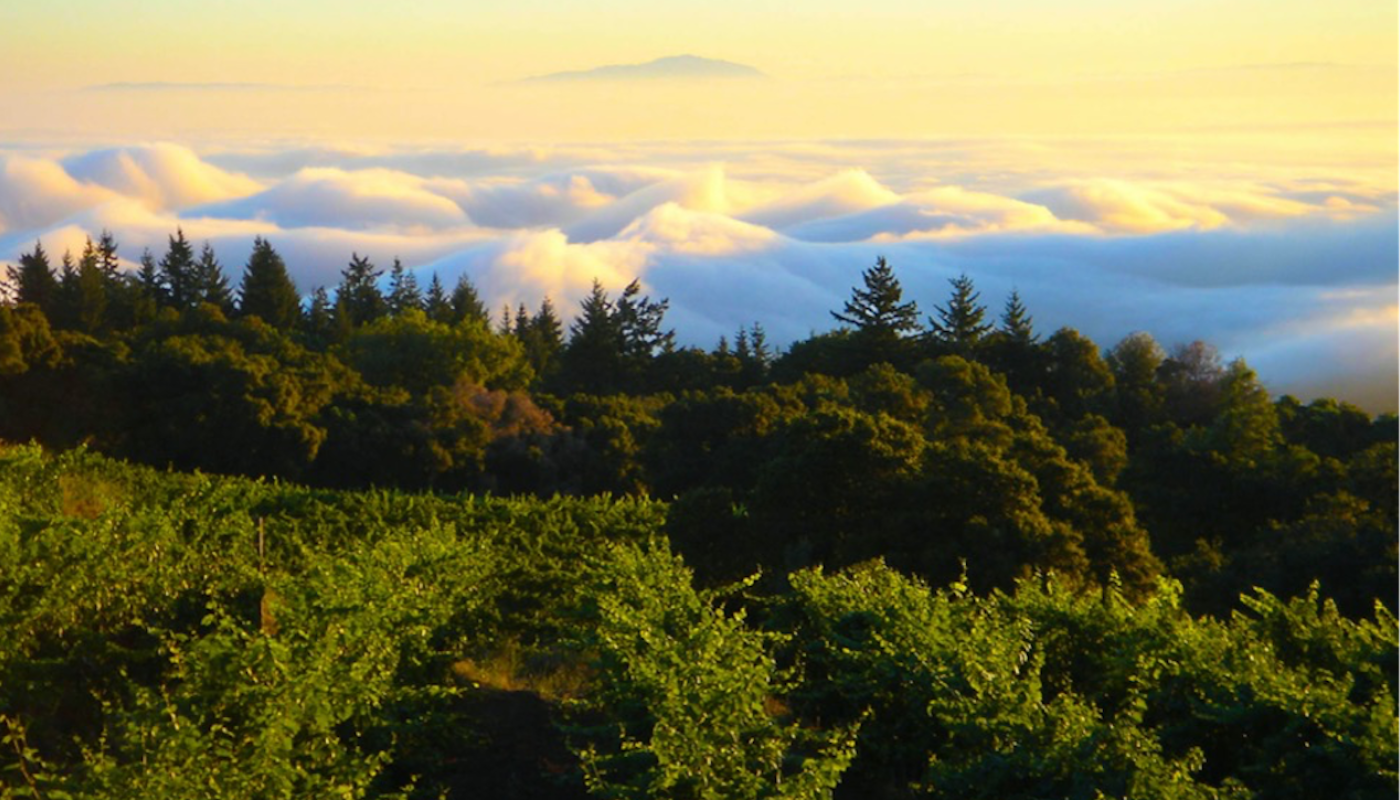
The Santa Cruz Mountains American Viticultural Area stands apart from all other California wine regions both literally and figuratively. As Paul Draper, the founder and long-time CEO at Ridge Vineyards likes to point out, it is the only coastal California AVA that is not enclosed by another region. Both Sonoma and Mendocino, for instance, lie within the greater North Coast AVA, but the legal definition of the Santa Cruz Mountains AVA specifically states that it has no overlaps with either the local San Francisco Bay AVA, nor the massive Central Coast AVA that stretches from San Francisco all the way south to Santa Barbara.
Even without the peculiarity of legal separation, the Santa Cruz Mountains remain one of California’s most distinctive winegrowing regions, and frankly one of its most dynamic. As the tasting notes below suggest, it easily qualifies as being the single most exciting source of Chardonnay currently being made in the state. Such a declaration will quickly have proponents of Sonoma and Santa Barbara Chardonnay in a huff, but I stand firmly behind this assessment. With production levels minuscule by comparison to the state’s traditional powerhouses of Chardonnay, the overall quality and personality of Santa Cruz Mountains Chardonnay is now second to none.
Moreover, the region continues to produce fantastic Pinot Noir, including some of the most rightfully sought-after bottlings in the state, as well as the bordeaux-blend reds for which Ridge Monte Bello has long been the standard-bearer.
A topography like no other
While California has several AVAs that are mountainous in either name or location, none is truly as precipitous as the Santa Cruz Mountains, whose very boundaries are defined primarily by elevation. The AVA declaration by the federal government delimits the growing region by an elevation of 400 feet (122 m) above sea level on the western slopes of the mountains, and 800 feet (244 m) elevation on the eastern flanks, a set of contour lines selected in part due to the similar vegetation profile in those zones on either side of the mountains. Extremely young by geological standards, the Santa Cruz Mountains were formed a mere one million years ago, a full 39 million years after California’s most prominent mountains, the Sierra Nevada.
Created by the slow-motion collision of the Pacific plate and the North American plate, the Santa Cruz Mountains are the geological equivalent of several people pushing a bolt of fabric towards each other across a smooth table surface until their hands nearly meet. The seam where everyone’s hands meet would be the San Andreas Fault, which runs straight up the mountain range, but at a slight angle, beginning on the western flanks of the mountains and eventually crossing over to the east side of the mountains before heading up towards San Francisco.
Bunched, folded, and crinkled up, the ridgetops, peaks, hillsides and steep valleys of the Santa Cruz Mountains don’t offer a particular terroir so much as offering hundreds of them. ‘Most of the vineyards are somewhere between two and 10 acres [0.8 to 4 ha] in size, and they’re dotted through these mountains like a patchwork of little hilltops that face every which way and have different slopes’, says viticultural consultant Prudy Foxx, who has been working with growers in the region for more than 30 years.
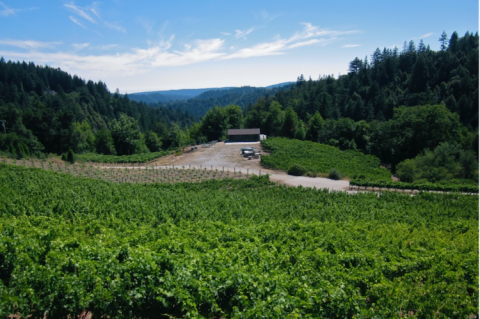
Because of how the mountains were formed, and their steep slopes, the bedrock and soils throughout the AVA vary considerably. Many feature different layers of shale and mudstone, the remains of ancient seabed sediments. Other vineyards have sandstone, marble or even granite bedrock. On top of the bedrock, however, it is quite typical to find soils comprised of a different sort of rock, thanks to a million years of landslides.
Apart from soils, slopes and endless variations in exposure, one more thing dramatically affects the viticulture in the Santa Cruz Mountains: trees.
Most vineyards are quite literally surrounded by forest – a mix of spruce, fir, live oak, madrone and manzanita, peppered with pockets of the coast redwoods and cypress which once covered most of the middle slopes and valleys of the region. These giant conifers and their smaller cousins contribute to the generally lower pH of the region’s soils, while also creating a dizzying array of mesoclimates.
‘If there’s one word that best describes the region from a viticultural perspective, it’s diversity’, says Foxx. ‘That’s both what makes this region interesting and dynamic, but also a challenge for consumers to understand.’
Serious history
The Santa Cruz Mountains have hosted grapevines since the very beginning of the nineteenth century, when Franciscan missionaries explored up the coast of what was then the Alta California region of Mexico. They planted vines on the hillsides above the town of Santa Cruz and laid the groundwork for the second wave of viticulture that would follow the logging activity of the mid 1800s, which, in addition to attracting residents to the area, also cleared swathes of land that could be planted with crops, including grapevines. By the 1880s, the region was well known for wine, with hundreds of acres of vineyards, many of which were wiped out by a forest fire in 1899, a scary precedent recalled by this year’s devastating fires in the region. One of the wineries that survived those fires was a little limestone building on the crest of the mountains which produced its first vintage in 1892 from a vineyard its Italian immigrant founder named Monte Bello.
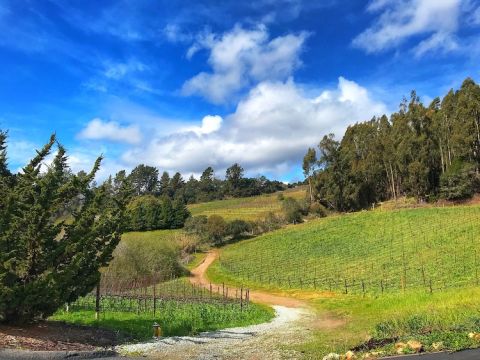
The ‘modern’ history of Santa Cruz Mountains wine began in 1901, when the Burgundian émigré Paul Masson purchased 573 acres (232 ha) of land above the town of Saratoga and planted more than 40 acres (16 ha) of vines. Masson established a winery whose sparkling wines earned him the moniker ‘Champagne King of California’. The Paul Masson brand still lives on today, perhaps in part due to its pioneering celebrity advertising campaign featuring filmmaker Orson Welles.
Masson’s protégé Martin Ray would end up purchasing the winery in 1936. Here he made some of California’s first 100% varietal wines of Pinot Noir, Chardonnay and Cabernet, labelled with their grape varieties, instead of the blends and sweet wines that were popular at the time.
Ray sold the Masson winery and brand in 1943. After changing hands several times it became what is known today as The Mountain Winery, while his own winery would eventually be renamed Mount Eden Vineyards after his financial partners kicked him out following a lawsuit in 1972. Mount Eden would, under the visionary winemaking of Richard Graff, and later Merry Edwards, go on to firmly establish California’s claim on world-class Chardonnay and Pinot Noir.
Eight years after the end of Prohibition, a man named William Short purchased the abandoned Monte Bello winery and replanted several of its vineyard blocks to Cabernet Sauvignon, which were purchased by four scientists from the Stanford Research Institute in 1959 with the idea of doing some hobby winemaking. In 1962, after what they thought were some spectacular initial garage-style wines, the group launched Ridge Vineyards, bringing on famed winemaker Paul Draper in 1969 to help them cement the winery’s, and subsequently the region’s, reputation for making world-class wines. The winery’s 1971 Monte Bello Cabernet triumphed at the famous Judgment of Paris tasting, as well as at several follow-up rematches.
The jewel-box AVA
Because of its scattered patchwork of vineyards ranging from tiny ridgetop sites peering out at the Pacific Ocean, to sloping colluvial slopes facing the warmer Silicon Valley, to coastal foothill vineyards a stone’s throw from the sea, any generalisations one might try to make about the AVA as a whole rarely bear up to much scrutiny.
Be that as it may, it can make sense to think about the Santa Cruz Mountains in terms of a few key zones, or ‘neighbourhoods’ as Foxx likes to describe them.
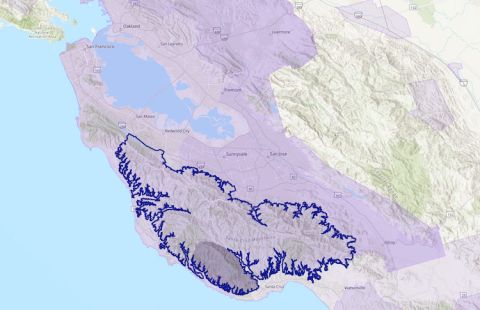
- Ben Lomond Mountain AVA The region’s only designated sub-AVA (shown in slightly darker colour above) is a granitic ridge that pushes up through the largely sedimentary rocks of the hillsides to the west of the San Andreas fault.
- Corralitos The most southerly portion of the AVA facing the Pacific with a heavy ‘redwood influence’ as Foxx calls it, often inundated with coastal fog and quite cool.
- Heart of the Mountains The middle of the AVA and primarily west-facing vineyards that are below the summit ridge of the mountain range and which see lots of marine influence but, depending on the site, can be above the densest fog.
- The Summit The ridge of the mountain range itself, primarily to the immediate north and south of where Highway 17 bisects the AVA, with vineyard sites that face west or east, or both, sometimes with lots of exposure, sometimes tucked within the trees.
- Skyline The northernmost vineyard sites in the AVA that fall to the west and east of Highway 35, which runs from Highway 9 to the north along the crest of the mountains. This area Foxx characterises as fairly ‘alpine’, with different, more arid vegetation away from the redwood influence of the mountain slopes.
- Saratoga Sometimes also referred to as Over the Hill, the south-eastern part of the AVA sits, with the southern portion of the Summit area, on the North American Plate on the inland side of the San Andreas Fault. Much warmer, with very little fog influence, this section of the AVA can more easily ripen Cabernet Sauvignon.
While these areas have become a form of shorthand among winemakers and more knowledgeable consumers, they remain only marginally useful in helping to anticipate the nature of any given vineyard site.
‘Unless you have visited the Santa Cruz Mountains, it can be hard to understand just how unlike most other wine regions it is, even within California’, says Foxx. ‘Most people have no way of grasping how forested it is, and just how much land is not developed and never will be.’
One can stand at various vantage points within Napa Valley, the Santa Lucia Highlands or Lodi and see the majority of the winegrowing region one is standing in. Not so in the Santa Cruz Mountains.
‘It’s quite an unusual thing to say, but there are only very few places within the AVA where you can be standing in one vineyard and actually see another,’ says Foxx.
This constellation of tiny vineyards, dotted among the trees and gullies of the mountains has seen an explosion in vineyard development in the past 10 years, though you wouldn’t notice if you didn’t know where to look. While dozens of new vineyards have been established, the mountains ensure their small size and relative isolation. Despite the boom, overall acreage has grown by only a few percentage points.
That boom may have been permanently slowed by this year’s fires, which destroyed one winery completely, damaged a few others, and inundated the region with smoke very close to harvest. Some producers say they will be lucky to make 25% of their normal volume for 2020, though as with all aspects of the AVA, conditions varied considerably from one spot to another. According to Keikilani McKay, the executive director of the Santa Cruz Mountains Winegrowers Association, the general consensus is that production levels will be down roughly 30% across the AVA due to smoke issues.
While there may be much less 2020 wine on the market, you can be assured that it will be exceptional, especially from reliable producers, and in the meantime, as the notes below indicate, there are plenty of fantastic wines to explore from the 2018 and 2019 vintages.
For an extended version of this article including Alder's reviews of 159 Santa Cruz Mountains wines – Chardonnays, other whites, Pinot Noirs and other reds – please visit JancisRobinson.com.













