In the autumn, traditionally the wine book publishing season for Mitchell Beazley, all they will have to offer is the Concise World Atlas of Wine (a paperback, condensed version for students and travellers), a new editon of Hugh Johnson's Wine Companion, a new editon of Matt Skinner's The Juice, and another edition of the annual pocket book.
Hardly ground-breaking, is it? But never mind. I took delivery yesterday of a  book that is truly innovative. Vignobles de Belgique by Messrs Boschman, Van de Sompel and Vanel with photographs by Joris Luyten introduces us in a well-produced, thorough volume to the vineyards of Belgium, on one of the wine world's newer frontiers. Bravo!
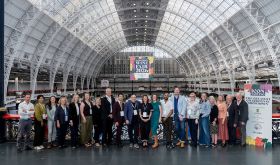
Below is the speech, more upbeat than the above observations, given by the assessor of the drinks books Peter Richards (pictured), an author himself of books on the architecture of wineries and Chilean wine, about which his knowledge is unrivalled in my experience. He is currently studying for the Master of Wine qualification, his wife, the wine writer Susie Barrie, having passed at the first attempt last year (mentored by our very own Julia Harding MW, I report with pride). What a household.
Good evening everyone. My name is Peter Richards, I’m a freelance writer and broadcaster, specialising in wine. And this year it has been my privilege to assess at the André Simon awards. I’d like to start by thanking the trustees and my fellow judges for the experience. It has been a real pleasure – not without its challenging moments, but always a fine experience, and I am very glad and grateful for it.
It’s been a tough year judging the drinks category, for a number of reasons. Firstly, there was a small minority of disappointing books, betraying a lack of vision, not living up to the hype or – most criminal of all when it comes to drinks writing – a complete failure to bring the subject to life. More saliently, the drinks category this year offered a shocking paucity of drinks books in comparison to the food category: only 18 books to judge versus 111 in the food category. This fact speaks for itself. Admittedly, this was a record year for the food books at the Andre Simon Memorial Fund Awards. Nevertheless, it highlights a stark truth that should concern all of us here tonight, and which I would like to come back to in a moment.
As ever with drink, there were corresponding highs to match the lows. There were some excellent entries: of those that didn’t make the shortlist, there was Clive Coates’ hugely authoritative The Wines of Burgundy, Stephen Skelton’s unrivalled UK Vineyards Guide 2008, the ever-incisive Wine Report edited by Tom Stevenson, and DK’s enlightening Beer Book. There was also notable diversity on show, with subjects ranging from Texan rootstock development through beer, coffee, tea and even Japanese whisky. A fundamental part of drink’s unique magic and enchantment lies in its wonderful diversity, so it was good to see some of that reflected in the books submitted. And it was a feature reflected nowhere better than in the range of short-listed books which, in alphabetical order, were:
Ciderland – by James Crowden, published by Birlinn. A nostalgic, passionate, evocative book written in a highly personable style. At its heart is a celebration of the English landscape, its traditions and its farming folk. It is unashamedly bucolic; quintessentially British. The book taps into the very contemporary, hugely exhilarating renaissance of cottage industries that offer locally sourced products with character and quality, and it charts its people and places in style. I learned a great deal and came away enthused to get out there and not only drink more traditional British cider and perry but also meet its producers, explore its heartland, even get scrumping myself…though I think I’ll have to run that one by my wife first.
Some gems of wisdom that I gleaned from the book were: the optimum length of grass needed to cushion fruit when it falls, to prevent bruising, but not too long to hinder fruit collection (around 4 inches, apparently). The various pros and cons of the wonderfully named Butt perry pear and the Buttery Door cider apple. And if you want to know more about how the Startlecock pear tree in Ross-on-Wye got its name: ask James.
Drink: A Cultural History of Alcohol – by Iain Gately, published by Gotham Books. I like to think of this book as a sideways look at history through the bottom of a beer glass. It’s a big subject to tackle and one that gives its author lots to live up to. But Iain manages it in some style. This is a wide-ranging, eloquent, humorous, notably human book that captures the broad sweep of history along with the telling detail. At times charming, at others terrifying, it is always entrancing. Importantly, it’s a book that wears its learning lightly. It shows both a polymathic and anarchic spirit, as well as a clear love for the subject.
There is a tremendous wealth of detail in these pages. If you want to know the origins of the words pornography, gibberish or nepotism (as I do) – they’re in there. If you’re interested to know which famous Greek sage perfectly distilled the appeal of booze as ‘to banish woe’ – it’s in there. And I’m sure Iain will be delighted to tell you more about the phenomenon that is ‘2-rabbits’, penguin barrels, ‘strangling the parrot’ and the delightful pairing of Bollinger with a dish of roast cat garlanded with rats. Finally, and because I can never resist an opportunity to quote Homer Simpson, I’d like to throw in his famous maxim, which is quoted in the book: ‘Beer: the cause of, and solution to, all life’s problems’.
Napa Wine: A History – Charles Sullivan, published by Napa Valley Wine Library Association. What this book lacks in breadth it makes up for in depth. It is a very valuable historical document on a subject about which relatively little has been recorded or written. What’s important about this book is that, along with the well known and well worn stories about Napa’s history, it brings to light other men, places and trends that deserve not to be forgotten but which have become obscured with the passing of time. It contains some wonderful historical insights and, as ever in books like this, lessons for our times (including how to survive a Great Depression and Prohibition). For all this and more, this book deserves to be recognised.
Starbucked – by Taylor Clark, published by Sceptre. A shocking, immensely engaging romp through the coffee-dark world of Starbucks. This is a highly readable, thoroughly researched and eminently humorous book. Its pages are packed full of insights and it’s a book that has the great value of achieving very wide relevance despite its seemingly narrow focus. For instance, the simple assertion that caffeine is, “the most widely used drug in the world”, says it all. Those involved not just in coffee but in wine, beer, spirits, tea – and big business in general – should all sit up and pay attention to this book.
Beyond this, Starbucked manages to throw light on the origins of the croissant, and how the prophet Muhammed reportedly claimed that a dose of coffee made him feel that he could ‘unhorse forty men and possess forty women’. (Again, I’ll have to run that one past my wife.) And how a coffee house is, “place for people who want to be alone but need company to do it”. In short, an instructive, original, hugely entertaining read – all factors I feel André Simon would have wanted to celebrate and reward, especially in a debutant young author.
In summary, these are all books that celebrate the diversity of drink, that exemplify its ability to entertain, instruct and stimulate. And this is incredibly important, now more than ever.
Because we live in a world of bad news. Wars. Natural disasters. Chronic injustice. Global economic meltdown. Climate catastrophe. And if you’re in the booze trade, a fundamentalist neo-temperance movement. We’re worried about everything: our careers, our personal relationships, our bodies, our minds. And don’t even get us started about our drinking habits…
In recent times, it seems as if it has become de rigueur for judges at awards ceremonies like these to have a go at the current state of drinks publishing.
But I want to do the opposite.
In Charles Sullivan’s book, he notes how Napa wineries not only survived, but positively thrived both during and after the Great Depression as well as Prohibition. “During hard times,” he writes, “there is always great elasticity in the demand for a product like wine”.
I find this a very telling comment.
We are hounded by a climate of fear, of instability. We can’t see beyond it. There is a strong sense that our world is changing but we don’t quite now how, or why, or when and where it will all end.
But times of change are times of opportunity for those who can see beyond them, and this surely is just such a golden opportunity for the drinks industry.
Wine, beer, spirits, coffee, tea – all great drinks celebrate the noble human desire to socialise and relax. The act of drinking – as well as reading about drinking – is a basic yet potent form of gentle diversion from the world around us. It’s healthy, it’s sociable, it’s civilised, it’s instructive – and it’s fun.
In short, drinks remind us who we are and just how uncomplicated pleasure can be.
There is a place for this in the world of today. Not so much a place, in fact, as a desperate demand. And that demand doesn’t evaporate in today’s world; if anything, it is intensified by it. As a result, it is our obligation – both for us the writers/presenters/judges, and you the disseminators – to recognise this and seize what may very well be a brilliant opportunity for drinks to carve out a prominent and positive place for itself in modern society, the like of which it has singularly failed to achieve hitherto.
Now is surely the time to pronounce the clear virtues of drink in a way that will present a powerful argument to those who seek to diminish, or deny it. That means showing vision and courage in order to get the message out there: celebrate drink. Oh, and buy my book while you’re at it…
The values that we recognise tonight in the André Simon Memorial Fund Awards are originality, educational value, readability and high production values, in an overall aim to benefit the general public.
As long as we stick to these, the drinks category can dare to dream of a very bright future.
On which note, the André Simon Memorial Fund Award for drinks book 2009 goes to: Ciderland, by James Crowden.