
As with the very best one-man shows, the one just opened by Mitsuhiro Araki in London’s West End began and ended with memorable lines.
Araki walked through the noren, the green three-quarter-length curtains that divide his small kitchen from the back of his sushi counter, bowed to the nine customers that constitute, other than a small private dining room for six, a full house, smiled, and said 'I’m so happy to be here.'
Two hours later, after he had prepared and served his remarkable eleven-course omakase menu to each guest, one mentioned what a lot of work it must have been. Still smiling, Araki responded, 'We like hard work'.
Araki’s sushi counter has just transferred from a highly successful three-year run in the Ginza district of Tokyo, where it garnered the highest accolades, including three Michelin stars and reservations that required a wait of six months.This move, however, is permanent and one of his ambitions is to make London the best place for sushi in the world.
Only part of this decision concerns Manae, his charming 14-year-old daughter, who was working here as a waitress during her half-term holiday from the British boarding school Repton. Equally importantly, Akari explained as I sat opposite him three days later and he waited patiently for the gas supply to be restored, are his philosophy and attitude to the pleasure being a sushi chef can generate as he serves each customer face to face.
Araki, 48, spent a year as a young chef preparing sushi in Sydney, Australia. Excited by his customers’ response, he returned to Tokyo to spend the next decade under two sushi masters. He then opened his own restaurant, Araki, and achieved the kind of status that would have guaranteed him a very comfortable life in Japan.
This would not, however, have presented him with enough challenges, a word he used frequently, and he began to consider a move. New York and Paris were initial favourites; there was a very strong financial offer from Singapore; and then one day the renowned French chef Joel Robuchon sat across the sushi counter from him and suggested London.
This move has taken three years and the support of four of Araki’s biggest fans: Keiichi Hayashi, the Japanese Ambassador to the UK; Hideto Yamada, the MD of Mitsui, UK; Fumito Nakae, his financial adviser; and the composer and musician Ryuichi Sakamoto, whose gift is the pristine blonde sushi counter made from a 200-year-old cypress tree.
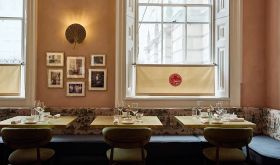
As a result, although The Araki is located between the very British Regent Street and Saville Row, its interior is pure Japan. There are only three paintings on the walls, one incorporating Araki’s hands holding a dragon, and the side of the counter at which Araki works with only a sink at either end. The cupboards behind contain beautiful crockery, either very old or made by some of Japan’s leading artists. It is also, at £300 per head plus service, extremely expensive.
Yet it is remarkable and not just for the ingredients. What was most impressive about watching Araki on his opening night was how confidently he faced his audience and with what calm he switched between the various tasks involved in serving 99 complex dishes, aided only by one young assistant, his wife Yoko (whose father Kazuo Yoshida grows the rice used in the restaurant, in Saitama prefecture) and two waitresses.
There were four courses before the sushi. An elegant, small ceramic cup of an essence of turbot consommé; abalone topped with caviar; an oyster marinated in soy and sake that, sliced in half, tested my chopstick capabilities; then a sublime tartare of tuna over which white truffles were generously grated.
As we sat, seventh and eighth at the counter, as he serves from right to left, our introduction into the world of Araki sushi unfolded. From inside a refrigerated counter Araki brought out a large piece of what could have been sirloin, dark red with a faint hint of marbling. In fact it was tuna caught off the Irish coast the week before.
For sushi to exude the maximum flavour, freshness is not necessarily a virtue, and part of Araki’s skill resides in maturing certain fish, tuna in particular, although Araki now wants to do the same with Scottish salmon, a fish he never prepared in Japan, to the optimum. Two tuna servings followed: chutoro and otoro, from the most highly regarded middle section.
Then four different sushi: Cornish squid on to which that delicate citrus fruit, yuzu, was grated; salmon; yellow tail; grilled eel; and finally, an omelette studded with crunchy black truffles.
Such close proximity to Araki allows for two other insights. The first is his dexterity as he takes the rice from the wooden container to his left, moulds it, picks up the slice of fish, coats the inside of it with just the right amount of recently grated wasabi, places the fish on top of the rice and coats the fish lightly with soy so that fish and rice glisten.
The second, intangible and invisible, is conveyed by the Japanese expression ichi-go ichi-e, an approach borrowed from the Japanese tea ceremony, of conveying hospitality even though those on either side may never meet again.
Mitsuhiro Araki’s arrival is a compliment, and complement, to London.
The Araki 12 New Burlington Street, London W1; tel: 020 7287 2481
Dinner Tuesday – Sunday at 18.00 and 20.30
The real wasabi
My first lesson in the preparation of authentic wasabi began with a sigh on our side of Araki’s sushi counter and an apology on his.
The sigh emanated from an innocent question about the cost of these 4- to 5-inch roots, quite dark before they are cleaned because they grow in shallow streams of spring water high in the mountains but a much paler green once scrubbed, and which I learnt cost £250 per kilo. Truffles may be far more expensive but they are not integral to so many dishes.

Next to the wasabi root, Araki placed his current grater but apologised for what may appear to be its rather dirty surface. In fact, this was just wear and tear on the best quality graters, which are made of shark’s skin glued to a piece of wood and on sale in Kappabashi, the district of Tokyo now known as ‘Kitchen Town’. An unused grater was pristine.
But the more such a grater is used, the softer it becomes and the creamier the resultant wasabi paste.
Araki took the wasabi root in his right hand and holding the grater in his left at an angle, rubbed the root firmly against it in broad, circular movements. As he did so in increasingly wider circles, a creamy green paste began to appear on the surface of the grater and a pungent, but not aggressive, aroma filled the air. After a few minutes enough paste had appeared for one serving and Araki explained that if he were to switch from this gentle pressure to one faster or heavier, then the ensuing aroma would be more aggressive. The wasabi we tasted had an initial sweetness then the recognisable warmth at the back of the mouth.
Freshly grated, wasabi’s charms do not last long. It has to be prepared just before the first customers arrive and throughout the evening.
Both photos are courtesy of Charlie Bibby/FT.