I met the founder of Antiyal Winery in Rochester, New York State, in 2018. It was during the 42nd Annual Conference of the Society of Wine Educators. The title of his session was ‘Back to the Future: Biodynamic Viticulture is Here to Stay’. I knew little about Biodynamic – I wanted to know more and understand the practices better – and the speaker was from Chile (a Latin American person, just like me). I was curious about what he had to say.
His personality conquered me in a professional way. I finally understood the concept of Biodynamic because he was very clear and enthusiast in his explanation, passionate when talking about the core principles of it, and the practices to promote of vital energy, by using natural preparations.
He is Alvaro Espinoza. Antiyal is his family winery, which name comes from a Mapuche word that means ‘sons of the sun’. Its history dated back to 1996, when Mr Espinoza and his wife Marina planted the first hectares of their project in the Maipo region of Chile. It is run by himself, but his wife and sons play a big role in the success of their business. Antiyal is a relatively small property with a huge purpose: a winery hundred percent based in organic and biodynamic agriculture, in a country that – at least by then – knew nothing about those principles.
During his session in the SWE Annual Conference, the tasting included a flight of different biodynamic products from several countries. The wine tasting clearly showed me two things: how a biodynamic wine is able to reflect the true nature of its terroir and how subtle – without losing power – these wines can be.
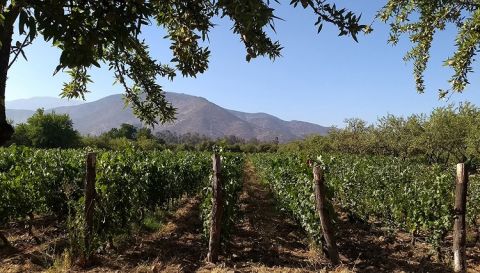
After that experience, visiting Antiyal turned into a must for me. I did it in January 2019. An Uber took me from Santiago to Paine, in Maipo Alto. The property is in a beautiful rural area. Finding the main door was not simple because it is a modest place, primarily focused in producing great wines. As soon as you pass the wood grating in the right side of a narrow street, you see the vineyards – ten hectares of a property with a total of twenty hectares – planted with Cabernet Sauvignon, Carmenère, Syrah, Petit Verdot and Garnacha, with the beautiful Andean pre-cordillera as a back scenery.
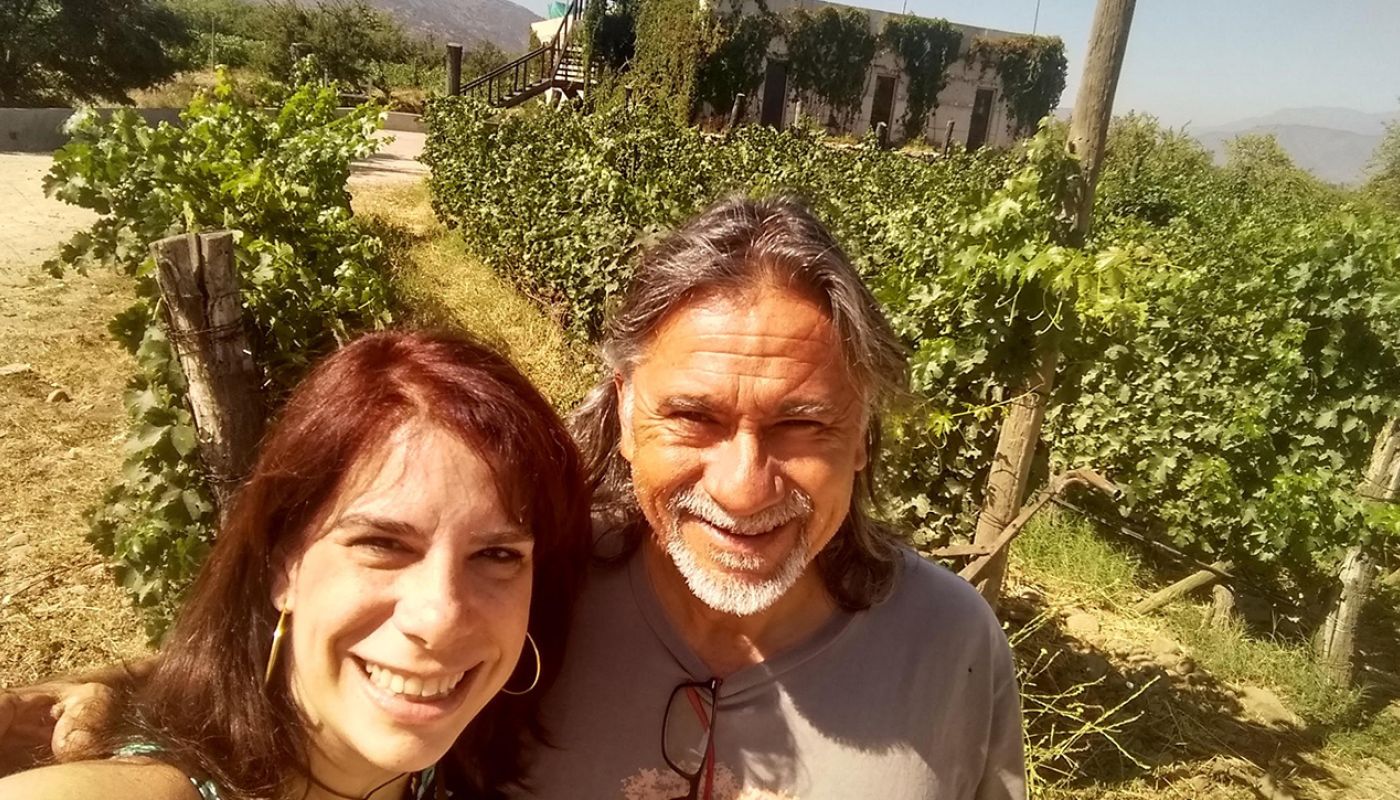
Before the tour began, many typical factors related to biodiversity did not have to be explained. They were so obvious: the number of trees and other plants around the area, the work in the soil, the effort to preserve the habitat, and the general respect for nature. I was admiring everything when Mr Espinoza appeared [pictured above, with the author]. He, in person, was the ‘tour guy’. Antiyal is not a commercial place with a sophisticated tasting room. Saying that, I was a very lucky girl who had been received by the owner of an amazing winery.
Mr Espinoza walked me thought the vineyards, almost explaining the presence of every plant and tree in the area. In Antiyal there are many almond-trees that originally came with the property and they kept them there to increase biodiversity. You can also see some cactus which were planted by Mr Espinoza and Mr Alan York, who was not only a good friend of him but also a California-based leader in the biodynamic viticulture movement.
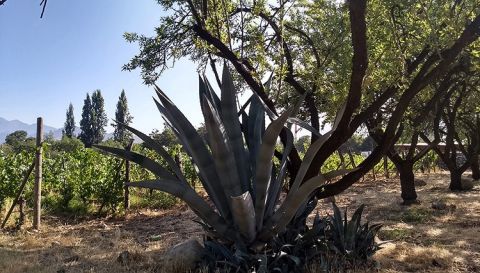
While walking around, one can notice a high-density vineyard, with around six thousand plant by hectare. They also have biological corridors to increase diversity, sometime in the year with grass and, in spring, full of flowers.
Antiyal works guided by organic principles meaning, of course, that chemical inputs are not allowed. It is an environment friendly place. They know their habitat, they make an effort to increase the biological diversity thinking in several species that can coexist in the same place, and as Mr Espinoza told me, it is very important the balance not only in the crops, but also in the entire area.
They use high quality food to feed their animals. Antiyal has chickens, horses, alpacas, sheep, goats and dogs as part of the family/workers members. Antiyal makes its own compost and that is the only thing they use to feed the plants, in order to maintain fertility, as well as the base of the organic management of the vineyard.
The property is divided in two sections. The one in the right side, which I have been talking about, is planted with Cabernet Sauvignon and Carmenère, with stony soils, difficult to work but excellent for the vines. The other section, crossing the street, is a soft sloping ground close to a river basin. A few more hectares of Cabernet are planted there, as well as some Carmenère and Syrah. Garnacha is cultivated in another part of the vineyard, closer to the river.
They have a big water well created by the winery. The original water comes from the snow melting of the mountain ranges, which falls into a community tank at the foot of the hills. Antiyal’s water well is filled with gravitational water, and the solar panel helps to speed up irrigation around the vineyards.
But this is not only an organic and sustainable place. Mr Espinoza is one of the most well-known personalities related to the biodynamic viticulture movement, not only in Chile but also overseas. I was too curious to let escape the opportunity to take a look at his ‘preparations room’. Mr Espinoza never shows it to anyone – or at least he told me that – but he made an exception with me. In the room there were some jars, many tools, and a magical wood box, full of peat. Inside of the box, some of the preparations… Were they 500, 501, 502 or 506? I don’t remember!
It looks like in this winery everything has been very well thought. They map the vineyards to understand each lot vigor and behavior, so not all the grapes are harvested at the same time. Of course, the harvest is manual, and it is a family/friend party around March, each year.
We walked to the winery itself. It is a concrete structure with a double space, since they work with gravity. At the top of the building, they receive the grapes and continue with the sorting, destemming and crushing. In the lower area, Mr Espinoza showed me the egg-shape concrete tanks (he was one of the pioneers in the use of these tanks in South America), the inox tanks in different sizes and, of course, the barrels. It is worth to say that the idea is not to mix different lots of grapes, thus preserve expression and quality of each.
Antiyal works with indigenous yeast and, asides of sulfites, he doesn’t utilize any other product in his wines, neither gelatin nor albumin. At the right time, the blending process occurs. Of course, my visit ended with a delicious wine tasting, some liquid from the barrel, some from one of the 50 thousand bottles produced by the winery, which has been certified by Ecocert and Demeter.
Antiyal wines are handcrafted wines infused with soul, with the soul of the sons of the sun. This family not only achieved their dream of making premium boutique wines that truly respect the environment, but they also – especially Mr Espinoza – have inspired other producers in Chile and outside of the country, to work their lands in the same way.
I close this text, reviving my memories of an amazing winery visit and the taste of the delicious Kuyen – one of its wines – in my lips.
















