See my tasting notes on 56 smart red left-bank bordeaux 1996s.
Of all the red bordeaux vintages to be drunk now, 1996 is a particularly good bet if you like mature, traditional claret – especially from the left-bank appellations in the Médoc and Graves. Anthony Barton, much-loved owner of Château Léoville-Barton, told me that he hasn't started serving 1996s, nor even 1995s, at his handsome dining table at Château Langoa-Barton yet, but few other mortals have quite such a stock of older vintages as he has. I would say that while you can certainly enjoy many a 2001, 2000, 1999 and 1998 already, the 1996s will deliver much more of what red bordeaux is capable of – the ageing potential we are asked to pay so much for. They were generally wines made for the long term that are absolutely in their prime now. (By extrapolation, one might expect the expensive 2010s just offered to be ready for drinking in 2026. I hope those who bought them are either young or optimistic.)
Earlier this year I tasted virtually all the 1996 classed growths of the Médoc, the majority of them blind thanks to the organisational skills of the Conseil des Grands Crus Classés, and I was impressed by what I found. You might call the 1996s classic, so long as you were sure that this would not be interpreted as skinny. There is certainly no excess of ripeness about the best of the 1996s – indeed at that time the majority of producers were still routinely adding sugar before fermentation to bolster the eventual alcohol content (to 12.5% at Château Margaux, for example). But the resulting wines have developed real complexity from all their years in bottle and seem to have just the right amount of well-developed fruit and weight (no flab) to be classified as quintessential red bordeaux.
The growing season had been quite rainy. In fact this was the second year in a row when grapes had to be picked in the rain, but whereas the 1995 growing season had been dogged by drought, in 1996 the rain came little and often, and ripening had been steady with no awkward periods during which the vine shut down and phenolics resolutely made zero progress towards maturity. In the end in 1996 the grapes only just made it to full ripeness and the vintage was relatively late. An Indian summer managed to polish the tannins and develop the flavours and, as Philippe Bascaules put it to me when as yet unpoached from Château Margaux by Francis Ford Coppola, 'we learnt it was better to pick ripe grapes in the rain than underripe grapes in fine weather'.
The talented winemaker at Château Mouton-Rothschild Philippe Dhalluin was still working at Château Branaire-Ducru in 1996. He remembers the grapes that arrived at the cellar in early October 1996 fondly. 'They were very beautiful, croquant [crunchy] grapes that were a big reference at that time.' His counterpart at Château Lafite on the other side of the plateau north of Pauillac, Charles Chevallier, agrees. 'I have an extraordinary memory of 1996. It was a vintage that was exceptionally easy to vinify – perfect for people who didn't want to make any effort. So easy. Without any hard work, you had perfect extractions. When you tasted them, the tannins looked great. You could get away with minimal remontages [pumping-over the must to maximise extraction of phenolics]. There were long macerations but the wine was very quiet during them. It showed me that we could do this for future vintages whenever the grapes were fully ripe. It was a revelation for me to see that you should wait for full ripeness and then pick really fast.'
My tastings earlier in the year compared the 1995s and the 1996s (see my tasting notes on the 1995 red bordeaux) and in most cases the later vintage outclassed the 1995s, with more fluidity of fruit and a more classic build. Wines made in the commune of Margaux were often disappointing in the 1990s and early years of this century, but I found a generally high level of quality in the 1996s, with the lovely fragrance that characterises a classic Margaux.
The Pauillacs were in general less beautifully balanced than the St-Juliens – more austere – and markedly more youthful than the St-Juliens with less sweetness of fruit and more greenness. But the St-Estèphe 1996s seemed to have rather more flesh than in many a similar vintage.
All the Médoc first growths, and both Châteaux La Mission Haut-Brion and Haut-Brion, performed well in 1996 – although director of Château Latour Frédéric Engerer told me about this particular vintage at his property, that while it had consistently been preferred to 1995 until about 2005, when the balance started to swing the other way, he has a few regrets about Latour 1996. 'If the '96 had been made in my era it wouldn't have the slight greenness and lack of density that it now has, even if that old style is very ancien britannique.'
The general character of the vintage is, indeed, rather old-style British, but with a very decent amount of flesh on the bones in most cases.
Below I have listed those classed growths that seemed on the basis of my blind comparative tastings last February to be punching above their weight. According to Live-ex.com's calculations of average prices for 23 significant Bordeaux crus classés, the fully mature gems of the 1996 vintage generally cost less than their callow counterparts from the 2005, 2009 and 2010 vintages (and less than the 2000s and 2003s) – an illustration of the craziness of relative bordeaux vintage pricing. You might have to pay as much as £1,500 a dozen in bond for a case of a classed growth as popular and reputable as Ch Lynch Bages but you can find some of the less celebrated names for much less.
I would strongly suggest opening and decanting these wines a couple of hours in advance of serving them, to expose them to air and allow them to open up and express themselves a bit more expansively than if they were poured straight from a bottle. There is also likely to be quite a bit of sediment, so decanting will separate clear wine from the crunchy dregs. I would serve these far-from-flashy wines with relatively straightforward, possibly quite chewy, food: roasts, chops, steak, or, for vegetarians, pulse-based dishes. Lentils and Lynch Bages, anyone?
SOME OVER-PERFORMERS
Margaux
Ch Brane-Cantenac
Ch Prieuré-Lichine
Ch Rauzan-Ségla
St-Julien
Ch Beychevelle
Ch Gruaud Larose
Ch Léoville-Poyferré
Ch Talbot
Pauillac
Ch Clerc Milon
Ch Duhart-Milon
Carruades de Lafite
Les Forts de Latour
Ch Lynch Bages
Ch Pichon Lalande
St-Estèphe
Ch Cos d'Estournel
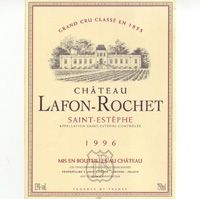
Ch Lafon-Rochet
Ch Montrose