In 2013, Julia Harding MW introduced this account of her first trip to Georgia (shortlisted for a Louis Roederer award) thus: ‘How do you take pride in your country without being nationalistic? How do you defend yourself against aggressively armed giants at the border while treating your guests as gifts from God? How do you maintain a strong orthodox faith while welcoming and giving freedom to all others? How do you remain creative in a country saturated in tradition? Georgia seems to have a quite remarkable ability to hold opposites in tension.’
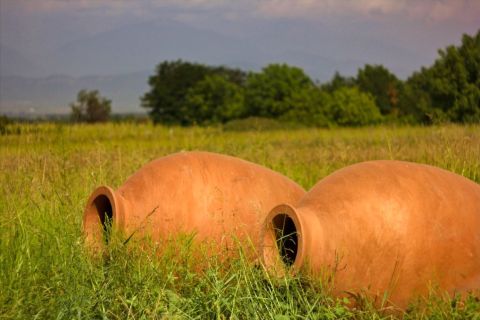
In my circles anyway, Georgia is most famous for its claim to be the cradle of viticulture. Wine is still intimately threaded through its culture, with Georgian wine distinguished by being made in buried clay vessels called qvevri (see below). But today that famous wine culture is increasingly polarised, holding opposites in tension indeed.
The poles were effectively embodied by two people I tasted with recently. The first was Irakli Gilauri, ex-CEO of the Bank of Georgia, inter alia. A wine nut who has somehow managed to acquire fruit from one of Napa Valley’s most sought-after sources, Vine Hill Ranch, for a fine-wine project in California, he is now determined to spend some of his fortune on making what he maintains will be Georgia’s first world-class wine.
The first I heard of him was in an email from a San Francisco-based PR woman inviting me to ‘meet the Georgian vintner fighting fascism with luxury wine’. In the email, current Georgian wines were described as ‘rustic’. Three times. And Gilauri was quoted as saying, ‘The only reason qvevri amphora remains our tradition is because no one ever had money to make wine any other way’.
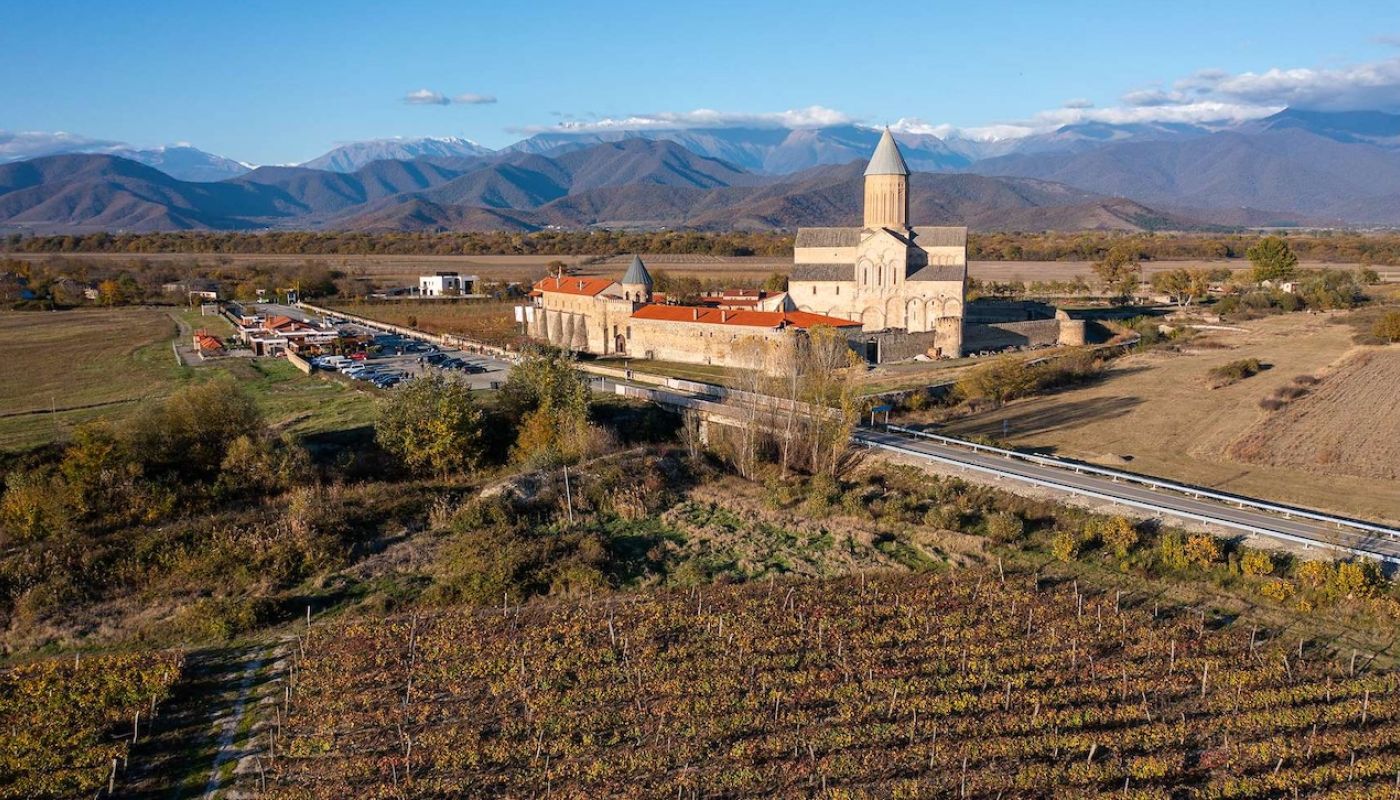
Gilauri does not lack money. He is building a fancy winery in the dominant wine region, Kakheti, in the south-east of Georgia and has hired Bordeaux’s most international wine consultants, Rolland et Associés, to help him with the project. ‘I don’t want to employ anyone with Georgian experience in either vineyard or cellar’, he told me sniffily before drawing two half-bottles of prototype Gilauri wine out of a bag from The Lanesborough, where presumably he was staying. This was after telling me that, at a blind tasting in Georgia of his new red alongside Bordeaux first growths, and with Pierre Lurton who directs two of them, his wine came second ‘after Château Ausone and above Haut-Brion’.
And that fascism claim? Despite its post-Soviet independence in 1991, Georgia is a small country sandwiched between Armenia and an aggressive Russia that maintains an illegal military occupation of 20% of it and has infiltrated its government.
Georgian wine has long occupied a special place in Russia (Stalin was Georgian) and even today 65% of Georgia’s wine exports are semi-sweet, basic wines that go north to slake Russian thirst. ‘Georgia’s dependence on Russia today is in wine only’, according to Gilauri, adding, ‘By making dry wine, we can wean ourselves off Russia. I’m on a mission.’ He has chosen ‘Resistance’ as the brand name of his wines, shown below with their proud producer.
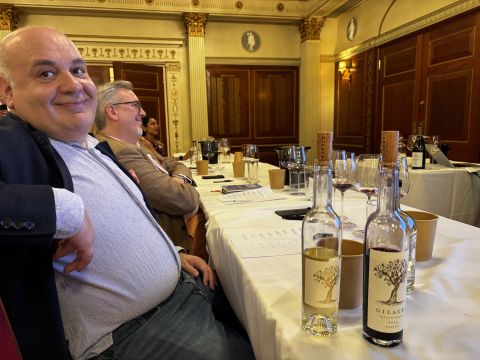
He was thrilled when I said his white wine, a barrel-fermented bone-dry Chardonnay, reminded me of a Chablis. It’s certainly unlike any Georgian wine I’ve tasted in its utter familiarity. The red is at least based on a Georgian grape variety, the main red-wine grape Saperavi. The Rolland imprint of oak and alcohol were evident in it, but I should point out that the wines he produced when he ambushed me at a Georgian wine tasting in the City of London were cask samples yet to be bottled, much less released.
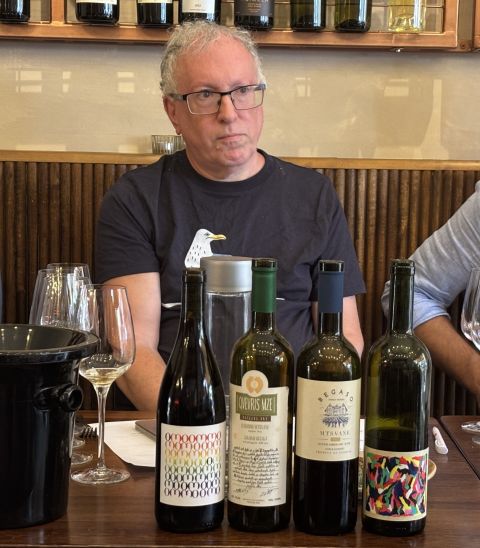
Very much more typically Georgian were the wines shown at a tasting two weeks later in Saperavi Social, a Georgian wine bar in Islington. The main presenter was Douglas Wregg of Les Caves de Pyrène, specialist importer of natural wine and the biggest importer of Georgian wine into the UK. Back in 2005, he’d heard on the grapevine that the country was making seriously distinctive wines in qvevri, which depended on extended contact with grape skins and made his first trip there. He fell in love with Georgia with its wine-sodden feasts long into the night conducted by a tamada, a toastmaster, often accompanied by dancing and polyphonic singing. ‘Wine is endemic to the culture there’, he enthused, ‘unlike the rest of the modern world. Hospitality is a religion. There’s always food, lots of different dishes, and it’s so unpretentious. Making wine with skins, and often stems, of the grapes – this is the complete wine.’
Keeping white wine in contact with chewy skins, and sometimes even chewier stems and pips, results in wines that are much more deeply coloured than conventional white wines. These are the so-called orange wines that Wregg describes as ‘a subset of natural wines’. Georgians call them amber and the colour can vary from palest apricot to a rich, deep almost-tawny. But perhaps an even more marked characteristic is that skin-contact wines are relatively astringent, especially on the finish. Wregg delights in what he describes as ‘a sort of bricky earthiness’ imparted by the clay of the qvevri and is rather dismissive of the sort of Georgian pale-amber wines to be found in UK supermarkets, which may have had relatively little skin contact. (The term qvevri is unregulated, by the way, and seems to be used with abandon.)
The timing of the first of Wregg’s annual visits to Georgia could not have been better. Early in 2006, the Russians effectively banned imports of Georgian wine until 2013 – a warning to Georgians against getting too keen on EU membership. In the long term, this did a great service to Georgia’s new generation of wine producers, who had to sharpen up their act and find new markets such as the UK.
We were told that, during the Soviet era, a good quarter of households made their own wine – which they regarded as real wine, as opposed to the semi-sweet stuff shipped off to Russia. But since the Russians sought quantity more than quality, only a handful of grape varieties, the most productive, were in commercial play. Today, however, a national vine nursery is collecting samples of the country’s incredible diversity of local varieties, into the hundreds, and analysing their DNA.
The Caucasus sheltered the country from the worst effects of the Ice Age, so it also has one of the richest repositories of wild vines. According to Gilauri, all of the familiar European grape varieties can trace their genes back to four of the most important Georgian varieties – Rkatsiteli, Saperavi, Mtsvane and Chkhaveri – but my co-author of Wine Grapes, grape geneticist Dr José Vouillamoz, disputes this.
What is indisputable, however, is that Georgian wine producers are having a wonderful time currently showcasing ever more indigenous grape varieties. To westerners they can have unfamiliar names, but Wregg is, perhaps predictably, dismissive of people who complain they can’t pronounce them. ‘They should just enjoy the experience.’
The recent City tasting, infiltrated by Gilauri, was a presentation of eight Georgian wines by Master of Wine Sarah Abbott, who has been hired by the Georgians to develop the UK market. Most of the wines she chose had been made in qvevri but, when she admitted that this applied to less than 10% of all Georgian wine produced, I wondered why her selection was so unrepresentative. She explained in a subsequent email, ‘Qvevri winemaking is small in output but huge in cultural symbolism for Georgians. The country has parallel heritage tracks: one as the mythic originators of wine, and one as the brutalised, industrial wine factory of the former Soviet Union. Qvevri winemaking is the embodied antithesis of that Soviet heritage and mindset.’
Fair enough. I’ve enjoyed many a qvevri wine – indeed have generally preferred Georgia’s hugely distinctive skin-contact whites to standard, rather overblown Saperavi reds – so long as there is enough fruit to support the astringency. But I can see why Gilauri thinks his country’s wine is a work in progress. Tbilisi-based wine importer Olivier Sauvage (proud of a great-grandfather who was mayor of Chassagne-Montrachet) veers closer to Gilauri than Wregg. He tartly summed up the current Georgian wine scene as ‘8,000 years of history, 30 years of experience’.
Recommended Georgians in the UK
White
Vachnadziani Winery Krakhuna 2024 Imereti 12.5%
£12.79 All About Wine, £13.99 Ratcliffe & Co, £14 Drinks Direct
Amber
Dugladze, Ranina Mtsvivani Kakhuri NV Kakheti 12.5%
£15.60 Amathus
Shilda, Rustaveli Signature Blend 3 Qvevri Amber Dry 2022 Kakheti 13.5%
£17.99 D Byrne & Co, £19.95 Spy Wines, £22 The Salusbury Wine Store
Iago Bitarishvili, Iago Chinuri 2024 Kartli 12%
£23.22 Les Caves de Pyrène
Orgo Rkatsiteli 2024 Kakheti 12.5%
£23.49 Butler’s Wine Cellar
Baia’s Wine, Tsitska/Tsolikouri/Krakhuna 2024 Imereti 13%
£24 Taste of Georgia
Red
Chelti, Family Collection Saperavi 2022 Kakheti 14%
2021 is £14.99 Novel Wines but is currently out of stock
Ch Mukhrani Shavkapito 2021 Kartli 13.5%
2018 is £23.99 Georgian Wine Guild
Sad Meli Aleksandrouli/Mujuretuli 2022 Racha-Lechkhumi 14%
£40 Saperavi Social
Tasting notes, scores and suggested drinking dates in Georgians white, amber and red. International stockists on Wine-searcher.com.
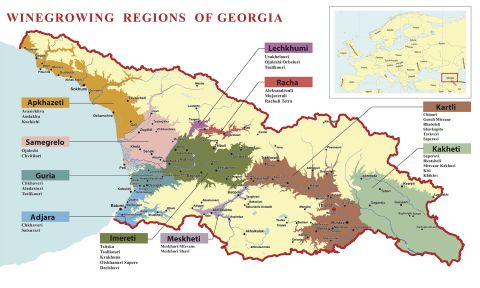
See also The National Wine Agency’s very useful map of regions and local vine varieties below.
Back to basics
Georgia’s magnificent local grapes |
| A host of unfamiliar names but some great flavours. Pale-skinned, productive Rkatsiteli is by far the most-planted Georgian grape, characteristic of Kakheti in the far south-east of the country, as well as being popular in Kartli around Tbilisi. It works especially well for skin-contact wines. Rkatsiteli is also grown in Ukraine, Moldova and Bulgaria, and its ability to withstand seriously cold winters is treasured in both Russia and New York State. I have long enjoyed aromatic whites made from Kisi – also found mainly in Kakheti – but a leafy Krakhuna white from Imereti in the far west was a recent revelation, as was a citrus-flavoured Tsolikouri from Naberauli in northern Racha, a newish producer specialising in lesser-known Georgian grapes. Mtsvane Kakhuri is the Kakheti speciality, while the fresher Goruli Mtsvane is associated with Kartli, where the even-tarter Chinuri can shine. Saperavi dominates Georgian red-wine production and it has been planted in much the same countries as Rkatsiteli, plus Australia. In youth, its wines can stain as effectively as vintage port. The versions aged in buried qvevri tend to be a bit more interesting than most of the more conventional examples. They can be a bit too hefty for their own good. I loved the much more transparent Shavkapito, recently rediscovered in Kartli. Aleksandrouli and Mujuretuli, often blended, even in the vineyard, are specialities of Racha in the mountainous north of the country immediately east of Lechkhumi. |