In the week in which the 2024 Old Vine Hero awards were announced, it seems entirely appropriate to write about António Madeira, an engineer who left a highly paid job in Paris to invest everything in making wines that are a reflection of the landscape and the old vineyards around his grandparents’ village of Santa Marinha, in the foothills of the Serra da Estrela towards the eastern boundary of the Dão wine region. (See this World Atlas of Wine map for the exact location.)
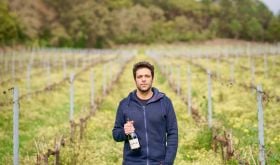
When I met Madeira and his wife Marina at the Simplesmente … Vinho wine fair in Porto last month (where I took the photo below), he told me how his father fled Portugal in 1970 during the Salazar dictatorship, just escaping the secret police on the train journey out of the country. That’s why Madeira grew up in France but his grandparents are from Dão – as is his wife Marina, who trained as a nurse but now works with António in the vineyards and winery and manages the whole team. They also have three children aged between 5 and 12. Busy people.

Although he studied engineering at the École Centrale in Lille – the first member of his family to go to university – and then spent 15 years working in Paris for big industrial and distribution groups, it seems that his roots are in the granite soils of Santa Marinha, where his grandparents were small polyculture farmers growing grapes only for their own wine (Madeira slips in, ‘they used to drink a lot’). His father-in-law worked in a textile factory but also made his own wine and now at the age of 90 still tends his kitchen garden.
Madeira used to go back to the village regularly and in 2010, in his holidays, began to make wine and seek out the Dão’s equivalent of grand-cru vineyards. He and his family moved back to the village permanently in 2017 and since then he has continued this journey of rediscovery, farming organically and biodynamically. He made the wine in a garage under his parents’ house until he was able to build a new winery for the 2020 vintage using the proceeds of their flat sale in Paris. It became clear as we talked and as I tasted his wines that Burgundy is his template and inspiration but that Dão is his obsession as well as his gold mine.
In the early days when he was prospecting for old vineyards to rent or buy, or negotiating to buy grapes for his ‘entry-level’ Dão red and white wines, he was met with some suspicion from the locals but, he told me later, ‘now people know me better and see my level of commitment in the vines and winemaking’.
The Dão Branco 2021 and 2022 vintages are shaped by the different weather conditions of those years – which is what you would expect when someone is trying to express their location as accurately and transparently as possible. Most influentially, 2022 was an extremely dry year so the ambient yeasts (Madeira does not inoculate the juice with cultured yeast) struggled for lack of nutrition (nitrogen), needing extreme care in the winemaking to avoid getting too much volatile acidity. ‘For me, vinifying in a natural way is the ultimate and most difficult level of winemaking and it is why we have to create conditions in the vines to grow grapes with a strong, healthy and diverse yeast, without lack of nitrogen in the must.’ His understanding of winemaking is influenced by his reading of iconic minimal-interventionist French winemakers of the past such as Jules Chauvet in Beaujolais as well as a visit in 2017 to veteran Jura winemaker Pierre Overnoy. As with these pioneers, for Madeira, minimal intervention means intense observation and scrutiny, the complete opposite of a laissez-faire attitude.
Both vintages are made from grapes he buys from local farmers in the Serra da Estrela subregion who tend small field-blend vineyards, farmed without herbicides or chemical fertilisers, some fully organic, and which are harvested by hand by Madeira's own team. 80% of the vines, dominated by Dão's outstanding Encruzado variety, are 20–30 years old, the rest more than 60 years old. Madeira explains that it is hard to persuade these growers to work organically, particularly when it comes to eschewing fungicides, but, he emphasises, ‘They know that if they spread a drop of herbicide in their soils, then I do not buy the grapes.’

The 2021 vintage is now perfectly ready to drink even if it will continue to age well for several years in the bottle. It’s piercingly pure as well as complex: a little bit smoky, with citrus and green fruits and a hint of cut cedarwood. The acidity is notably fresh and the texture as well as the flavour are deliciously dry, almost chalky, until the very end, when it balances it out with an unexpected creamy impression.
The 2022, on the other hand, smells simpler at first, more straightforwardly fruity and even a touch floral but that chalky freshness is there too, suggesting the potential for a greater range of flavours with a little longer in the bottle. This is 12.5%, the 2021 just 12%.
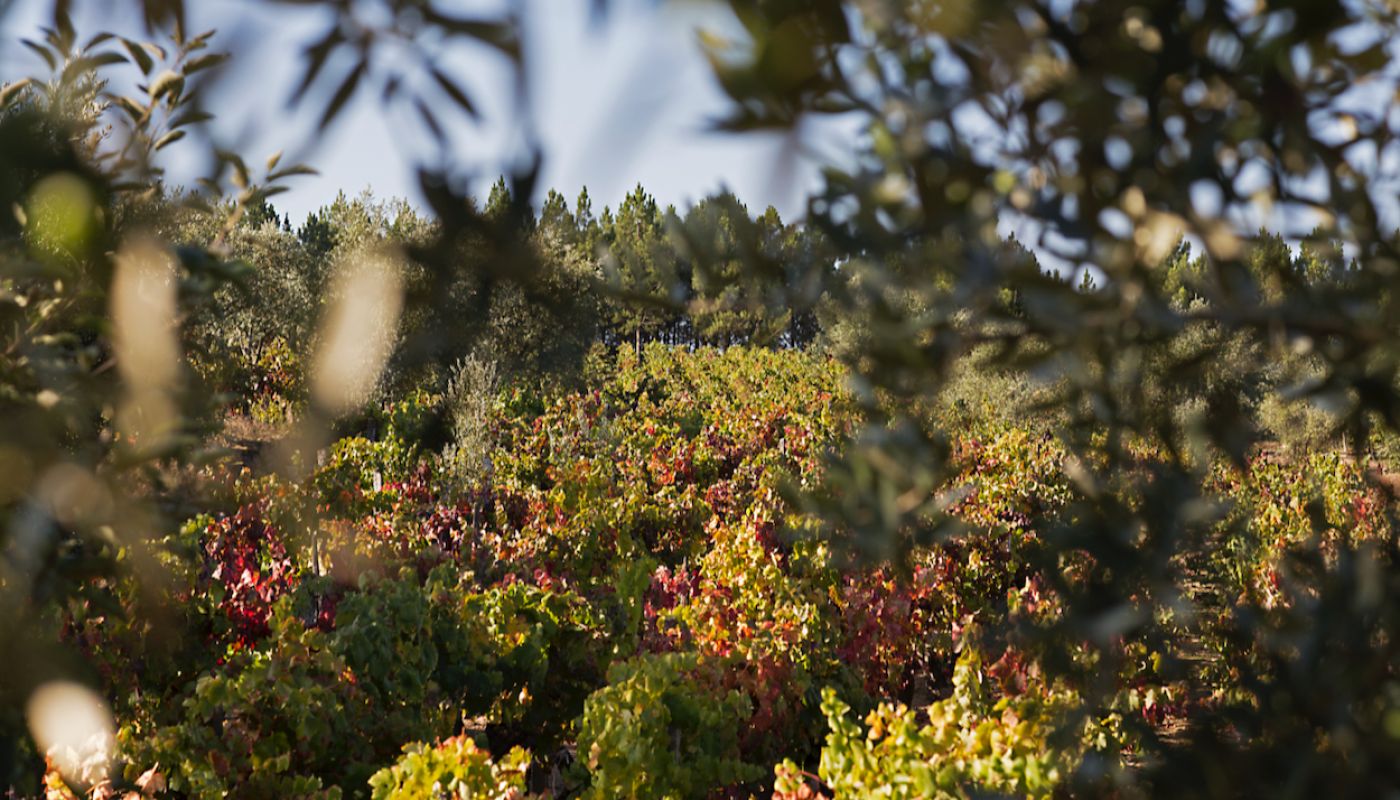
Madeira makes such great red wines that I could not resist also mentioning his Vinhas Velhas Tinto 2019/2020. Unlike the Dão white described above and the entry-level Dão red, this wine and his single-vineyard wines such as Os Granitos (pictured at the top of this article) and A Centenária are made from 20 small field-blend vineyards that are 50–100 years old, 16 of which he rents and 4 he now owns. For the Vinhas Velhas red, he uses the fruit from ten small parcels, all on the region’s classic granite soils, farmed biodynamically. Each parcel is vinified separately, Burgundy style, fermented in open lagares and blended after ageing in older French and Austrian oak. The red varieties in the field blend are typically Baga, Jaen and Tinta Amarela.

The 2019 has a subtle aroma of red fruits with a suggestion of stone dust but is also delicately floral (wild flowers not manicured garden blooms). The tannins are super-fine, the acidity and the tannin structure wound together and playing off each other, held at the core by pure, non-sweet dark-red fruit. It is elegant in the extreme and so light on its feet and yet persistent, with 13% alcohol.
The 2020 is darker, deeper and more savoury yet still has that impression of stone dust that I associate with the Dão granite soils in the Serra da Estrela. There’s a little more spice and the tannins are slightly chewier but there’s immense freshness and potential for greater elegance with a little longer in the bottle – and both wines will age well over at least 10 years if you have somewhere to keep them at a cool and constant temperature. This too comes in at 13% alcohol.
By working with old-vine field blends and fermenting the grapes with indigenous yeasts, he may have up to 40 varieties in a wine and up to 50 strains of yeast. The way he works is labour-intensive, requiring seven full-time workers to care for just 7 ha (17.3 acres) divided between those 20 vineyards in six local villages. Many of these old vineyards had missing vines and he has been busy planting rootstocks in the gaps to then graft them in the field (rather than in a nursery), using cuttings from the best vines and rarest varieties from the same vineyard, ‘in order to maintain the same identity of each vineyard’.
Madeira was diffident when we first started talking at his barrel-top table at Simplesmente … Vinho but he seemed to warm up when he could see I was really interested in what he is doing. He confided, ‘I am the black sheep of the Dão’, suggesting it has not been easy for him to come back and do what he does and yet these wines are as much a tribute to the Dão as to Madeira himself.
The wines are imported into the UK by Modal Wines, who also sell them online, and into the US by Polaner Selections in New York and WineWise in California.
The Dão Branco – either the 2021 or the 2022 – is available not only in the UK and the US but also in Portugal, Spain, Switzerland, Germany, Ireland and Australia. Some stockists may soon be moving from the 2021 to the 2022. The old-vines red – 2019 or 2020 – can be found in Portugal, Belgium, France, Switzerland, Australia, the UK and the US. Older vintages of both wines show up on Wine-Searcher but I have not tasted those.
Members of JancisRobinson.com can access recent reviews of António Madeira's wines, and of nearly 700 wines from this region of Portugal.