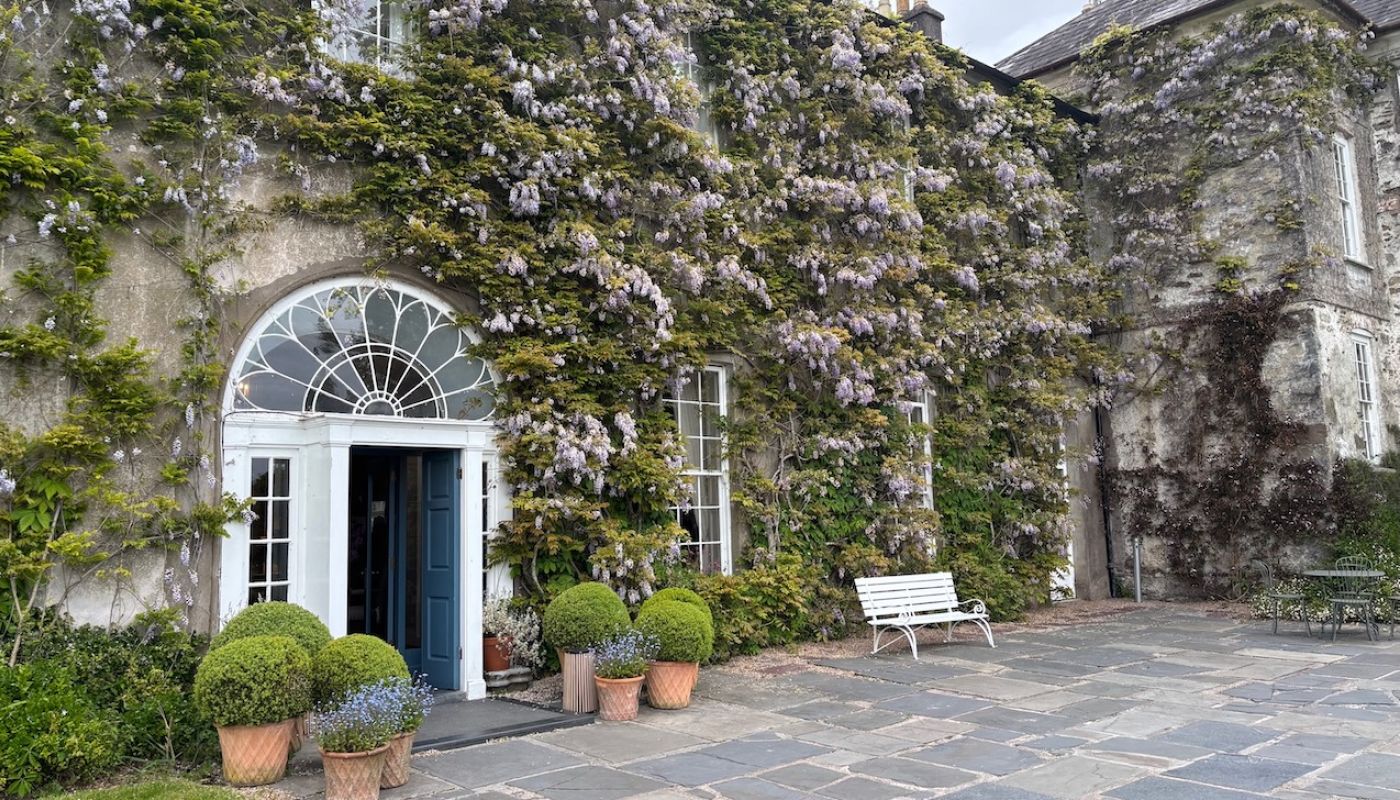
In 2011 I travelled to Ballymaloe House, a 40-minute drive from Cork, Ireland, to stay the night and to interview the late Hazel Allen, the first of the five female restaurateurs featured in my book, The Art of the Restaurateur.
We returned, very happily, in May 2026 as guest speakers at the 2026 Ballymaloe Festival of Food, as JR reported yesterday in The green, green vines of Ireland. Little appears to have changed in the intervening 15 years.
- The grounds and the hotel itself are as charming and comfortable as ever.
- The weather there is totally unpredictable. Last year the Festival took place in a heatwave. This year it was alternately sunny and wet with a cold east wind.
- Their breakfast is the best ever. The only change seems to be the addition of ricotta pancakes to the options.
- Their dessert trolley hits the same high spots and is unlikely to change now that J R Ryall, their talented head pastry chef, has built himself a house close by and appears unlikely to move.
- The hotel’s walled fruit and vegetable garden seems as fruitful as ever. The fishing harbour of Ballycotton is 10 miles away providing lobster, crabs and fresh fish. The countryside around is among the most fertile in Ireland. Irish beef, pork and lamb are deservedly renowned. And the cookery school nearby provides plenty of talented cooks.
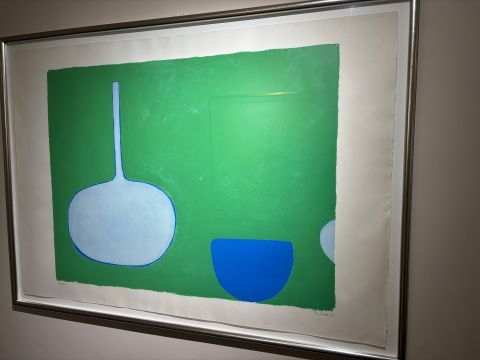
- The art displayed on all the walls, including several such as that below by William Scott, is an unsurpassed personal collection amassed by the late Ivan and Myrtle Allen.
As we sat in one of the seven dining rooms I looked around with great pleasure and thought back to that initial interview in which Allen raised a couple of issues that continue to confront concerned restaurateurs. The first was what should constitute a ‘dress code’.
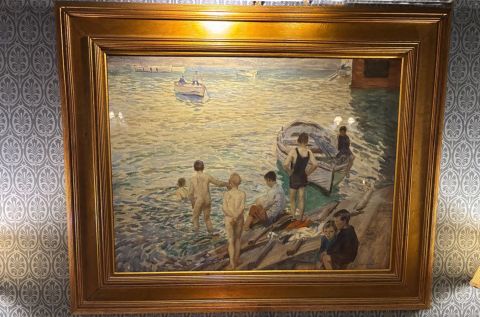
‘Smart-casual is a phrase that drives me mad’, Allen observed, ‘but I haven’t been able to come up with anything better.’ And as I looked around the room last month I sympathised. I was wearing a jacket; JR was as smart as ever. In one corner sat a couple, perhaps our age, who had dressed up. He was wearing a shirt, tie, cufflinks and a suit, she was in a dress with a shawl. Between us sat London-based corporate advisor Roland Rudd in a ‘smart-casual’ jacket with his daughter, a student at the cookery school. In the far corner there was a table of three Irish women and one man, casually dressed. Next to us, under the glorious painting below of young boys swimming, sat a couple who were perhaps the most casually dressed of all the tables. Allen, if she had been in the room, would have been mildly irritated – as are many, principally those who run restaurants within hotels – at this lack of conformity.
The second issue raised by Hazel Allen back in 2011 was the hotel’s continuing reliance on young non-Irish waiting staff, a move which Allen embraced and which led to waiting staff being encouraged from as far afield as Tunisia. This continues to this day, as Fern Allen, referred to as house manager but omnipresent, explained: ‘They form an invaluable cohort but they also have to be housed which raises other concerns’. Colm McCan, the Irish sommelier who once worked here, still runs his pop-up wine shop by the hotel at the weekends but has been replaced by the half-Italian/half-French Samuel Chantoiseau.
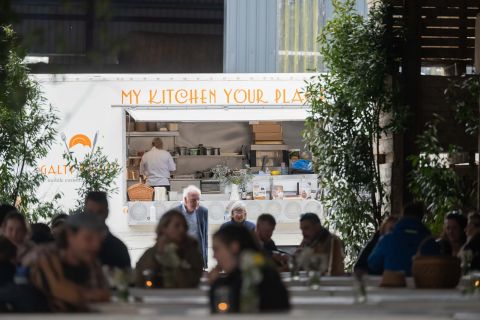
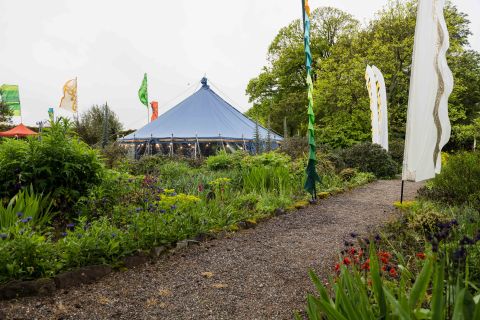
The biggest physical changes at Ballymaloe were self-inflicted as the grounds and outhouses were adapted for the Festival of Food. In the farmyard were more than a dozen food trucks selling everything from coffee to ice cream; the Little Catch Seafood Bar also had a stand, selling extremely popular fresh lobster rolls. The nearby Grain Store was given over to well-attended cookery demonstrations. A building that had once housed tractors was given over to the Drinks Theatre that Jancis described yesterday. And the main farm building was, for this weekend, home to the stalls of about 50 artisanal food producers from across Ireland, a couple selling antiques, and a bookshop. A tent for a small number of diners was squeezed into the walled garden below.
There was also a popular bar with a stage for a roster of extremely competent musicians (below).

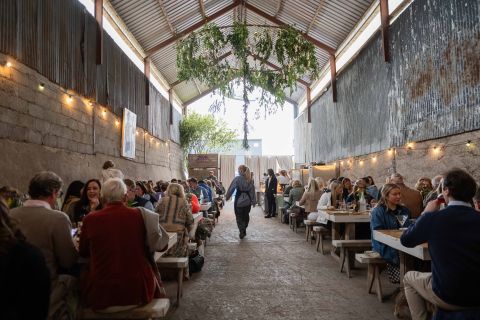
When the extensive Allen family decided upon this festival, they obviously realised that it would most widely appeal if they backed it wholeheartedly. This included inviting like-minded chefs from several other restaurants they admire to cook over the weekend in yet another large farm shed. In this spacious pop-up with its trestle tables (below) was The Fat Badger from Notting Hill on the Friday night, Robbie and Sophie McCauley from Homestead Cottage in Doolin, County Clare, on the Saturday night and a Sunday lunch cooked by Ed Wilson and managed by his wife Josie Stead of Brawn in East London. That lunch consisted of white asparagus with bottarga and clams; vignarola, the Roman dish of artichokes, broad beans and peas; roast chicken with morels and vin jaune; and a lemon tart as dessert, all of which we sadly had to miss.
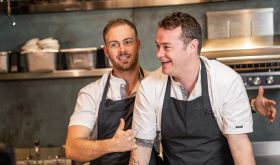
On the Friday evening in the main house that serves as the hotel they even handed over the stoves of their newly renovated main kitchen to yet another chef, Australian-born James Edward Henry, who has made a considerable name for himself in France. In 2017 Henry and his business partner, Shaun Kelly, started work on converting the former stables of the Château du St-Vrain in the village of St-Vrain 41 km (25 miles) south of Paris together with the Mortemart family into Le Doyenné, a restaurant with rooms. They welcomed their first guests in 2021. They have converted the adjacent farmland via regenerative farming techniques to provide the vegetables, fruit, salads and herbs for their kitchen.
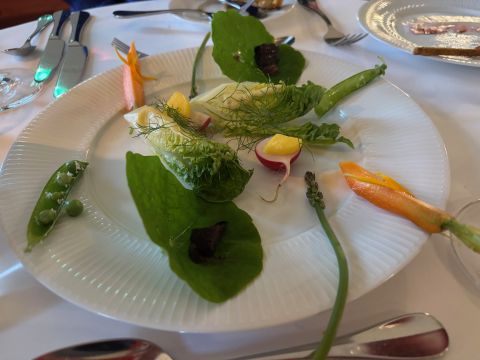
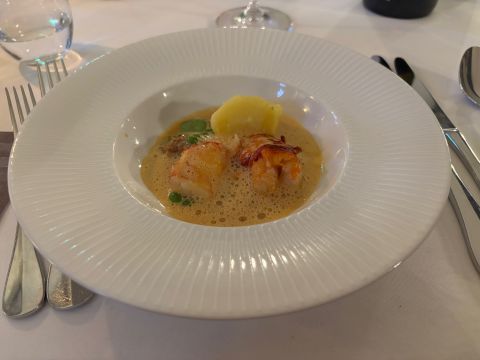
Our meal began in extremely generous fashion, international even, with a spring barbajuan, a fritter filled with chopped spinach that is a national dish of Monaco. It continued with two types of charcuterie from Le Doyenné, a spiced Rossmore oyster, and an artful plate of crudités. This was followed by a spear of Ballymaloe asparagus with an elegant oyster sauce and then, the highlight of the meal, a bowl of lobster bisque with hazelnuts which would have been even better with more bisque and less lobster meat. The potato was superfluous.
The main course was a bit of a disappointment, as it so often is: a half slice of beef fillet, cooked too rare, too red. The spinach gratin accompaniment was delicious. The meal finished on a high note with J R Ryall’s peach-leaf ice cream and a small rhubarb mille-feuille.
In the past 15 years, Ballymaloe has only improved, as well as changing but only for the better. It is no longer a small, provincial hotel and cookery school but one that is recognised as among the finest in the world despite its intensely rural location. ‘The school invariably has students from 15 different countries every time a new term opens’, according to Fern Allen, ‘and some students do find it a bit of a shock when they arrive.’
Ballymaloe, hotel and cookery school, is now an international institution and is unlikely to change its approach or to be taken over by a large hotel chain. A couple of years ago, on our last visit, we were invited to lunch in the cookery school by Darina Allen. I sat with three students from the Middle East and Toby, Darina’s son, whose explanation of the set-up would put any potential visitor’s mind at rest. He commented, ‘The businesses make some money but not a huge amount which in some ways is good because there isn’t enough to fight over. I think we all look on the businesses we run as lifestyle businesses that give us and our families a job, provide us with job satisfaction and enough money for us to have a comfortable life. But no one is driving a Porsche.’
Ballymaloe House Shanagarry, Co Cork, P25 Y070 Ireland; tel: +353 21 465 2531
Le Doyenné 5 rue St Antoine 91770 St-Vrain, France; tel: +33 1 60 80 00 99
Photos of the 2026 Ballymaloe Festival of Food by Joleen Cronin; all others by the author.
Every Sunday, Nick writes about restaurants. To stay abreast of his reviews, sign up for our weekly newsletter.