Of the many sorts of restaurants in the world today, none offers an easier route to expansion than one that specialises in fish.
Who in their right mind would object to a successful fish restaurant opening a wet fish shop nearby? In Notting Hill Gate in London the late, lamented Kensington Place combined the two most successfully with the Kensington Place Fish Shop next door. Following in its footsteps, the owners of Dorian restaurant, not that far away, have repeated this successful formula with their Notting Hill Fish shop. Close to Hampstead Heath, the London Shell Co manages a fish restaurant and a fish shop in a location no bigger than 700 sq ft. There is something very appealing about this type of sideways expansion.
In fact I find it relatively difficult to think of a successful fish restaurant that has stood still, continuing to operate in its original location exactly as it always has done. Can any reader?
We recently found one but it comes with several caveats. Firstly, it is in Tangier, Morocco. Secondly, for anybody who insists on a bottle of crisp, dry, white wine as the accompaniment to a lovely fish lunch or dinner, then I’m afraid that this recommendation is not for you. This restaurant is alcohol-free. And also, there is no shellfish on offer. Finally, getting into or out of this restaurant is not that straightforward.
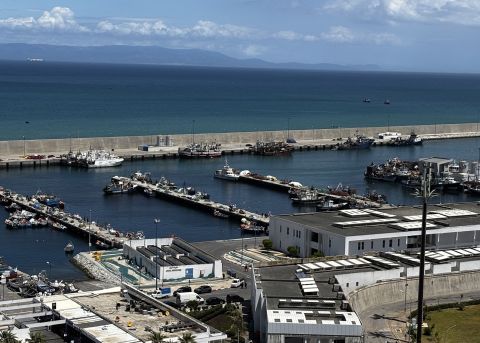
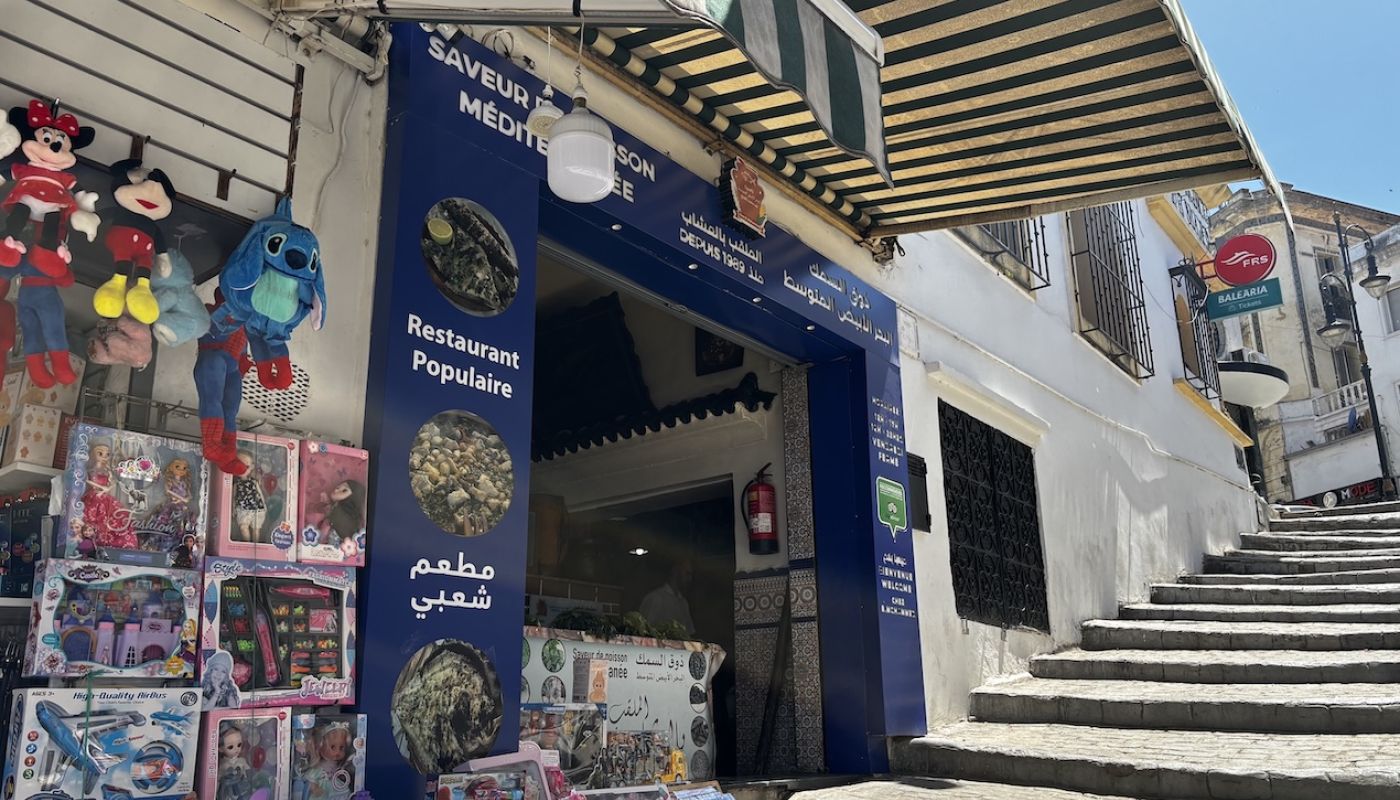
The restaurant is located on a steep incline with the blue waters where the Atlantic meets the Mediterranean in the distance. It is extremely easy to miss as you descend a steep run of steps, behind an opening on the right containing numerous dust-covered jars. To reach the restaurant behind the jars we had to pass a member of the small, charcoal-smoke-filled kitchen behind, preparing strawberries on a counter covered with heads of spinach.
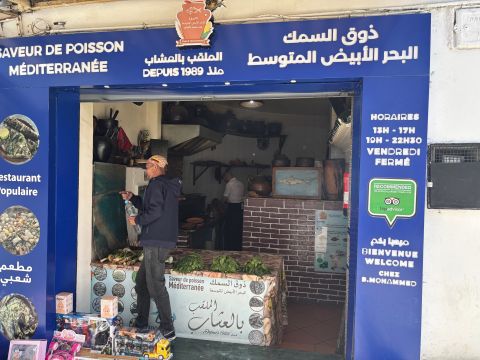
By the time we left, our exit was even more precarious as the steps had been taken over by a man who had laid a plastic sheet over them and had filled it with cardboard boxes full of plastic toys for sale.
If this isn’t quite enough to put you off, let me continue. There is no choice about what you will be offered: this restaurant continues to offer nothing other than its four- or five-course set menu (the final count depends on whether you calculate their two desserts as one or two). They do not accept credit cards, only cash. But the menu price is extremely low by the standards of London, Paris or New York: 250 dirhams (13 to the pound so less than £20 per person excluding a cash tip). There’s a usefully close cash machine.
But do persist. What ensues may not be the ‘life-changing experience’ that our guide promised before leaving us. But it was a terrific meal and one that also managed to win over my five somewhat sceptical fellow travellers.
Saveur de Poisson at 2 Escalier Waller is today very well known. According to the business card we were given at the end of our meal, along with a pottery mug each, this is a ‘Restaurant Populaire’ and is, I would say to use a well-worn adjective, unique. Its only purpose seems to be to fill its customers full of the flavours of fish – as its name implies. And to do so with many a welcoming smile. From the moment I sat down I was referred to as ‘Boss’ by this restaurant’s boss while the only other man in our party was called The President. The women were addressed as señoritas (Spain is a swift ferry ride across the Strait of Gibraltar).
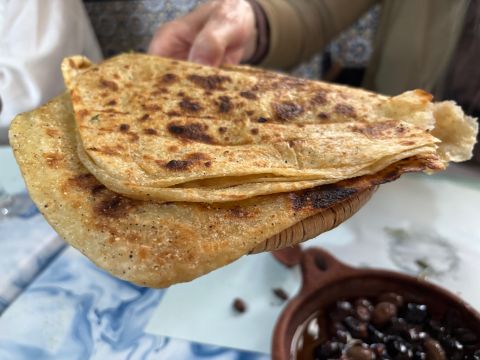
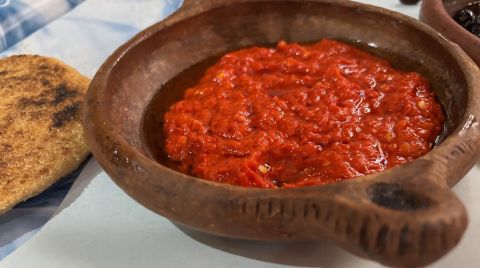
There then ensued a series of good things to nibble on: grilled flatbreads, a large bowl of local olives, an equally large bowl of delicious toasted walnuts and almonds. Alongside these came a bowl of glistening harissa that shone brightly even in the dimly lit dining room.
This was immediately followed by a bowl of fish soup that was served with a kind of wooden spoon that I quickly dispensed with in favour of my two hands, drinking the soup and only reverting to my spoon when it came to enjoying the pieces of fish that lingered at the bottom of my bowl. And with this came the first insight into how this restaurant manages to keep its menu price so low.
All the cutlery is wooden and only three implements are offered. A spoon is offered first, with a small indentation on a large handle; then comes a fork for the main course. This is the same size as the spoon and proves particularly adept at releasing the flesh from the grilled fish. Then finally the fork returns for the dessert. All this on entirely spongeable tablecloths which are overlaid with paper place mats into which all the bones of our main course were speedily bundled.
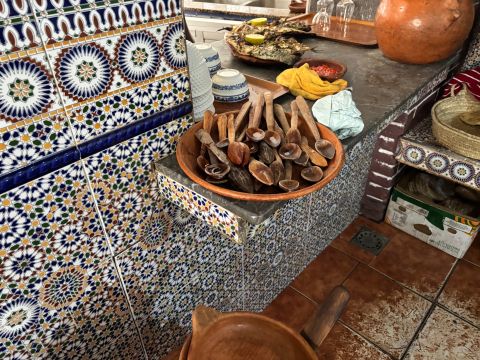
This is all as close to zero waste as any restaurant can manage, with our main courses forming the basis of the first two courses. The bones from the grilled fish are presumably the basis of the fish stock which underpinned our delicious bowl of fish soup. The trimmings from all the fish that come into the kitchen provides the small pieces of fish, which together with the rest of the trimmings from that day, provided the basis of our second course. This is not easy work but it is unquestionably astute and extremely efficient.
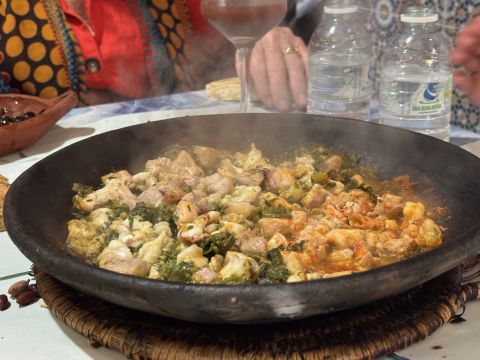
Just before our second course, two huge pieces of a second flatbread were served: crisp, almost burnt round the edges and cleverly timed, we realised, when two large round tagines were delivered from which the smoke from the charcoal underneath continued to rise (the distance from the kitchen pass to our table was five yards at the most). The tagines held a fricassee of small cubes of various fish, and arrived on a bed of well-seasoned wilted spinach. It is a dish made very easily for sharing and for conversation while it cools down. I polished off as much as I could, as my greedy eyes had already taken in the main course which I had spotted being delivered to other tables.
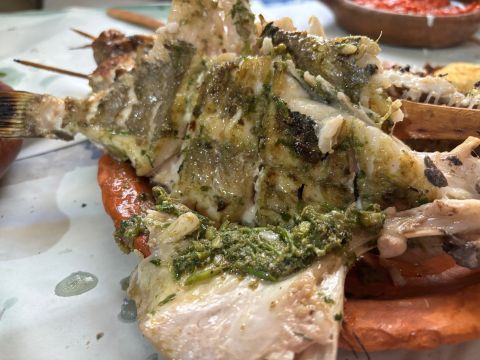
Ours soon arrived. Our party of six was served as though we were two separate tables of three: one large plate holding a whole John Dory, a whole sole with several kebabs of shark meat hiding between them, for each of us. With this, we were served sliced lemons and a clean fork.
What was particularly interesting about these fish – other than the fact that the cost of a meal here was less than the retail cost of one of these fish in London, New York or Paris – was how the taste of the grilled fish just got better and better. The fish had been coated in a mixture of numerous herbs before being grilled on both sides.
We ate the first side of both fish with gusto and then I turned them over with the help of the fork and my fingers. The second side was even better for the extra minutes it had spent in the herb mixture, with the flesh easily coming off the bone. There were smiles on everybody’s faces around the table; we were in fish heaven.
Our meal ended with two desserts: a bowl of strawberries whose sweetness was enhanced with honey and a bowl that seemed to me to contain the flavours of a liquidised baklava. There is no written bill. The restaurant’s ‘boss’ – whose roles combine that of maître d’, waiter and table clearer – came round and told us the giveaway price. We left a generous tip.
We managed to get a table for six, waiting only while they put two tables together, at 1.30 pm on a Monday lunchtime. Waiting times can be longer and it seemed to us that the restaurant was full of tourists early – and then from just after we had sat down, it refilled with tables of locals.
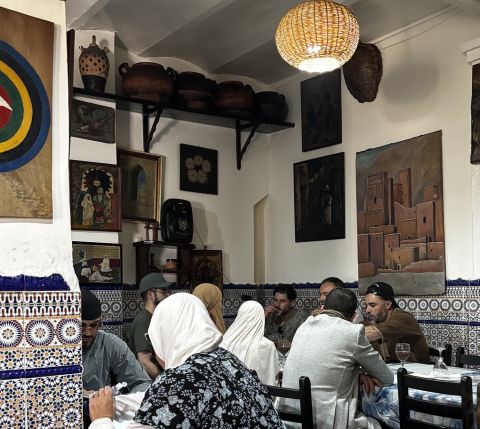
Despite the absence of any wine, you never go thirsty. They pour you a thick, dark-red fruit juice that is constantly refilled and is extremely refreshing.
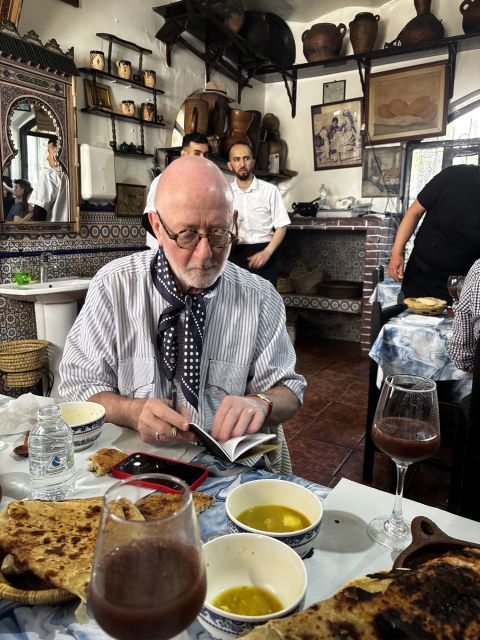
Finally, the dark interior contains numerous items from a life at sea. There is a drawing of a spiny dogfish as you walk in; another of four different fish; a ship’s wheel with a clock in the centre; and, just past a mounted shark, there is a smiling Popeye.
When you are next in Tangier, do go. Just don’t forget to call in at an ATM beforehand.
Le Saveur de Poisson 2 Escalier Waller, Tangier, Morocco; tel: +212 0539 33 63 26. Open for lunch and dinner. Closed Friday.
Although this restaurant doesn’t serve wine, Morocco does make wine, which you can explore in our tasting notes database or in The Oxford Companion to Wine.