Prosecco Conegliano-Valdobbiadene is set to become a DOCG, as heralded in Prosecco diluted last October.
Just in time for August, when the harmonisation of the European wine law will convert existing national wine denominations into a single system of DPOs, or Denominations of Protected Origin, the Consorzio per la Tutela del Vino Prosecco di Conegliano-Valdobbiadene announces the elevation to DOCG for sparkling Prosecco wines produced in the historic area, beginning with the 2009 vintage.
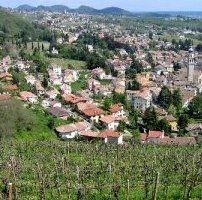
The production zone of Prosecco di Conegliano-Valdabiodene is confined to the hills around the towns of the same name, where yields are naturally lower as vineyards are planted on terraces. This guarantees, at least in theory, a higher quality of wines than the ones produced under the much more lenient IGTs Veneto, Marca Trevigiana and Colli Trevigiani, which stretch for miles and miles on the plains of Veneto. This trio spews forth enormous volumes of sparkling wine which have become so popular internationally that foreign imitations of Prosecco abound.
In a way the Italians have only themselves to blame, allowing Prosecco to become shorthand for inexpensive bubbly. Current total production of Prosecco is around 1,300,000 hl annually, of which 60 million bottles are marketed as DOC, but more than 100 million hl as IGT, and selling at half the price.
As with all varietal wine, protection of origin is a sheer impossibility, which is why the Consorzio has been fighting to get recognition for the superiority of produce from the hills. Unfortunately, at least from a consumer’s point of view, the name does not exactly roll off the tongue.
While British and German supermarkets in particular have kept downward pressure on prices, the ultimate slap in the face came with the introduction of a Prosecco in a can, with Paris Hilton recommending drinking it with a straw. Producers were up in arms about what they saw as a further deterioration of the wine’s reputation, but the regional government was less offended, welcoming the product as an ingenious way of dealing with potential overproduction.
However, officials did begin to worry after Prosecco from outside the prescribed zone started to appear on the markets, potentially affecting profitability of the Italian original. Allegedly Luca Zaia, Italy’s Minister for Agriculture, and from the Veneto region himself, promoted the idea of the creation of a generic DOC Prosecco, which would stretch all the way up to Friuli Venezia Giulia, where the village of Prosecco is located near the Slovenian border. This would provide the legal condition of protection, which is based on provenance of agricultural produce only, and hence what was previously the name of a grape variety would now be a name with geographical significance.
It therefore comes as no surprise that while DOCG status is introduced for Prosecco Conegliano-Valdobbiadene (and at the same time also for its much more obscure southerly neighbour Prosecco Montello e Colli Asolani), a new DOC has been designed to encompass no less than eight provinces (Belluno, Gorizia, Padova, Pordenone, Treviso, Trieste, Udine, Venezia, and Vicenza), absorbing practically all of the IGTs under which Prosecco production outside the classic hills has been marketed. Curiously, while the province of Treviso boasts more than 10,000 ha devoted to the grape, Padova, Vicenza and Belluno together have no more than 600 ha planted with Prosecco, and Friuli a mere 125 ha.
Although the producers from the classic area now at last may see official recognition for the superiority of their wines, the ambition of their Consorzio goes further. During the annual Vino in Villa festival to be staged next month, the Consorzio will introduce the notion of crus. This in itself is nothing new, as witness the suffix Cartizze, a tiny subzone within Valdobbiadene considered the source of the finest Prosecco of all. Apart from this subzone, common knowledge within the region itself has it that, among others, the villages of Saccol, Vidor and Santo Stefano historically have been the source of outstanding grapes. An official classification, however, has previously not been considered, and it will be interesting to see whether the wines actually allow for such subtle division reflecting their terroir.
At the same time the Consorzio has started a campaign to obtain recognition for Conegliano-Valdobbiadene as an official Unesco World Heritage site – which could confer even great prestige on the area than any DOCG could achieve.