The biggest challenge facing restaurateurs today was brought home to me by the behaviour of couples sitting at the same table in the same restaurant with a ten-year gap.
About 10 years ago we were seated at a table in Le Gavroche, the two-star Michelin restaurant in London. The next table to us was occupied by a Russian couple who were quite obviously enjoying a bottle of mature wine from Domaine de la Romanée-Conti. With it no more than half-drunk, they paid and left the restaurant. We cast envious eyes before the bottle was whisked away.
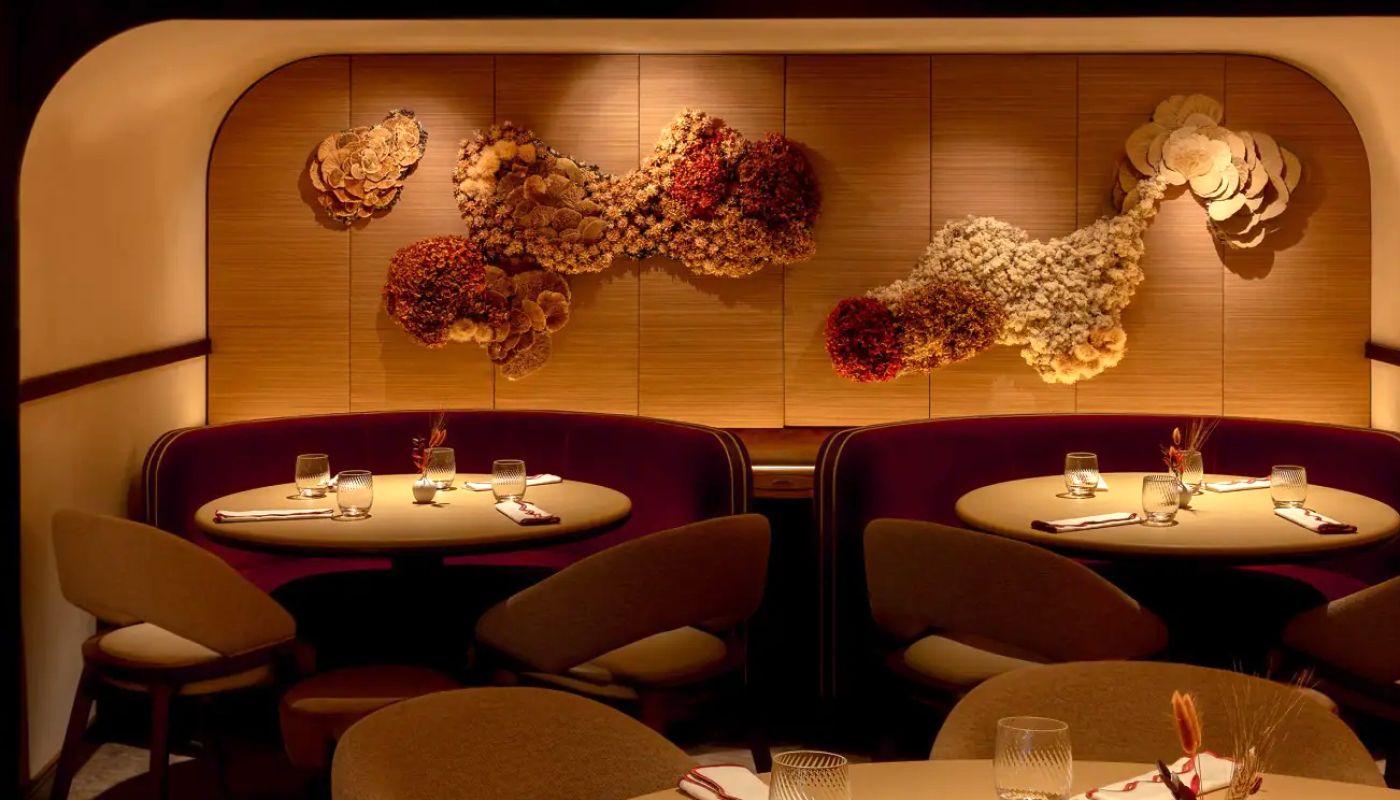
Last week, in an equally luxurious establishment that is now called Bonheur by Matt Abé, that same table was occupied by a couple of young Asian women, with a single Asian woman dining alone at the next table. They drank mineral water with their meal and spent a long time on their mobile phones, before paying and leaving the restaurant.
Such abstemious behaviour is increasingly common as the decline in wine consumption continues and threatens every restaurant’s bottom line. Restaurants have only two sources of trading income: the sale of food and the sale of drink. As our dinner companion at Bonheur, chef and wine enthusiast Isaac McHale of The Clove Club, commented, ‘restaurant economics simply don’t stack up if you can’t sell drinks’.
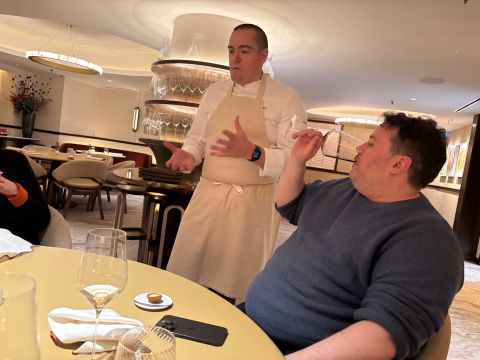
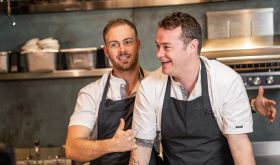
The significant change in alcohol consumption was not the only change to be seen on these premises. Le Gavroche is no more and for the first time in 57 years no member of the Roux family is involved at 43 Upper Brook Street. Instead, in charge of the site is Australian-born chef Matt Abé, with backing from Gordon Ramsay. He has called his new restaurant Bonheur, ‘happiness’ in French, a name, which Abé explained when he came to our table, ‘came to me immediately. It’s the feeling I hope I can imbue in my clients after they have spent a couple of hours here.’
The physical changes are obvious and significant. There’s a smart doorman. The staff are young and welcoming and possibly more smartly dressed than many of their customers, in light brown suits. And this pale palette has been used throughout by the Russell Sage Studio (currently London’s go-to restaurant designers) in what we thought was a successful renovation of a restaurant that has continually managed to convey happy experiences and memories.
Gone are the former dark green and red, to be replaced by a much brighter off-white and pale amber which run throughout and liven up the downstairs restaurant where no natural light ever shines. ‘I am aware of this limitation’, Abé continued, ‘but it tied into my wish to introduce some Australian warmth into the restaurant’.
The number of tables has been reduced from 21 to 14 and the small private dining room that seats six to eight next to the kitchen door has been opened up. Ice buckets have been built into the fabric of the restaurant, a decision that leaves the room uncluttered and also with considerable space between the tables. The tables are no longer covered in white linen but instead with caramel-coloured leather which is pretty stain-resistant as we soon discovered, and which blends in with the overall colour scheme.
The foldout card arrived with its three differently priced menus. There is an à la carte (three courses at £165) on the right; a ‘Dream’ menu in the centre (seven courses at £225); and one called ‘Journey’ (five for £195) on the left. These turned out to be for reference only as Abé decided he would cook his Dream menu for the four of us but charge us ‘only’ the à la carte price of £165 per person as he and McHale are part of the Michelin mafia of chefs holding two stars each.
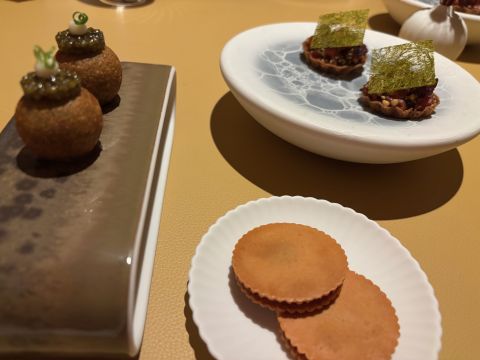
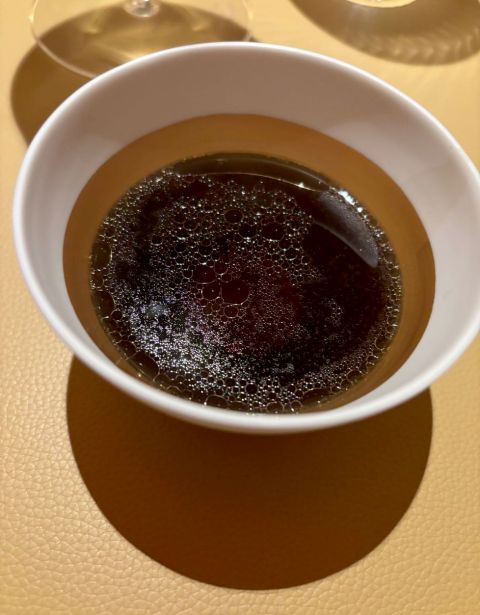
Almost unnecessarily, our evening got underway with a barrage of small appetisers which conveyed some of the principles upon which the dishes which followed were built: great technical precision; a deft hand with the seasoning, particularly the salt; marked acidity in each dish; and an emphasis on crunchiness in the contrasting textures. Particularly pleasing was the beignet topped with caviar and the parmesan biscuit sandwich, followed by a small bowl of glistening broth.
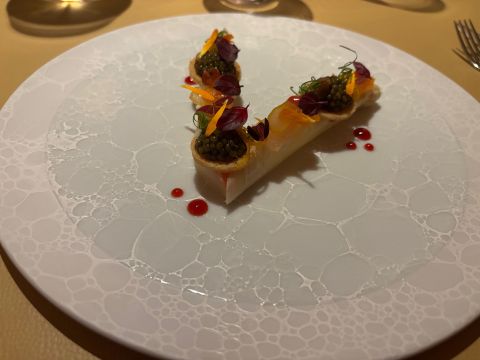
All of this helped to prepare us for the elegance of the first two courses. Two spears of Loire white asparagus, not too big or fat, were served topped with slices of blood orange and wafer-thin pastry cases holding more caviar, topped with a blood orange-infused sauce maltaise. This was excellent and immediately dispelled any reservations about the pleasure and enjoyment of eating white asparagus (which is too watery and flabby).
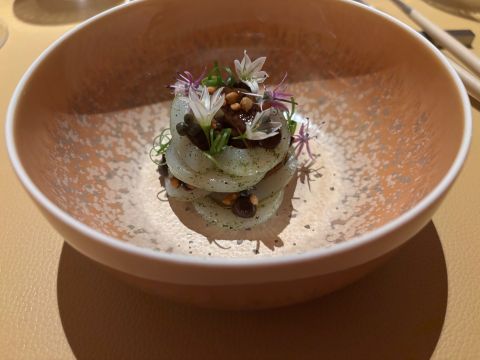
There then followed a dish described as ‘South coast squid, XO sauce, allium and shiitake’ that was served with chopsticks with metal points and a glass of sake IWA 5 Assemblage 6, made in Japan by ex Dom Pérignon Richard Geoffroy. This was Abé’s homage to the noodle, the squid cut to the same thickness and served wound into a mound before being topped with miniature leaves. This was immediately followed by a loaf of Japanese milk bread.
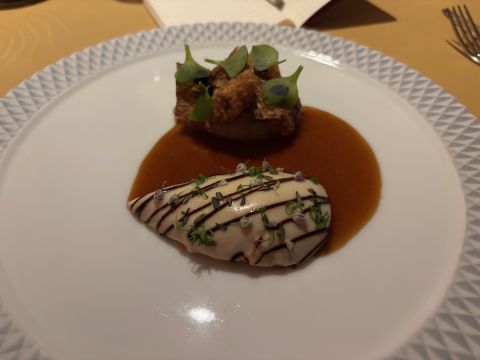
But it was the final Japanese ingredient with the next course (below) that encapsulated Abé’s approach. Alongside an attractive, glistening breast of quail came a thick puree of crosnes, the Japanese artichokes that are so expensive – £45 a kilo – that McHale was surprised at their inclusion. ‘These are just too expensive for many chefs to use at the moment’, he observed as he enjoyed every mouthful.
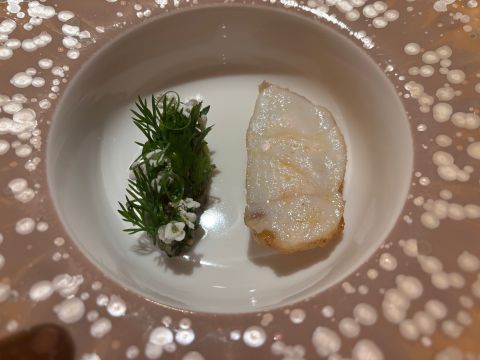
It was the next dish, the monkfish with Café de Paris butter (above), that revealed that Bonheur has still something to learn. This is another kitchen which likes to serve its dishes in bowls rather than on plates but the steep sides of the bowl in which this fish dish is served are just too deep, making cutting the fish a real challenge.
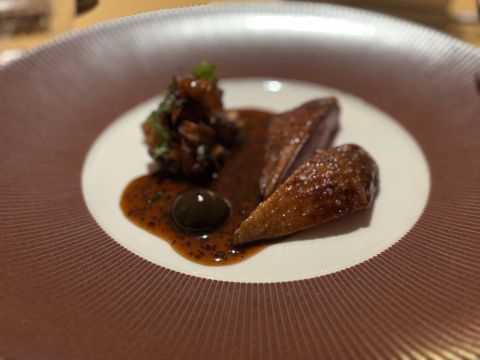
The numerous dishes that followed were impressive, particularly the pigeon which was thoroughly cooked through, crisp-skinned and salty with a sort of accompanying lollipop made of the legs.
The pecan praline and an array of petits fours were all excellent. It was most impressive, as was the bill of £1,095.95 for the four of us, or £273.99 per person. This included two bottles of wine which JR had chosen as relative bargains after carefully studying the vast wine list before our visit. The first was a Schoffit, Rangen Riesling 2022 Alsace Grand Cru for £120, the second a Xinomavro 2017 from Naoussa in northern Greece for £110.
These were both extremely interesting but sadly are rare bargains on the wine list. The first was from the native region of Bonheur’s sommelier Eric Zwiebel MS and the other was an off-piste red with considerable bottle age. I do not envy Zwiebel’s challenge in compiling this wide-ranging list. As well as pleasing his customers, it has to generate considerable profits to cover what must be considerable costs. This is one of those in which a wine under £200 a bottle looks like a bargain.
I would like to hear from readers their opinions on pricing a wine list. Should it be heavy on the margin as a way to cover overheads and contribute to profitability, bearing in mind that higher prices may dampen consumption in a market where demand is already falling? Or should the wine list be priced for excitement and to stimulate demand with the obvious risk that profitability may be prejudiced?
But in the four months that Bonheur has been open, Abé and his team have achieved a great deal, culminating in two stars from Michelin in January. Taking over a long-established location and building a new identity for the restaurant must be more difficult than opening somewhere free of numerous long-standing encumbrances. To do so with such excellent food and service deserves further praise.
And the differences in the style of food between Le Gavroche and Bonheur are not as wide as they may appear. Abé has spent the previous 20 years cooking under Matt Moran and Shannon Bennett in Australia and then Gordon Ramsay and Clare Smyth in London all of whom cook principally French cuisine. Bonheur is French with Australian warmth. I wish it a long life.
Bonheur by Matt Abé 43 Upper Brook Street, London W1K 7QR; tel: +44 (0)20 7139 8624. Open Thursday to Saturday lunch and Tuesday to Saturday dinner.
Every Sunday, Nick writes about restaurants. To stay abreast of his reviews, sign up for our weekly newsletter.