Paul Symington of the Symington Family Estates (Graham's, Dow's, Warre's) sends this report on the 2009 vintage in the Douro.
This has been a challenging year for the people of the Douro and the vines that they cultivate. Three dry years in succession in a region such as ours complicates the already difficult task of farming mountain vineyards. By the end of September, only 285 mm of rain had fallen at Quinta do Bomfim, 40% less than normal. Many neighbouring villages have been with little water, sustained only by tanker deliveries from the volunteer fire brigade. Peoples' wells and springs were giving the merest trickle of water and the Douro dust was thick on all our farm tracks and covered our vehicles. At Vesuvio the young Touriga Franca that was planted in March had to be watered by hand five times. The Douro is not an easy place to farm.
But this was not like 2005, a year when drought and heat combined to assail our vines. June gave 39.6 mm of rain and this was enough humidity for the vines to face the summer and they were in good shape with enough leaf growth for bunch shade. The Douro is perhaps the most diverse wine region on earth. It is nearly 100 km long and an average of 25 km wide with a very wide range of terroirs. Some vineyards are at the river's edge at 90 metres above sea level and others are high up the valley at 450 metres, temperatures, ripeness, aspect and sun exposure vary widely. It is impossible to give an assessment that will characterise the whole Douro in a year such as this.
The low-lying vineyards that face south in the Douro Superior above the Valeira dam did suffer this year, it could not be any other way. The classic Douro heat came on 12 August, having been quite cool till then. On the 13th the temperature reached 40 °C and it stayed in the high 30s for several days. On 9 and 10 September, we again had hot weather with temperatures nearly touching 40 °C, after which there was a gradual cooling.
It was quite strange; we had our vintage gear ready for the cool nights and we warned friends due to visit that they might need coats but they needed hats. It became apparent that the thin-skinned Barroca in some low, south-facing locations had suffered from dehydration. Baumés were high and with the warm weather there was pressure to start picking. Our viticultural team, who take their holidays in July, had been at work for weeks in the vineyards carefully measuring the evolution of the berries while most people were in the Algarve. Our team knew that the phenolic ripeness was not there yet. Green stalks and unripe tannins in the pips are not a good recipe for great ports and wines even if the Baumé's were high. So despite knowing that we were losing berry weight, we held off while a few hot-heads rushed to pick.
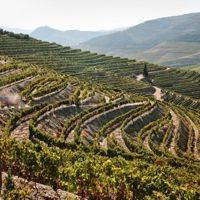
Nevertheless it was an early vintage and we started picking at Quinta do Vesuvio, Telhada, Vale Coelho and Senhora de Ribeira on 7 September and at Malvedos (pictured above) on the 14th. Bomfim followed on the 17th and Cavadinha on the 20th. This is about a week earlier than the average. There was absolutely no sign of any rot in the berries and unless heat-affected, the bunches were in excellent condition and gave good, concentrated colour and aromas. Cooling the musts was required on many days.
Yields were substantially down, by about a third in my family's vineyards. In the whole region the reduction will not be as large because the Lower Douro (Baixo Corgo) is considerably wetter, with richer soils. The reduction in yields was due to the low rainfall and to rigorous selection on the sorting tables, so good wines will emerge. In some vineyards we had our teams picking into different coloured boxes, one for the first quality fruit and another for the dehydrated bunches. Each contour on the hillside gave a different quality.
Our challenging geography (see the photo below of the vineyards of Quinta das Netas, near the higher sections of the Cavadinha estate, for example) and our well-adapted grape varieties played decisively in our favour and fine ports and wines were made from particular vineyards in some areas of the Douro. Barroca at about 450 metres was really excellent and enjoyed the dry weather at this altitude. Touriga Nacional had a great year in most places and showed how incredibly well adapted this vine is to the Douro climate. The late-ripening Touriga Franca also performed very well. My oldest son Robert, working at Roriz for his second harvest, made a perceptive comment midway through the harvest; 'The quality band here seems to have moved up the hillside by some 150 metres'. This is exactly what happened.
![Netas_Sept_09]()
This was a year for flexibility. It would have been a mistake to stick to the traditional patterns and my cousin Charles was busy switching the varietal picking order around as the conditions changed. We had the major advantage of farming vineyards from Quinta de Telhada in the far east of the valley just 30 km from the Spanish frontier as well as vineyards to the west in the Pinhão Valley at nearly 500 meters. With 25 Quintas, from the tiny Madalena in the Rio Torto to the imposing Quinta do Vesuvio, this diversity allows us to select some lovely wines in a year such as this. Running several small wineries in widely separate districts (some processing no more than 120,000 kg of grapes) costs money but is a decisive quality factor. This is a logistical challenge, but the specialist wineries at Vesuvio, Sra de Ribeira, Tua, Malvedos and Cavadinha again proved their worth, receiving a steady flow of the very best quality fruit that each team handled with the utmost care and attention. Each winemaker likes the idea that they are personally responsible for each ferment.
On the night of 6_7 October, just as the last day's picking was due to start, nature played a nasty trick and delivered a monumental storm that came powering in from the west over the Serra de Marão. Over 60 mm of rain fell at Cavadinha and caused damage to farm tracks and to some young vineyards. 60 mm was more than the total rainfall for any month since January and it all fell in just a couple of hours. This was nature's way of telling us who really is in charge. We need rain, but not like that.