Dinner at Robata Honten and Mikawa, on my last two nights in Tokyo, remain unforgettable, even several weeks after my return.
Although the food is very different in each, and the bill in the second was three times that of the first, they share vital common ingredients that have ensured their popularity over 30 years.
Both are presided over by gentlemen in their mid 60s although one is the epitome of a restaurateur, the other of a chef. Both exude old-world Japanese hospitality. Both inhabit buildings at least 60 years old, venerable in a city that has seen more than its fair share of recurrent structural damage. And both, as in so many of Tokyo’s restaurants, take only cash.
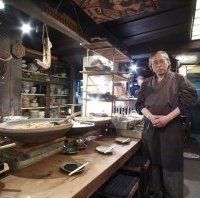
Robata Honten (pictured here by Jean-Pierre Gabriel) is located in the narrow road, full of restaurants, that links the Imperial Hotel and the Tokyo International Forum. From the outside it displays two distinguishing features. It is at least one storey lower than those on either side, an obvious clue to its age in this crowded city, and while all the other restaurants along the street display plastic images of the dishes they offer, Robata Honten shows off a tray of fresh vegetables by its front door.
It was this, plus the bottle of wine in the window, which first made me stop and peer through its sliding door and what I saw intrigued me even further. There was a Buddha-like figure dressed in chef’s whites sitting behind a range of pots on the right-hand side while the whole interior seemed to be made up of dark and obviously well-worn wood. In the centre was a man wearing formal Japanese attire with, behind him, a strikingly tall woman in a dark kimono. No restaurant I had ever seen more resembled a film set.
Over the next two days I got to know Takao Inoue, the third generation of the same family to oversee Robata Honten, as much as our limited knowledge of each other’s language permitted.
Having studied Japanese and Chinese literature as well as film (he quipped that the well-known Belgian food photographer with me looked like the late director Stanley Kubrick), he took over this restaurant that his grandfather and father had owned before him. A man of conspicuous good taste, he explained in his gentle voice that all the paintings, as well as the ceramic plates and bowls on which the food is served, have been made by friends of his from around Japan.
The restaurant is narrow with a low ceiling and a steep staircase that leads to two further floors. The first is entirely Japanese with three private tables and tatami matting, the second a mixture of Japanese and Western seating with a considerable collection of Inoue’s books around the walls.
All the food is served from the ground floor, where the chef sits in front of his robata or grill. Between this and the counter where customers can sit are about 25 dishes full of food from which you make your selection. This is then detailed by the lady at the cash desk and brought to your table elegantly laid out on an equally elegant dish.
When I asked Inoue what his style of food was his response was ‘Japanese family style but not too traditional’ and this does seem to be a very accurate description. There are vibrant salads of mizuna, asparagus, sardines and plums; trays of fresh fish such as herring, octopus, wakasagi (similar to smelt) and yellowfish with daikon; finally, there is a string of hot dishes which included pork belly with hard boiled eggs and star anise and a wonderfully thick stew of oysters stuffed with enoki and shimeji mushrooms. When I complimented Inoue on this last dish, he bowed and said 'Thank you. I like mushrooms, too.' Dinner ends (it is open from 5pm-11pm seven nights a week) with excellent green tea and, most unusually, some sweetmeats.
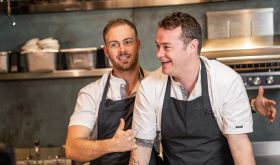
It would be impossible to calculate how many customers the three generations of Inoue gentlemen have looked after over the years (although he told me with some pride that the French actress, Juliette Binoche, had eaten there the night before me). It is, however, much easier to put a relatively precise figure not just on how many customers Tetsuya Saotome has cooked for at his small Mikawa tempura restaurant but also roughly how many pieces of tempura he has cooked in the 33 years he has stood next to his nabe, or tempura pot. 'I have cooked for about 50,000 guests in that time', he explained with a chuckle, 'so that means with about ten different pieces per person about half a million pieces of tempura in total.'
Saotome-san, as he is referred to because of his expertise, can be so precise because the initial Mikawa over which he presides in the evening (there is a second site in Roppongi and a third full of his antiques due to open in late spring) is so small. There are nine seats at the counter and two small private rooms that seat a further 13.
While two young men look after the customers, another two in the tiny kitchen behind prepare the fish and vegetables for Saotome-san to transform. He stands at the apex of the counter in front of a chopping board, with a bowl containing the flour and egg next to it and just to the right, his magical nabe. Alongside are pairs of long-handled bamboo and metal chopsticks that with a strainer form his ‘batterie de cuisine’, while just below are large tins of sesame and salad oils. As cooking techniques go, it could not be more minimalist.
We began with two shrimps which he cooked in seconds and I was told to eat just as quickly with a dash of salt, pureed daikon and soy sauce. There then followed over the next couple of hours his tempura rendition of the head of the shrimp, squid, various local Japanese fish, conger eel, asparagus, and, best of all in my opinion, a single plump shiitake mushroom. The final two dishes were a bowl of miso soup with clams, to clean the kidneys, and a bowl of rice topped with tiny scallops cooked in a tempura batter that was so good that I finished it with immense regret.
Saotome can, I was warned, be as closed as one of his clams but that night he was wonderfully chatty, a tribute perhaps to my attractive Japanese translator. Like Inoue, he has a most lovely face and his boyish grin reveals the continued passion he obviously feels for his particular culinary art. 'I’m not frying', he explained, 'but baking in oil and my role when the fish is in the pot is to calculate the right combination of air, water and batter. I think that I am able to see the scales on the fish that other people cannot see and then just coat each piece in the appropriate amount of batter. After that the trick is simply to count the seconds the fish should be cooked for.' Like all artists, he made it sound rather simple.
I also detected in our three-way dialogue a sense of frustration on his part that while sushi chefs are now considered to represent the very finest Japanese cooking can offer, the charms of his particular discipline have been forgotten. He laughed when I told him that in Japanese restaurants in London tempura dishes tend to be coarse and invariably the cheapest dishes on the menu.
Saotome-san knows how to charge but rightly so. My meal here was certainly better balanced than the sushi I ate at Jiro, considered to be the city’s finest sushi restaurant. Less protein; less filling rice; and, above all, a sense that this simple combination of batter, oil and one man’s sensitivity can produce genuine culinary magic.
Robata Honten, 1-3-8 Yuraku-Cho, Chiyoda-Ku, Tokyo. Tel: 03-3591-1905. Approx 5,000 yen per person.
Mikawa, 3-4-7 Nihonbashi-Kayabacho, Chuo-ku, Tokyo. Tel: 03-3664-9843. Approx 15,000 yen per person.