
There are several striking similarities between Franschhoek and Stellenbosch, the neighbouring vineyard areas of South Africa, and the verdant slopes of the Napa and Sonoma valleys in California.
All are within an easy drive of a major international airport, Cape Town and San Francisco, respectively. All are stunningly beautiful with perhaps Franschhoek the most impressive of all thanks to the dramatic range of mountains that surround it and the fact that mixed fruit farming is still practised here, with the citrus, almond and soft-fruit orchards adding an extra layer of natural beauty alongside the many rows of neat vines rustled by the breeze. And because these are still principally agricultural areas, they all offer equally breathtaking views of the stars at night.
In each instance, as well, the vine is an interloper. Vines were first introduced into California by the Spanish missionaries around 1770, and into the Cape by Jan van Riebeeck, of Dutch descent, who, according to his diary, first harvested vines in the Cape on 2 February 1659. Huguenots, escaping religious persecution in France in the late 17th century, followed – Franschhoek means ‘French corner’ – although this Gallic influence lasted only a generation before the arrival of the more numerous German and Dutch.
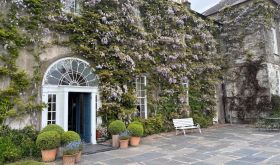
The arrival of this later wave has had many consequences for the food and wine lover but two are very particular. The first is the simple, natural beauty of the Dutch Cape architecture that survives on the wine farms they established. Long before air conditioning, they managed to create high-ceilinged thatched interiors that are cool and a pleasure to sit in, areas that have so often been converted today into restaurants with wine-tasting rooms close by.
The second has been the initial leaning towards making white wines. Thanks to low grape prices and a weak rand, white wines from South Africa, particularly but by no means exclusively those made from Chenin Blanc and Sémillon, offer excellent value to the world’s wine lovers.
History is today having a profound and extremely positive effect on the Cape’s hospitality industry, to such an extent that I can confidently say that I have never experienced such enthusiastic, warm, interested and delightful service as I did during my week in the Cape last January.
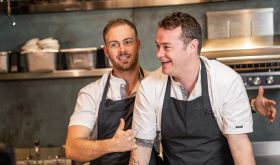
From my two most exciting meals in Cape Town – an exceptionally creative and successful one at The Test Kitchen run by Englishman Luke Dale Roberts, and the Chefs Warehouse & Canteen (see Bree Street – Cape Town food with a view), where Irish-born chef Liam Tomlin is in charge – to the more traditional Cape Malay food served at the Delheim winery (described in part 2) to that of Chris Erasmus at his recently opened Foliage in Franschhoek – the service was first class.
In most instances, this level of hospitality was delivered by teams of young, black waitresses and particularly waiters who managed to convey a genuine friendliness and professionalism, whether standing in front of their customers reciting that day’s specials, serving the wine and food, or clearing the tables.
Quite how many of these are in fact young South Africans is, however, a more difficult question to answer, precisely because there are many who have crossed the border from countries north of South Africa, Zimbabwe and Mozambique in particular, in search of a better life. Many are highly qualified but are having to settle, initially at least, for a job that will allow them to eat before they can manage to move upwards and onwards, perhaps back into their original professions.
I have to say that it was this exceptional style of service that left the most lasting impression. But there were two other strong impressions, both perhaps less surprising, that link this wine region to other newly emerging wine regions in the rest of the world.
The first is how wineries across the US and Australia and wine farms in South Africa have attracted investment from numerous, extremely wealthy individuals.
The association with the lifestyle symbolism associated with producing one’s own wine is obviously attractive to many, underlining once more the long-held maxim that ‘to make a small fortune in the wine business, one must start with a large one’.
Two striking but very different examples of this approach, no more than 20 kilometres from each other, are the glorification of the La Motte wine farm in Franschhoek by the Rupert family who control the Swiss-based Richemont luxury goods company, decorated in a style referred to locally as ‘Afrikaans Baroque’ and what is now the Delaire Graff Estate just outside Stellenbosch, financed by Laurence Graff of the Graff diamond company.
The Pierneef à La Motte restaurant takes its name from the family’s large collection of early-20th-century paintings by J H Pierneef that hang in the gallery next to the large, bright restaurant monitored from a critical corner in the open-plan kitchen by executive chef Michelle Theron. Here we followed the custom of many of those who spend weekends nearby and cycled on a Sunday morning for a breakfast of omelettes stuffed with vegetables and locally produced mozzarella.
The association between diamonds and the Delaire Graff restaurant is more obvious: to reach the dining room and the tables on the extensive terrace under massive pin oaks one has to pass by a large diamond showroom obviously astutely positioned to tempt the better-heeled diners. This particular restaurant (Indochine, the hotel’s other restaurant specialises in spicier, Asian food) is run by chef Michael Degg.
Degg has just returned from four years in Dublin and is now cooking with great precision. A chicken-liver terrine; beetroot-cured trout; a slow-cooked casserole of neck of lamb with mashed potato; and a fillet of kingklip, the popular deepwater fish, with cauliflower and sultanas, were all very well executed. What added to the pleasure was the view across the valley from the shaded terrace (pictured above) that made one feel almost as though in a restaurant under the plane trees in the south of France.
And yet here, as in California or the Margaret River south of Perth in Western Australia, those with considerably smaller budgets can astutely harness Nature’s bounty to the most impressive effect, too.
On the slope of the valley directly opposite Delaire Graff, across the Helshoogte Pass pictured below, is a complex of buildings that houses the highly admired Thelema winery alongside Tokara, which produces wine and olive oil and houses a stunning restaurant with a menu from chef Richard Carstens, who brings well-conceived Japanese influences to local ingredients. The high-ceilinged restaurant runs east to west with glass windows from floor to ceiling that offer spectacular views across Stellenbosch with False Bay in the distance.

Top-quality olive oil is also produced at Waterford Estate, alongside the vines first planted here 20 years ago by Kevin and Heather Arnold. But their approach to enticing visitors to their beautiful estate involves making excellent chocolates, of which the rock salt was my favourite flavour, and commissioning Land Rover to build a 14-seater open-sided model that is parked by their entrance. This can be hired to take groups to two shaded settings so that wine tastings can be enjoyed in the vineyard. Arnold confessed to me that few return from this journey without placing a significant order for his wines.
See the second part of this travel guide tomorrow.