The citizens of Singapore are obsessed by food. That is not just my opinion, having spent four nights there recently at numerous tables, but also that of my brother-in-law, who has been married to a Singaporean for decades. Lured back there every year by at least one wedding invitation, his appetite is never quite up to the challenge. ‘My wife’s family sit down to one multi-course meal’, he explained, ‘and there they begin to plan the next one.’
So my review of what I ate in Singapore cannot hope to be comprehensive but is, for your ease, broken down by meals with a little preamble. What connects all these meals is the simple fact that this city state has acted as the final refuge for a wide range of differing aspects of regional Chinese cuisine whose practitioners have settled here over the years. I had breakfast courtesy of one individual who settled here in the 1930s; lunch courtesy of the Peranakan/Nyona (the male and female names of people descended from the intermarriage of Chinese traders with local women in Malacca in the 15th century and who then sailed on) style of cooking; and dinner enjoying the Teochow style of cooking from those who settled here originally in 1819 from China’s Guangdong province.
Breakfast
Head for one of the many branches of Ya Kun Kaya Toast (there is also a branch in Singapore’s vast Changi airport), particularly if you have a sweet tooth.
These cafes, which have expanded internationally while remaining under family control, trace their presence here to the energy of Loi Ah Koon, who arrived here from the mainland in the 1920s and started serving cups of coffee and toast. He was subsequently joined by his wife and it was at her suggestion that he began to cut the toast in half and fill it with the kaya that she made. Kaya, coconut jam, is a relatively easy-to-make concoction of eggs, pandan leaves steeped in coconut milk and cane sugar. In 1944 the first Ya Kun stall opened.
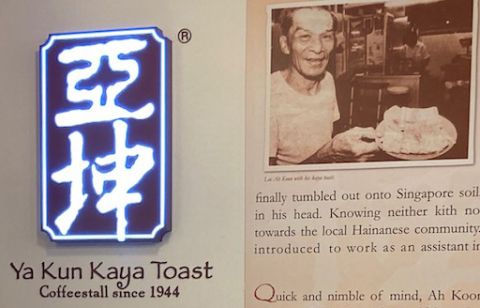
Since then the business with its sweet offerings has grown notably, by sticking to precisely what it is good at. The thin slices of bread are still grilled over charcoal: the bread is then sliced and stuffed with butter and kaya; the eggs are still quickly cooked (they are too runny and undercooked for my taste); and the coffee and tea are still hot and inexpensive (a kaya breakfast for two including tea or coffee, toast and eggs is just over SG$10 or £6/$7.50). The appeal of these relatively simple cafes is enormous: the customers at the branch I breakfasted at ranged across all ages, professions and incomes. Singapore in a teacup.
Lunch
When I asked a knowledgeable friend in Singapore which recently opened restaurant had excited him the most, his reply was immediate. ‘Rempapa’, he said. A Saturday lunch here at this modern, very relaxed restaurant in the Geylang neighbourhood, a 15-minute drive from the city centre, justified my friend’s excitement and also allowed me to continue my admiration for the culinary skills of its chef/proprietor Damian D’Silva.
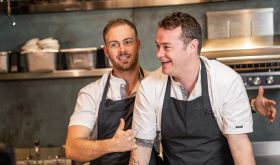
The restaurant’s name is derived from a combination of rempah, a spice paste that is the basis of many Peranakan dishes, and D’Silva’s reputation as the Papa of this style of cooking – a reputation earned over the many years he has spent behind the stoves in many different restaurants. But this opening sees him at his most relaxed. He was wearing a white jacket over jeans, and having his own place seems to allow him and his obviously talented brigade to cook to the best of their abilities.
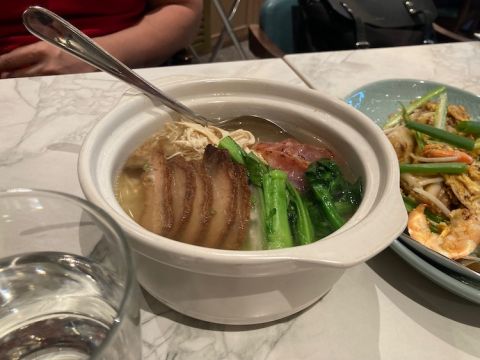
Here the menu is slightly more complex in the evenings, but even at lunchtime the flavours are complex and long lasting. There is a fish or chicken nasi lemak cooked for three hours in coconut milk enlivened with lime; seafood curry mee, a dish that first emerged at a Hokkien hawker stall in the 1920s and which D’Silva adapts, substituting for cloves and nutmeg his own curry powder; and a very personal interpretation of kai fan, the bowl of shredded chicken, char siew, bok choy and noodles shown above, which was wonderfully satisfying. The restaurant itself is light with indoor and outdoor seating in a mall within the Paya Lebar quarter and has notably friendly and attentive service. The prices are friendly too with most main courses around the SG$20 (£11/$15) mark.
Rempapa quietly conveys what has kept D’Silva at the stoves for so long: the determination to pass on the secrets of his style of cooking – cooking that combines Indian, Sri Lankan, Malay and Chinese influences – to the next generation of customers and cooks. I look forward to my next meal here.
Dinner
My enjoyment of the Peranakan style of cooking stems from its broad influences and the accomplishment of its practitioners with spicing. The pleasure I derive from eating Teochew (Chiuchow in Cantonese) cooking comes from an admiration of the chefs’ hard work and long hours that have to be spent at the stoves. While Peranakan cooking is rich and satisfying, Teochew cooking affects the mouth most of all. It is, by contrast, lip-smackingly good.
Again I am indebted to a Singaporean friend for his recommendation for our Teochew dinner for six at Cheng Hoo Thian restaurant, located on the ground floor of a public housing block an SG$18 taxi ride from the city centre. Because we had planned our trip some time in advance, my friend was able to suggest a menu and to have it agreed with Jimmy, the owner. Now in his seventies, Jimmy learnt many of the recipes from his father, who started this restaurant; on one of its walls there hangs a framed menu from 1930.
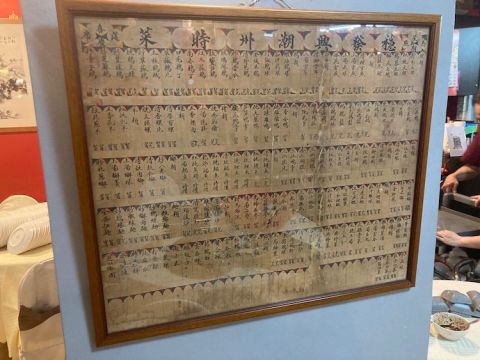
As we walked into this unglamorous, unlicensed restaurant, teeming with local families at 7 pm on a Sunday, I was extremely glad that we had taken this advice. The menus here seem not only extremely numerous but also complex. I managed to steal two of them. The first, headed Teochew classic fragrant porridge, comprises 16 different styles, from plain porridge with three preserved ‘tibits’ (sic) to goose-meat porridge via pomfret sliced porridge. Another menu lists their eight varieties of classic noodles on one side with 24 dishes on the other, headed simply ‘Good Taste’. They range from chilled pig’s trotter to a fresh-oyster omelette, a Teochew specialty (and also that of Singapore's first Master of Wine Tan Ying Hsien).
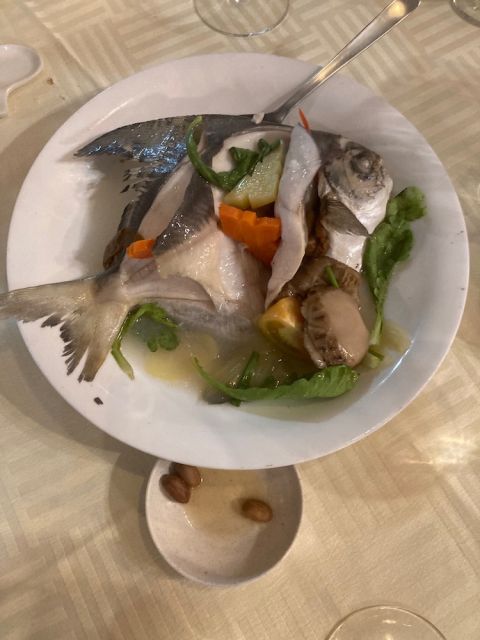
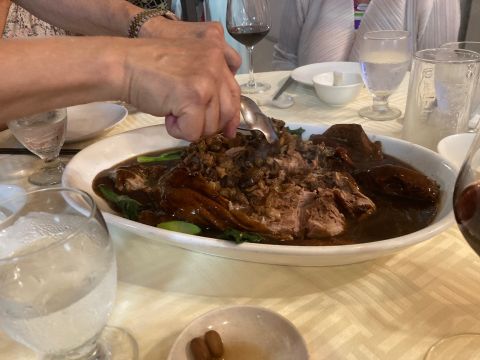
We began with an appetising combination of a dish of chilled jellyfish and numerous handfuls of Chinese peanuts boiled until they were soft, before moving to a delicious fresh-oyster omelette, followed by a pomfret poached in colourful vegetables (above). Then Jimmy arrived bearing the restaurant’s pièce de résistance, a whole spiced duck that had been stuffed with chestnuts and mushrooms and cooked for eight hours. Because of this, this bird fell into pieces under his expert hands wielding a fork and spoon, and we helped ourselves (the duck, from a particular farm in Malaysia, was truly exceptional).
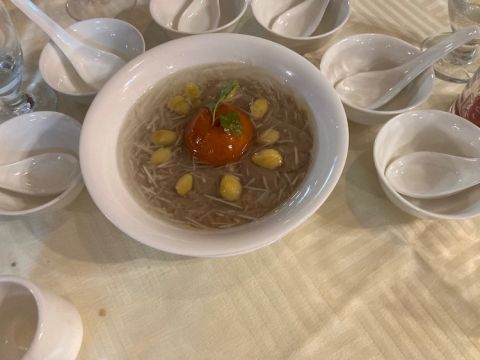
This was followed by an individual plate of crayfish mee pok in which the sweetness of the noodles matched that of the meat of the shellfish. Finally, came the restaurant’s signature dessert, a bowl of yam paste in the centre of which was a whole mandarin. This classic Teowchew dish takes seven days to make. It took Jimmy a full five minutes to mix it altogether and divide it into six bowls, and took us rather less time to polish it off.
I paid my bill of SG$466 (£262/$342) for the six of us without any wine (our local friend had delivered two and a half bottles for us in advance) and we went outside to wait for the taxi. It was to be our last night in Singapore and I think my stomach was quite relieved.