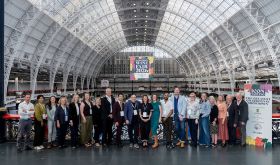
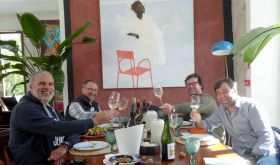
At lunch after last week’s particularly close-run Oxford v Cambridge wine tasting championship I found myself sitting between Patrice Noyelle, president of Pol Roger champagne and Aidan Craig, the captain of the Cambridge team who had notched up the highest personal score in this boozy annual prelude to the Boat Race.
Noyelle volunteered that he was as careful to avoid tasting wine on ‘root days’ as he was to make sure that he planted his carrots on them. Flower and fruit days are best for wine tasting, he assured me. (The day of the tasting competition was a leaf day.) Every day is designated either root, flower, fruit or leaf in Maria and Matthias K Thun’s Biodynamic Sowing and Planting Calendar, Calendrier des Semis in French (which can be ordered here), used principally to advise biodynamic farmers when to perform various operations according to the rhythms of the cosmos.
I knew all about this because the previous week I had witnessed much wringing of hands on the part of southern French wine broker Charles Blagden who was worried that the only day free in the London wine trade calendar for his first big trade tasting there was a root day. (He had been, like me, at the very disappointing tasting of 1998 Rhône wines on which I reported in feb 05 and believed the surliness of the reds was largely due to the fact that we were tasting on a root day.)
I then turned to my neighbour from Cambridge, a biophysicist who is just completing his PhD, and asked him what he thought of all this. “Complete rubbish,” he said, but checked himself. “That’s not quite true. There is a relationship between the lunar cycle and hormones, so anything hormone-related in plants such as auxins [growth regulators] in vines may well be affected, but not wines.”
Having just hosted a discussion on my website about how vignerons in Burgundy, including those as grand as Domaine de la Romanée Conti whose wines can sell for over a £1,000 a bottle even when babies, allow the phases of the moon to dictate when they bottle their wines, I was keen to find out more. Wasn’t there a connection between phases of the moon and atmospheric pressure so that it made sense to bottle unfiltered wines when the moon was new and the lees least troubled?
More rubbish according to my Cambridge neighbour (raised in Hawaii and educated in Berkeley, so probably exposed to more mumbo jumbo than most of us). The only proven, lunar-related nugget of advice he could offer me, I think, was to stay out of moonlight if I wanted to avoid cancer (its incidence being lowest in those parts of the world that are darkest at night). Bedroom curtain interlining already ordered.
But adherence to a cosmic calendar is increasingly common among even young turks throughout the wine world. Names as renowned as Araujo, Chapoutier, Faller, Gauby, Grgich, Huet, Lafon, Leflaive, Leroy, Palacios, Joseph Phelps, Quintessa, Selosse, Trapet and Zind Humbrecht are all committed biodynamic vine growers and I seem to hear of dozens of new converts all over the world each year.
Benjamin Leroux, the respected young winemaker at Domaine Comte Armand in Pommard which has been fully biodynamic for the last six years, says that the influence of the cosmic calendar on his wines, whether in barrel or bottle, may not be scientifically explicable but is obvious nevertheless. “I don’t just see it every month. I see it every day. The key is to work with these rhythms – not to put man in the centre of the universe. And it’s not just the moon but the weather. For two months after the big storm of December 1999, for instance, the wines in this region were simply untaste-able.”
It is certainly true that red burgundy seems the most susceptible to inexplicable variation in how it tastes. Different bottles of the same wine, even from the same case, can vary from surly to dazzling within days. Indeed there was much discussion among wine professionals during the second week of January this year when no fewer than 17 British wine merchants decided to organise tastings to show off their samples of the young 2004 burgundies in London. This provided us frequent chances to taste the same wine several times and many of us have since agreed that the wines were noticeably disappointing throughout Monday and early on Tuesday but seemed to perk up as the week went on. Surely this was the hand of nature as translated by the Thuns?
Not exactly, it would seem. According to the Thuns’ calendar, the curse of the root should technically have been observable only from 2pm on the Monday, when it took over from fruit, and then ruled all the way through the week until 9 am on the Thursday, after which we switched to flower then fruit. (Should you be interested, this weekend is fruit until 4pm on Sunday when root takes over.)
It’s hardly surprising that the general reaction to all this jiggery pokery is pretty sceptical. I wrote to Jeff Dawson, California’s leading consultant on biodynamic viticulture, to ask what sort of reaction he finds to his work there. His reply began, “I’ve just come in from an hour on my hands and knees picking the first of the season’s dandelion blossoms. These beautiful flowers mimic the sun in their shape and color. The flowers, when dry, will be wrapped in the mesentery of a female cow, harvested from the pastures of the Carneros district. This animal organ encloses the cow’s digestive system. Why the cow you may wonder? Cows are digestive animals, constantly grazing, and processing the green life which grows from earth. So we take this package of sun and light wrapped with this digestive sheath and place it into the belly of the earth for the winter. During this time of year the earth is actively decomposing all of that organic matter that has accumulated during the growing season. When this preparation is removed in the spring it has gone through a dramatic transformation, it now is a rich dark humus material.”
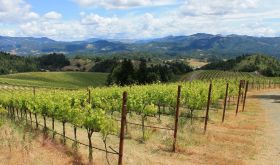
Hmm. Well I don’t begrudge him going to all this effort but it certainly isn’t immediately convincing. So what does he do when he encounters (as surely he does) sceptics? “All I have to do is bring them out to the Araujos’ vineyard. There they can see the health of the vines and the diversity of the site, not just a monoculture of vines but olives, fruit trees, insectaries, bee hives, wild life, creeks, forest. All of this adds up to a unique site that produces unique wines.”
And here we have the nub of it. In general, barring some biodynamic practitioners who just don’t seem very competent winemakers, wines made from biodynamically grown grapes do taste more intense, more energetic and more interesting than similar wines grown conventionally.
Aubert de Villaine, the scholarly co-owner of Domaine de la Romanée-Conti farms part of the domaine organically and part of it biodynamically. He has studied the results over many a year and reckons that there is no great advantage to the additional quasi-mysticism involved in biodynamic techniques. On the other hand a 10-year study in California, published in the December 2005 edition of the American Journal of Enology & Viticulture, compared the quality of similar grapes grown organically versus biodynamically and found that overall the latter are superior. How can this be – when even the most devoted converts to BD, as it is increasingly known, admit that they have no precise scientific explanation of the mechanism whereby biodynamics produces such good wine?
One theory is that people who go through all the hoops required to farm biodynamically (burying ground cow horn according the phases of the moon and all that) are just so committed to their crops that the extra care and knowledge of them is automatically transmuted into quality, whether critically influenced by exactly when that cowhorn was buried or not.
Benjamin Leroux, who goes the whole biodynamic hog, points out that it costs considerably less than conventional viticulture once it is established. But those who object to all this hocus pocus do so with a vengeance in my experience. They clearly see it as a threat to rationality, as it most certainly, and sometimes deliciously, is.