Much gnashing of teeth and wringing of hands followed, as you can imagine, and now the VDP hierarchy seems to have rethought its plans and admits the naturally fruity styles of wine for which the Mosel-Saar-Ruwer is so famous.
For the serious German wine geek, the relevant official announcement appears below.
VDP Growers on the Mosel, Saar and Ruwer Present a Regional Classification
Erste Lage reflects the Region’s Distinctive TerroirsWallhausen/Germany... 'The cornerstone for a classification on the Mosel, Saar and Ruwer has been laid,' announced Michael Prinz zu Salm-Salm, president of the VDP (Verband Deutscher Prädikatsweingüter, Association of German Prädikat Wine Estates), and Richard Löwenstein, spokesperson for the region's Comité Erste Lage, at a press conference during the ProWein trade fair in Düsseldorf in late March.
The regional classification embraces the same stringent production criteria – the wines originate from classified, narrowly demarcated top sites, yields are restricted to a maximum of 50 hl/ha, the grapes must be at least ripe enough to qualify as Spätlese, etc, – outlined in the classification pyramid in the VDP Accord of 2002.
With regard to wine style, the Erste Lage concept (comparable to Grand Crus in France) takes into account the distinctive terroirs of the Mosel, Saar and Ruwer. Just as the classification in St-Emilion varies from that of Medoc, regional differences in Germany necessitate that classification be open to various interpretations. Nevertheless, all regions that are participating in the classification system will use a common logo to identify wines from the peak of the quality pyramid. Given the region's traditional wine style, the classifying estates on the Mosel, Saar and Ruwer have agreed that their wines labelled Erste Lage will comprise a whole spectrum of fascinating interpretations of terroir: full-bodied, dry QbA; light, subtle Kabinett; elegant, fruity Spätlese; and complex, lusciously sweet Auslese wines. As such, these estates are assigning clear taste profiles to the individual quality categories. According to Salm, 'We are convinced that the wine connoisseur who seeks and loves these highly regarded wines will be willing to understand and appreciate the philosophy behind the Erste Lage concept. The rare, classified growths are the highest refinement of taste.' In conclusion, he added (quoting the futurologist Matthias Horx): 'Tracing a wine back to its origin is a luxury that requires a considerable quantity of the most limited resources available in today’s information society: time and sensitivity.'
Declaration of the Comité Erste Lage Mosel-Saar-Ruwer on Classification
In times in which the focus of wine production has increasingly shifted to the cellar, in which the vineyards have mutated into agricultural surfaces capable of generating Oechsle degrees, and in which clever cellar techniques produce, at will, wines with taste profiles tailored to the market, it’s high time to turn our thoughts to terroir...
- to acknowledge that wine is the expression of the interplay that has historically evolved between man, grape and vineyard
- to focus consciously on the roots of European wine culture
- to pay homage to the Riesling grape for its ability to transform magically the individual character of a specific vineyard into a unique, authentic taste experience.
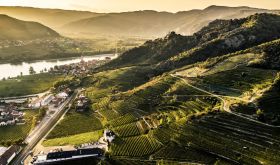
The criteria for wines from a classified site and from an Erste Lage reflect the characteristics of the terroirs on the Mosel, Saar and Ruwer. Based on the vineyard classification initiated by Napoleon, only the very finest steep sites – about four percent of the VDP-owned sites in the region – have been included in the circle of 'classified sites'. Wines from classified sites are made exclusively from the Riesling grape, are harvested by hand, and cannot exceed a yield of 65 hl/ha. As of 2004, all other wines will be marketed as Guts- and Ortsweine (house wines). Wines bearing the designation Erste Lage represent the peak of the quality pyramid. They originate from the very finest, narrowly demarcated, classified top sites (or parcels thereof) – about two per cent of the region's vineyard area. The grapes must be at least ripe enough to qualify as Spätlese and are restricted to a maximum yield of 50 hl/ha. The diverse slate formations and microclimates of these world-renowned top sites comprise a whole spectrum of fascinating interpretations of terroir: full-bodied, dry QbA; light, subtle Kabinett; elegant, fruity Spätlese; and complex, lusciously sweet Auslese wines.
Mosel-Saar-Ruwer, 24 March 2003
For additional information, please do not hesitate to contact:
VDP Die Prädikatsweingüter, Press and Public Relations
Mrs Hilke Nagel, Gebr-Baruch-Str. 46, 55543 Bad Kreuznach, Germany
tel +49 (0)671 8959252, fax +49 (0)671 8959251, email [email protected]