
No sooner had our party of six been seated for Sunday brunch at Red Rooster, which chef Marcus Samuelsson opened last December on Lenox Avenue, Harlem, than the hand of history, to which this restaurant is so conspicuously linked, intervened.
It was 11.10 and our pert waitress wanted to know whether we would like a drink before ordering our food. 'Two Bloody Marys and a beer' was the innocent response but one that promptly wiped the smile off her face. Here, as in every restaurant in New York State, no alcohol may be served on a Sunday before midday, a hangover of the 'blue laws' introduced many years ago.
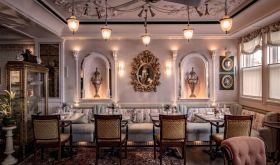
Samuelsson intends that the three interlinked parts of Red Rooster restore the glory days of this much-neglected borough. At the front there are communal high tables, and a large curved bar, 'the watering hole' as he called it; downstairs is for music, a speakeasy for the 21st century; and behind the bar is the aesthetically appealing restaurant.
While the open fire behind the chefs acts as a magnet for the eyes and the stomach, a great deal of attention has gone into the art on the walls, which includes work by leading black artists, hurricane lamps, pots of peanuts in their shells, and black and white photos of women in church. The lavatories are intriguingly bedecked with unframed household photos of Samuelsson's own family's journey from Ethiopia to Sweden and, finally, to the US.
I took all this in as our table filled up with food, and was also intrigued by an attractive young woman in a tight purple dress standing right next to our table – for professional reasons, of course.
I had to concentrate hard on what was being laid out in front of six hungry eaters. There was a bubbling macaroni cheese with a salad of brussel sprout tops; pecan waffles; lamb hash; baked eggs; red grits with shrimps; chicken nuggets with maple toast; and fried 'yard bird', or chicken, which the friend who had ordered it passed round only with extreme reluctance.
All the food was nourishing, clean and fresh, the equivalent of eating in someone's home in the South. Including our drinks, which arrived on the stroke of midday, the bill came to US$170.
Meanwhile the young woman next to me, joined by a fellow singer and a backing musician, had opened her set with 'Somewhere over the Rainbow' and then moved on to some gospel songs. There was a queue at the reception desk and Red Rooster was humming. 
It was much quieter at 10 am two days later when I returned. Samuelsson walked in wearing a red cardigan, red trainers and a Red Rooster cap that will soon be on sale from the store by the front door that will also retail biscuits, grits and coffee. A cup of tea in his hand, a brief chat about English football out of the way (he is currently an Arsenal supporter) and the story of the Red Rooster's long gestation was under way.
The story reflects not only Samuelsson's ethnic background but also his career since opening the original Aquavit in mid-town New York 15 years ago. Now 40, Samuelsson has tasted professional success and adversity and during that process has come to appreciate just what an influential role busy restaurants can play in generating jobs and fostering skills.
'I had seen how Brooklyn had been transformed by the opening of so many cafés and restaurants and the farmers markets and the small companies needed to supply them. I wanted to do the same for Harlem, so the first step, three years ago, was to move up here from Central Park with my family', he explained.
And as he got to know Harlem, he realised that his new restaurant had to be on Lenox Avenue. 'This is the broadest street here and the address to which all the leading blacks over the years, from Joe Louis to Martin Luther King and our current President, who hosted a Democratic Party fund raiser here last week, come to be acknowledged. It had to be here.'
While the architecture of the street, the brownstones and the proliferation of churches nearby have inspired its interior, Samuelsson described his menu as the equivalent of a 'bike ride' through the different communities that constitute Harlem past and present.
'From east to west, there are Mexican and Dominican communities, Afro-Caribbean, Jamaican, Jewish and Italian enclaves as well as the students and professors at Columbia. Then there's the comfort food that immigrants have always brought with them. We'll never lack for culinary inspiration round here', he added with relish.
As the intended engine of change, Red Rooster has already had a significant impact, creating 85 new jobs, 55 of those for residents of Harlem and many for those who had until then eaten only in the self-service cafeterias still so common in this part of town.
But on Red Rooster's second day, Samuelsson realised that he had allowed himself to be lulled into a major tactical mistake. 'The place was full, but only with those who had made reservations. There was no place for anybody from around here who wanted to call in, have a drink and wait for a table. We were in Harlem but not of Harlem.'
Samuelsson promptly changed their booking policy, allowing only half the available tables to be reserved in advance, the rest to be available for those who call in – and no reservations at all are taken for weekend brunch, which now starts at 10.
As we left at 12.45, a man was walking out disconsolately reporting to his wife on the pavement outside that they would have to wait an hour for their table. But the solution to this obvious pent-up demand for great food in Harlem is also part of Samuelsson's vision. 'What I hope for above all is that in five years this street will have become Restaurant Row', he explained, 'full of places opened by young blacks who started out here at Red Rooster'.