
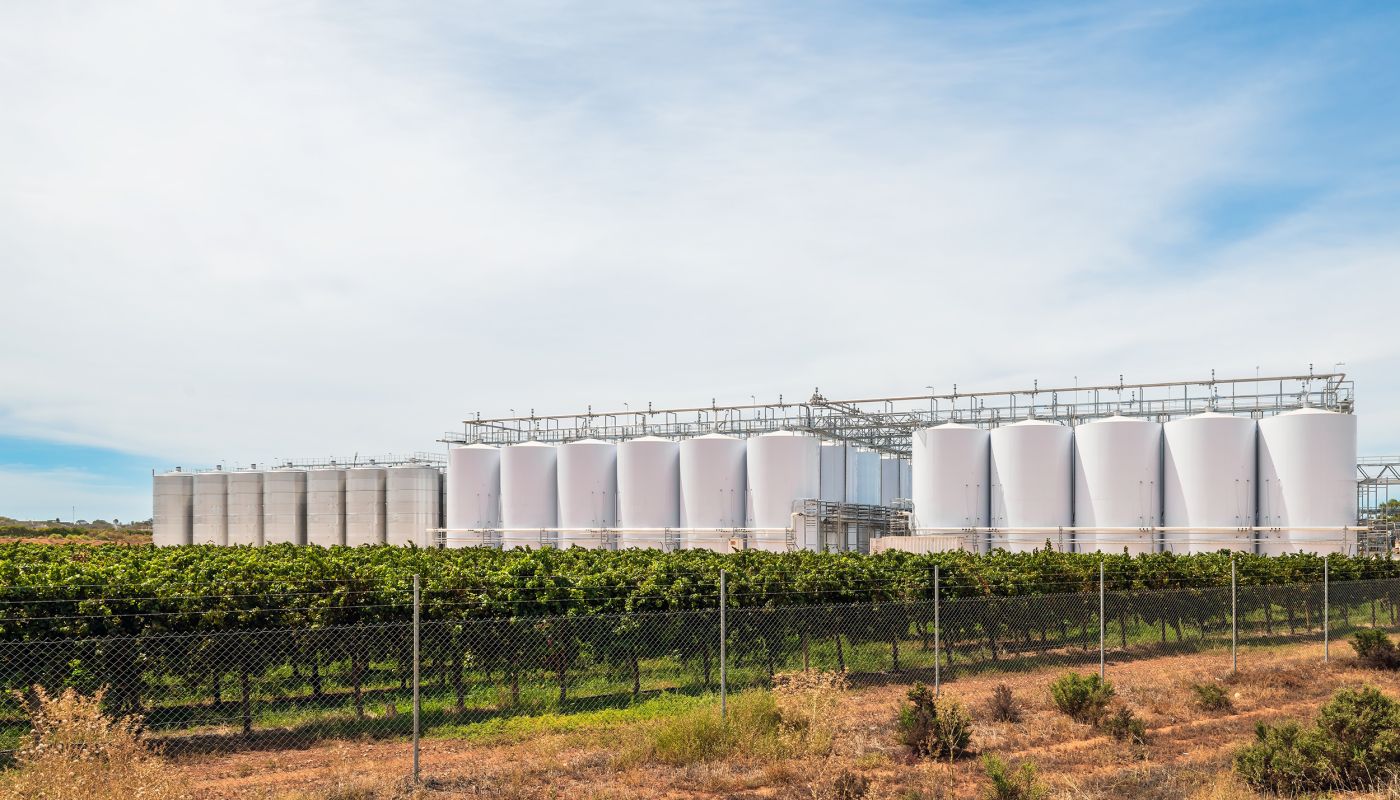
Reading about the current whisky loch set me thinking about the glut of another alcoholic drink, my favourite one, wine.
The distillers may be having to build new warehouses to mature their excess stock in but that’s not an option for the great majority of wine produced today which is designed to be drunk within a year. Moreover, while Jim Beam can simply choose to close down its much-advertised production base in Kentucky for at least this calendar year, just as any distiller or brewer can simply pause production, no such option is available to wine producers. Vine growers are presented with a crop every autumn or, increasingly, late summer.
Grapes are currently ripening relentlessly in the southern hemisphere, but what will happen to them? The generic body Wine Australia admits that producers there have nearly twice as much wine in stock as they can reasonably expect to sell, and sales are in decline pretty much everywhere, even in Australia itself. Tanks full of wine, and a relatively generous 2025 grape crop, have led to widespread cancellation of grape contracts and a substantial proportion of grapes are expected to be left on the vine yet again this year.
Along with the most beleaguered wine districts of Bordeaux and the southern Rhône (whose wines can be found retailing in France for less than €2 a bottle), the irrigated inland wine regions that supply 70% of all Australian wine are some of the world’s most obvious casualties of shrinking global demand for wine. To add insult to injury, irrigation water has recently become much more expensive, and growers there feel particularly sore when they read of government-provided financial compensation to French vignerons who pull out vines.
Things are not helped by the fact that Australian wine production is dominated by two large, globally spread companies that would have been expected to absorb much of the surplus wine had their prospects been brighter. Treasury Wine Estates owns brands such as Penfolds and Wynns in Australia, and a slew of California wine brands, some acquired relatively recently. It warned investors that profits in the second half of last year would be considerably less than expected because of the weakness of its two biggest export markets, the US and China. The other large Australian wine group, whose name was recently changed from Accolade to Vinarchy and whose answer to TWE’s Penfolds is Hardy’s, took on Pernod Ricard’s brands when the French drinks group gave up on wine in 2024. It is currently pinning its hopes on a revival of the likes of Jacobs Creek of Australia and Campo Viejo of Spain.
(Power in Australian wine retail is also dangerously concentrated in the hands of two groups, Coles and Endeavour.)
It was powerful red wine, especially Shiraz, that led Australian wine’s export boom at the end of the last century and is by far the chief product of the country’s most challenged wine regions. But global tastes are moving towards white wine and lighter, fresher reds.
Kim Chalmers of Chalmers Nursery, the leading supplier of grapevines to the Australian wine industry, is based in inland Mildura, whose biggest winery by far, Karadoc, which once had 400 employees, was shut down by Treasury Wine Estates in 2024. She reports that growers there ‘are busy grafting-over or replanting to whites, although the swing has been hard and, like all reactionary permanent-planting changes in agriculture, we could see the pendulum go too far. Spot market pricing for white grapes in vintage 2026 is already lower and industry bodies have started calling it an over-correction.’
Even New Zealand, for long one bright spot as a wine exporter with relatively high prices and a predominance of white Sauvignon Blanc, is currently suffering a glut.
It’s commonly believed in wine circles that the global downturn in consumption may not be disastrous overall because it will mean that consumers will drink less but better. I, too, expected wine to be seen increasingly as an occasional luxury with mid-priced wines prospering and that the most obvious casualties would be the sort of inexpensive brands that languish on the bottom shelf of supermarkets.
However, when I asked Walter and Ferran about the current situation in Italy and Spain, the world’s first- and third-biggest wine producers respectively, the results were surprising. Each of them, separately, reported that those regions which are suffering least are those that sell wine in bulk, the cheapest sort of wine available. In Italy there’s reluctance to lose face by admitting to personal difficulties but most regions report cellars full of unsold wine. And according to Walter’s UK-based Italian wine-broker informant, the only wines that are doing well are those that are being sold to the trade for €2 or less a bottle.
Unlike the Italians, Spanish wine producers are swamped by efficiently collected statistics on sales volumes and prices for each region. According to the most recent figures, for the first nine months of 2025, the extensive Rioja region, heavily dependent on red wine and currently celebrating the centenary of its becoming Spain’s first official appellation in 1925, is under real pressure with the volume of exports down by 18.5%. Sparkling white Cava may dominate wine production in Catalunya but its sales have slumped even more. The only Spanish wine regions registering growth are Valencia and Castilla-La Mancha, the latter being one of the world’s major suppliers of bulk wine (and grape concentrate), at an average of less than €0.5 a litre. Germany and France are the two biggest buyers, much to the dismay of the Languedoc’s militant vignerons over the Pyrenees.
Ciatti, headquartered just south of Sonoma in California and with branches in 10 of the world’s biggest wine-producing countries, is the world’s leading bulk-wine broker but even it reports that its customers are ordering smaller volumes than ever.
Fortunately for Australia, this year’s harvest is not looking like a bumper crop and it won’t be as hot and rushed as last year. Ciatti partner and president Greg Levengood expects the total 2026 southern-hemisphere grape harvest that will be picked in the next few months to be very slightly smaller than in 2025, helped by a considerable reduction in Chile’s productive vineyard area. South Africa’s wine production is more or less in balance but Argentina, like Australia and New Zealand, is already oversupplied with bulk wine and he is advising stockholders to try to sell, ‘even at less-than-ideal pricing’.
We can expect to see white and pink southern-hemisphere 2026s on our shelves in the next few months from producers desperate for cash flow, but presumably the wine trade’s professional wine buyers can more or less dictate prices.
Back to basics
Vintage variation and reputation |
|
Much more than other alcoholic drinks, wine is crucially affected by each year’s weather – not just in terms of the quantity produced but also its quality. Vintages really do matter, even – and increasingly – in warmer wine regions. In cooler times we thought that all that was needed for a good vintage was sufficient heat, light and water to ripen the grapes fully, but now that we’re experiencing far more hot, dry summers, the heat can be overdone and the fruit can lose the acidity and freshness that’s essential for a really appetising drink.
However the climate is not just warming up, it’s becoming far more extreme and unpredictable. Wildfires (currently raging in South Africa and Australia), floods, hail, crop-reducing frost and severe heatwaves are all becoming more common. But some years, and in some regions, there are still summers that are so cool and/or wet that grapes struggle to ripen. The vine is so prone to fungal diseases that wet weather can lead to mildew and rot that can ruin a crop, or certainly a vintage’s reputation, and require the almost uneconomic rejection of unhealthy grapes.
It’s clear that vintages can vary enormously, and tend to have their reputations made early on, largely as a result of the weather during the growing season. But this can be unfair. The burgundy 2024s currently being offered, for instance (about which I will write next week), are the product of a seriously trying cool, wet growing season. As in 2021 in the region, it was a real struggle to end up with ripe, healthy grapes and vintage reports of rampant and persistent mildew have tended to colour perceptions of the vintage. But there are some creditable wines from each of these two years – just not for long-term cellaring.
Good producers can be relied upon to make good wines, no matter what the growing season and harvest conditions. Many of them relish expressing vintage variation as much as terroir. I recommend some stunning wines from vintages with less-than-stellar reputations below. |
Fine wines from lesser vintages
(If you’re looking for wines that are considerably cheaper than these, see my October 2025 collection of Wines under a tenner.)
Whites
Montecillo, Viña Monty Reserva 2018 Rioja 13%
£40 Waitrose Cellar (20% off any three-bottle purchases until 27 January)
M Chapoutier, Lieu Dit Fels Riesling 2021 Alsace 13%
£47.80 Millesima UK
Reds
La Rioja Alta, The Society’s Exhibition Reserva 2020 Rioja 14%
£17 The Wine Society
Ch de Pez 2021 St-Estèphe 13%
£22.80 Four Walls, £37.20 Millesima UK
Dom des Hauts Chassis, Les Galets 2021 Crozes-Hermitage 13%
£26.75 Corney & Barrow
Bodega Lanzaga, Lanzaga 2017 Rioja 14%
£28.92 Lay & Wheeler
Cigliano di Sopra 2023 Chianti Classico 13%
£29.75 reduced from £35 Swig
Ch Gloria 2017 St-Julien 13.5%
£43.20 Four Walls
Petrolo, Bòggina A 2017 Valdarno di Sopra 13%
£51.59 Lay & Wheeler
Arnaud Mortet, Ma Cuvée 2021 Gevrey-Chambertin 13%
£102.16 IDealWine
Vieux Château Certan 2017 Pomerol 14.5%
£166.45 Lay & Wheeler, £213.20 Corney & Barrow
Image by myphotobank.com.au on Shutterstock.
For tasting notes, scores and suggested drinking dates see our vast tasting notes database. For international stockists, see Wine-Searcher.com.













