The devastating wildfires that have swept across the province of Ávila have left one of Spain’s most distinctive mountain wine regions facing an uncertain future. The fires, which investigators say were sparked by illegally operated heavy machinery during a period of extreme fire risk, spread rapidly through the Alberche Valley and the foothills of the Sierra de Gredos. Authorities estimate that around 50,000 ha (124,000 acres) have been affected, making it one of the largest wildfires in Spain’s recent history.
While the destruction of forests has dominated the headlines, concern is now turning to the vineyards of DOP Cebreros, where prolonged exposure to smoke and ash could have serious consequences for the 2026 vintage.
For now, however, the denomination is refusing to speculate.
‘At the moment we cannot make any official assessment’, says Marta Burgos, technical director of DOP Cebreros. ‘Many of the villages remain evacuated, and we still cannot access the vineyards because the ground is too hot.’
According to Burgos, the inability to inspect individual parcels means that any estimate of direct vineyard losses would be premature. ‘At the vineyard level, we simply don’t know yet what has happened parcel by parcel.’
Beyond the flames themselves, another concern looms over the region. ‘The other major problem is the number of days we’ve had smoke and ash hanging over the vineyards.’
The outlook for the appellation’s celebrated old-vine Garnacha is uncertain. ‘The entire Alberche Valley, and even the Tiétar area, has been covered by smoke and ash.’
Although the denomination has not yet confirmed the extent of smoke taint, Burgos acknowledges that previous experience and scientific research leave little room for optimism. ‘Based on our experience from previous fires and on the scientific studies available, prolonged smoke exposure could result in smoke taint. Unfortunately, we may not know the full extent of its impact until the wines are made and evaluated over the coming years.’
The environmental impact extends far beyond the vineyards. ‘Practically all the Sierra de Gredos mountain range that crosses our territory has burned.’
Even assessing the damage has proved impossible. ‘Between the smoke and the emergency restrictions, it has been impossible to see the full extent of the damage.’
For the time being, DOP Cebreros is waiting until authorities declare the area safe before issuing official figures. ‘As soon as we can provide official information, we will’, Burgos says. ‘Unfortunately, at the moment, things do not look encouraging.’
Vineyards as natural firebreaks
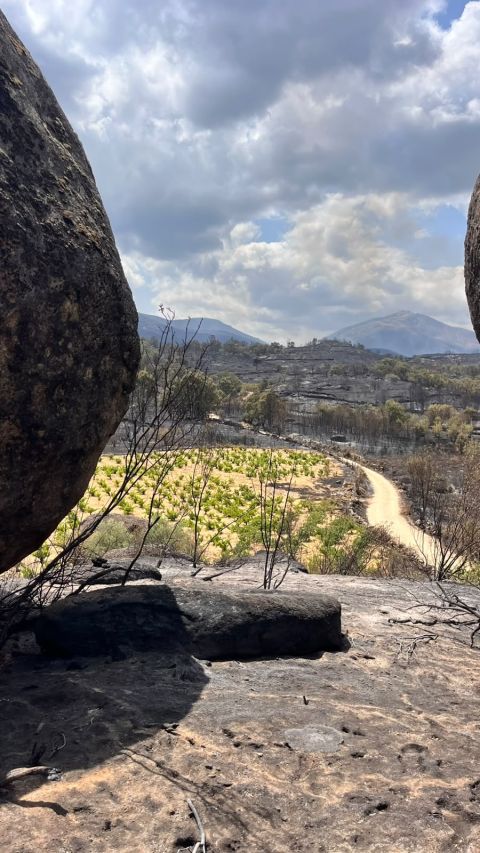
One striking image from the aftermath of the fire comes from Rico Nuevo, where a vineyard remains green while virtually everything around it has burned.
The scene illustrates a phenomenon well known to wildfire specialists: vineyards can act as effective firebreaks. Unlike dense forests or scrubland, vineyards contain relatively little combustible material. The rows of vines are separated by bare soil or cultivated ground, the canopy retains more moisture than surrounding vegetation during much of the growing season, and regular vineyard management removes much of the dry biomass that would otherwise fuel a fire.
Juanan Martín, founder and winemaker at Rico Nuevo, reports that, ‘practically all of our vineyards have survived’. Nonetheless, while the vineyards appear to have escaped the flames, the wider landscape has been profoundly altered, and the emotional toll on the local community remains immense.
Top chef’s immediate response
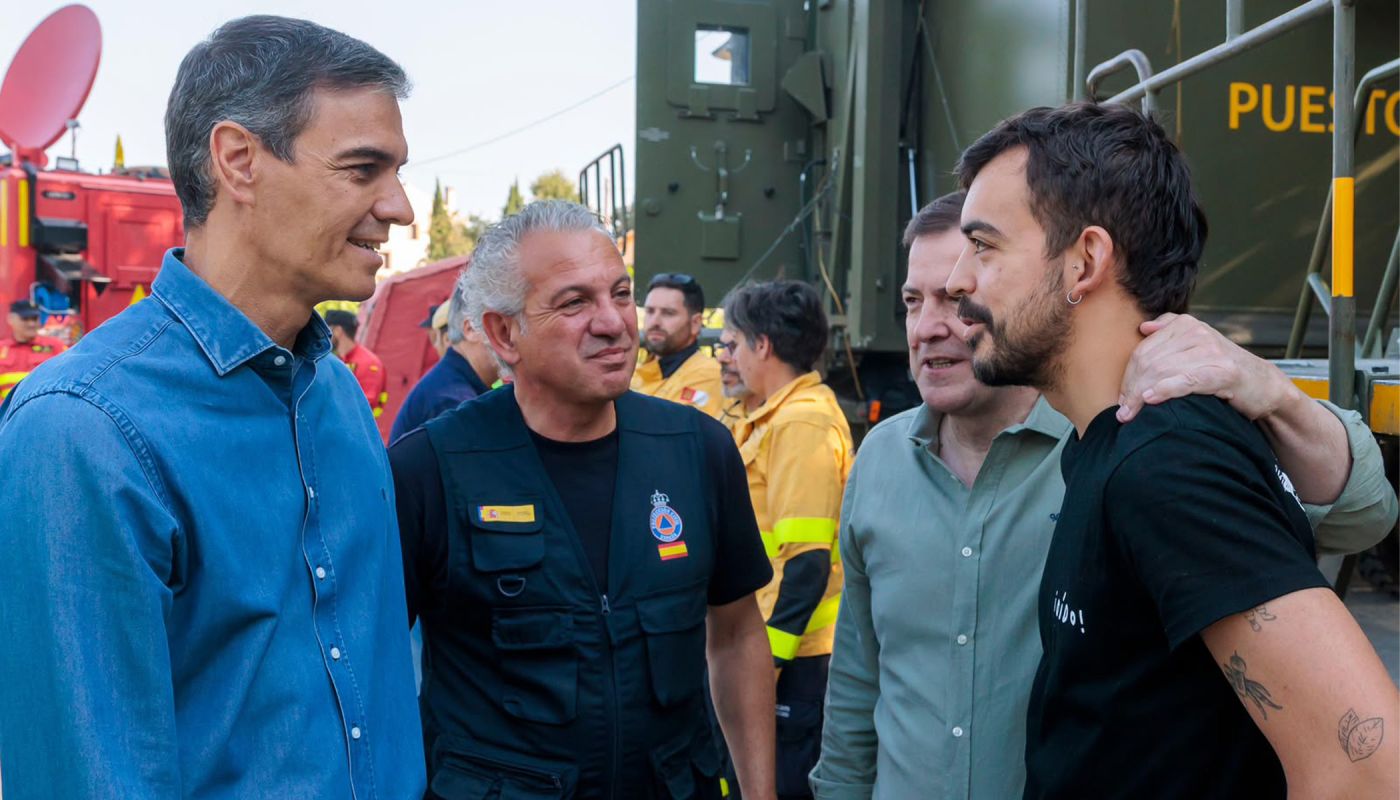
As firefighters battled the blaze, one of the region’s best-known chefs mobilised almost immediately to help those affected.
Carlos Casillas, whose restaurant Barro recently earned a Michelin star and who is also widely recognised for his passion for wine, great wine list and his close ties to the vineyards of Cebreros, realised the scale of the disaster as he finished lunch service and saw the enormous column of smoke rising above the Sierra de Gredos.
He immediately contacted World Central Kitchen (WCK), an international organisation providing meals on the frontlines of communities in crisis. Together with WCK and a network of volunteers, his restaurant has since helped prepare and distribute nearly 18,000 meals to firefighters, emergency crews, evacuated residents and others affected by the disaster.
His rapid response has become one of the most visible examples of solidarity in a region now facing not only the immediate aftermath of the fire but also the uncertainty surrounding one of its most important agricultural products: wine.
These have been incredibly difficult days for everyone in the Sierra de Gredos. My thoughts are with the winegrowers, their families, the local communities, the firefighters, the volunteers and everyone who has worked tirelessly to protect this extraordinary landscape. I sincerely hope the region can recover as quickly as possible from such a devastating tragedy.