It was inevitable that the 2001 vintage would be overlooked, occluded by the long shadow of the millennium vintage, which, against the odds, turned out to be so successful. It was not inevitable that 2001 would continue to be overlooked. However, the exceptional nature of the 2003 heatwave vintage and the 2005 vintage, whose perfect natural conditions coincided with the arrival of so many new, well-heeled investors in the market, ensured that prices for the 2003s, then 2005s, reached new levels, leaving vintages 2001, 2002 and 2004 looking, relatively, modestly priced.
The 2004s are just being delivered and are too young to consider drinking, especially since their tannins are still pretty obvious. The 2002s are generally a little cheaper than the 2001s currently, and for the good reason that in most cases they taste considerably more angular and their fruit is a little less vivid. But while the best 2000s, 2003s and 2005s nowadays seem for most of us too expensive to even consider drinking, there are some very delicious 2001s which can be bought for well under £25 a bottle, which, alas, counts as good value nowadays. Furthermore, the 2001s are just approaching drinkability at petit château level. And even the most serious wines show every sign of being ready to open within the next five years – less in the case of a dazzling but already quite broachable Lafite. This is not a vintage for the very long term.
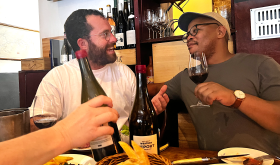
It was fascinating therefore to look at 150 of the finest 2001 red bordeaux recently in single blind conditions. This meant that the wines were divided into 15 flights, from simple Médoc to leading right bank properties, over two days, and we knew which wines were in each group but within that group they had been sorted at random. None of us tasters assembled at Farr Vintners in London earlier this month – wine merchants, fine wine traders and wine writers, including James Suckling (far right) from the Wine Spectator, Neal Martin from The Wine Advocate (far left) and Steven Spurrier from Decanter – knew which wine was which.

Overall the vintage is very nicely balanced, quite classical claret but the tasting showed just how patchy it was geographically. The single most successful and consistent appellation was Pomerol, where the wines are beautifully plump and mouth-filling, yet have attractive freshness and a good framework for future development. Wines from the neighbouring right bank appellation Saint-Emilion on the other hand were, as usual, all over the place both stylistically and qualitatively. Clearly it would seem that the late September rains affected the Merlot grape that dominates Pomerol much less than they did the later-ripening Cabernet Franc of Saint-Emilion (and Cabernet Sauvignon of the Médoc and Graves). The two flights of lesser and mid-priced Saint-Emilions had the highest number of really unpleasant wines: heavy, oaky, evolved, tortured wines that tasted highly confected. We had to wait for the top Saint-Emilions before the wines had sufficient fruit to bear the weight of all this activity in the cellar – or perhaps before the owners had sufficient confidence in their terroir not to attempt to add too much make-up. The Saint-Emilions might have been more advanced in general than their left bank counterparts but not often attractively so.
Similarly on the left bank of the Gironde, the rather lighter soils of Margaux and the tendency to pick earlier there than further north seemed to suggest that Margaux had avoided the worst of the rain damage. For once this southern Médoc appellation seemed more successful, often showing Margaux’s lovely fragrance and silkiness, than Saint-Julien which is usually so reliable. This was not a vintage in which big, concentrated, origin-obliterating wines could be made in any case. The Margaux wines seemed to have much more freshness as well as perfume, even if they tended to be at very different stages of maturity.
Tasting the chunky, sometimes obdurate wines of Saint-Estèphe immediately after the lovely Margaux wines was quite a shock. The famous names did not show especially well and, not for the first time, there was much discussion about whether some bottles of surprisingly under-performing wines were in good condition. Overall of the 149 wines tasted, group marks (out of 20) were not recorded for Clos Badon and Chx La Gaffelière, Beau Séjour Bécot, Tertre Roteboeuf, Feytit Clinet, Clinet, La Bernadotte, Léoville Poyferré and Branaire Ducru - a rather shocking failure rate, if that is really what it was, of six per cent.
In Pauillac below first growth level, between Saint-Estèphe and Saint-Julien both geographically and in terms of style, there were some very impressive wines that will make lovely drinking, without necessarily costing a bomb.
The wines of Pessac-Léognan, the finest terroirs of the Graves region south of Bordeaux itself, were quite consistently true to their origins, not blockbusters but very pretty, aromatic wines, most of which are already starting to drink well. Wines with the simple Médoc appellation were mainly just too light to counterbalance the marked acidity and slight greenness.
The single most common failing throughout the tasting was a certain under-ripeness of phenolics, especially tannins and especially in the later ripening Cabernet Sauvignons. That the left bank first growths tasted as well as they did must have been due to particularly strict selections – but it has to be said that, Latour 2001, for example, when tasted alongside its immediate predecessor and successor, is trumped by the 2000 – it doesn’t have the opulence – even if it is much more flattering, polished and fun to taste than the 2002.
As for individual wines, the Dutch Jelgersma family, who have taken over and renovated Chx Giscours and du Tertre in Margaux so effectively, clearly have a magic Jancis-attractor ingredient for, tasting them blind in two different flights, I found myself awarding both these wines top marks. The Tesseron family who own both Lafon Rochet in Saint-Estèphe and Pontet-Canet in Pauillac clearly have access to that magic ingredient too as I marked both these wines top of their respective flights (which in the case of Pauillac omitted the first growths. which were corralled into a special top left bank flight of their own).
Pomerol-based oenologist Michel Rolland seems to have made a particular success of this less opulent vintage, having a hand in many of the most successful wines – although it should be said that he has a hand in a great number of wines period, especially on the right bank. Perhaps the biggest shock of the tasting for some was that the highest average mark of the group was awarded to the very luscious Ch Pavie 2001. I gave it 17.5, a full point ahead of my already quite favourable assessment of it en primeur (much better balanced than the controversial 2003).
My top wines are listed below, along with some of the best buys according to my marks out of 20.
For full tasting notes, scores and suggested drinking dates on all these 2001s, see the tasting notes.
MY TOP WINES
with my score out of 20 in brackets
Lafite (18.5)
Haut-Brion (18)
Eglise Clinet (18)
Latour (18)
Margaux (18)
Le Pin (18)
Pontet Canet (18)
BEST BUYS
in approximately declining order of price
Haut Bergey (17)
Batailley 2001 (15.5)
Haut Bages Averous (16.5)
Gloria (15.5)
Haut Bages Libéral (15.5-)
Chasse Spleen (15)
Fiefs de Lagrange 2001 (15) (see wine of last week)