
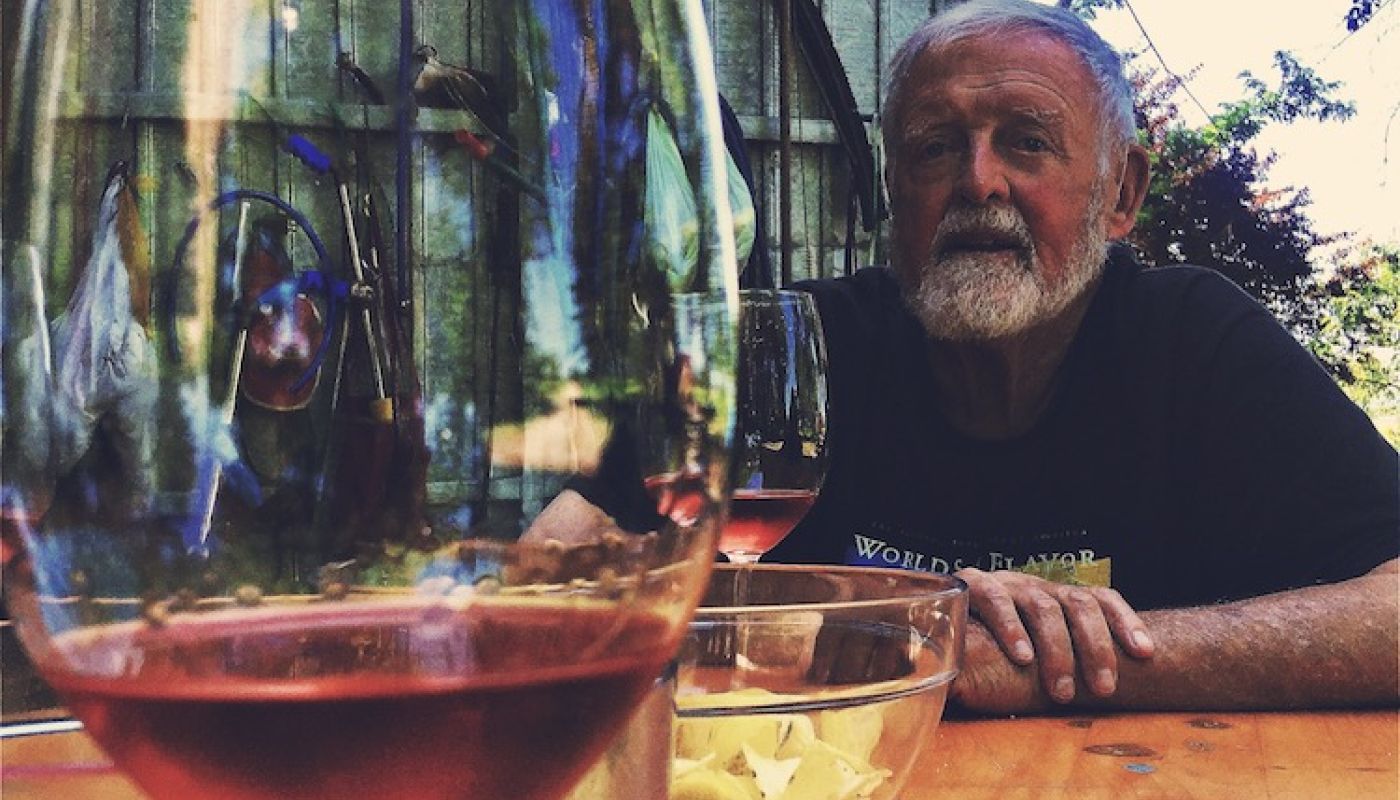
Observing and reporting on Italian wine for over 50 years and well before the country had a wine law or a DOC system is something very few people in the world can lay claim to. At 80 years of age, Burton Anderson can. He has written numerous books and articles on Italian wine and even one on Italian cooking (Treasures of the Italian Table, which won a James Beard Award in 1995), but I think his magnum opus is The Wine Atlas of Italy published in 1990, the only work of its kind ever to have been published, although Anderson himself disagrees. He calls it a work in progress, half done, 'thrown together in 18 months', and which never saw an updated version.
The atlas, with which few readers will be familiar, gave Italy deserved gravitas and, above all, a sense of origin, with 57 maps covering all Italian regions, most of them produced from scratch by Anderson himself, simply because at the time there were hardly any. The work, already extraordinary because of this, is even more exceptional because of the travel information, including restaurants, hotels, wine shops and local sights at the end of each chapter, long before enotourism even existed as a concept.
'Food and wine go together and [so food] had a place in the atlas too, but Mitchell Beazley [the publisher] had difficulty in putting the two together', is how Anderson explained, when I visited him last February at his home on a hillside in the Alta Maremma, why a second edition never materialised. The house, which he shares with his wife Nancy and dog Philo, has gorgeous views of the Maremma landscape with vineyards and olive groves descending to the Mediterranean in the distance.
'I recount all of this in my unpublished book The Good, The Bad and The Bubbly', he told me. Having read the first proof, I think a more appropriate title would be No Compromise – 50 Years Living Italian Wine. It is a take-no-prisoners kind of book, a cross between an autobiography and a chronicle documenting and commenting on Italy's wine history from the 1950s onwards. While being critical in content it is also a declaration of love for all things Italian, its people, its cuisine and its wines.
American by birth, Anderson came to Europe straight after he had finished his BA in journalism. He applied for a job at the Rome Daily American which he got and he settled in Rome in 1962. This dolce vita lasted until 1968. Anderson rarely touches upon his private life in his unpublished book, so I asked Nancy, who during my visit cooked a fantastic lunch on a wooden stove, how they had met.
Late in the 1960s, a few years after Anderson had moved to Italy, Nancy was on a European trip with a friend and duly arrived in Rome. Her friend was meeting a journalist there in whom she was 'interested'. One evening she came back to the hotel while Nancy was already in bed. 'Get dressed', she said, 'we are going out', Nancy recalled. Her friend's love interest had organised a companion for her as a date. It turned out to be Anderson. After a week of what might well have been one of the shortest courtships in history, Anderson said to her: 'quit your job and come live here in Europe with me', and she did.
In 1968 Anderson was offered the position of news editor at The International Herald Tribune (now The International New York Times), for which he and Nancy moved to Paris. The ties with Italy weren't loosened because in 1969 they bought a derelict farmhouse in Tuscany near Cortona, which over the following years served as a family holiday home.
In 1971 Anderson wrote his first article on Biondi Santi for The International Herald Tribune. According to Anderson, it was also the very first English article on Montalcino ever to be published. 'At that point, in the 1970s, Italian wine was considered inferior to French and just about everything else', Anderson told me. 'It was a challenge but inspired me to go ahead. I tasted a lot in cellars, not just from bottle, and I knew Italy was full of great wines. The potential was there. I had been living in France for nine years and people asked: '’Why don't you write about French wines?’', but I was already totally converted. I wanted to write about Italian wines. I did it on a gut feeling, because in trattorie there was mostly sfuso [unbottled], but enotecas like Trimani [a historic Roman institution] were great reference points.'
During his time in Paris, Anderson remembered drinking mostly cru beaujolais 'and when I could afford it, a good burgundy'. Luckily he knew Steven Spurrier of Les Caves de la Madeleine, who gave him good deals on bordeaux. 'They were bargains, but I remember the drop in quality from the top level to even just the level right underneath. And Rhônes were considered bargain wines as well – solid, without the prestige they have now. In those days they were sources of easy, inexpensive wines. The same for Alsace.'
The first book Anderson wrote was called Vino, published in 1980, but written between 1976 and 1979 [it was truly groundbreaking – JR]. 'I began to think about it in the 1970s, but probably even before I joined The International Herald Tribune as news editor', Anderson recalled. In 1977 The paper offered him the position of managing editor, 'but I decided to move to Italy and live in poverty'.
While he started to work on Vino he would travel regularly from Paris to Italy for research. 'As an editor I worked at night and you got those hours back as overtime', Anderson explained this back-and-forward. 'In those days there weren’t any sources, except Mario Soldati whom I liked and Luigi Veronelli whose publications were useful because he used star systems and showed labels.' But in the absence of any other books or written accounts on Italy in English, every article and book published by Anderson was made from scratch and the result of spending an incredible amount of time in the field: Italy's vineyards.
Immediately after Vino was published, Anderson was asked by Mitchell Beazley to do a pocket guide to Italian wine. 'Until then, they had only done France.' The book, The Pocket Guide to Italian Wine and modelled on Hugh Johnson's Pocket Wine Book, sold steadily and was updated and published for over 30 years.
While based in Italy, Anderson spent most of his time writing more articles, many for Decanter and the American magazine Food and Wine, discussing every imaginable aspect of Italian wine, including one article arguing that sparkling wine is not a French (nor English) invention. In an article written in 1987 for the Quarterly Review of Wines entitled ‘Confessions of a Closet Lambrusco Drinker’, Anderson was the first to praise a wine style that only now, in its genuine, non-industrial form, is gaining in recognition. All of this was interspersed with the publication of yet more books.
Although he was a prolific writer, nothing seems to have prepared Anderson for his Wine Atlas of Italy, which he researched and wrote in less than two years. Endless travel through Italy was required; he tried to cut back on expenditure by sleeping in his car. With many appointments with wine producers for months, the biggest and most time-consuming challenge was to draw the maps. At a time when the fastest way of transmission was a fax, Anderson couldn't fall back on existing maps, and many of his 57 had to be drawn by hand by him before being faxed to the illustrators. 'Some regions had maps, rough but they could be traced. Piemonte, Veneto and several others had basic maps', Anderson recalled. 'And then they [the producer associations, the Consorzios] were changing the boundaries to enlarge the DOCs, which turned out to be another challenge.'
Each regional map had to show the outlines of the DOC and DOCG zones, which at that time numbered over 230 nationally. Many Consorzios didn't have anything to work with, so Anderson drew the maps while following the exact boundaries of each denomination, as described in detail – in words, that is – in the various regulations.
To give you an idea of the challenge, the description of the exact limits of Barolo, a relatively small denomination, are described thus: ‘From the line starting from the village of Verduno going down along the old road of the Tanaro, until it runs parallel to C Pradonio, where, at 300 m elevation, it joins the road to Monvigliero. From there it [the border] goes down to the road to Ronchi where, at that point, the confines continue until they reach (at 276 m) the border between Roddi and Verduno.' The rest of the description, which I will spare you, continues for a whole page, but was the only guidance Anderson had, long before such a thing like Google Maps existed.
To Anderson's enormous disappointment, a second edition never materialised, because he and the publisher failed to agree on a fee, all of which he outlines in his forthcoming book. I for one feel it was and still is, the publisher's as well as our loss, a loss for which Alessandro Masnaghetti’s cartographic work has only partially been able to compensate. Anderson did approach Masnaghetti to discuss a possible co-operation, but apparently the latter felt that the detail needed for a new atlas of Italian wine would take up so many years that the book would never come to be.
I asked Anderson why, after years of not having published any books, he decided to write The Good, the Bad and the Bubbly. 'I hit 80 and I thought I had written a lot about Italian wine, while tracing its evolution over the last 50 years.' His book is bound to fill in many a gap in the history of Italian wine. 'It seems unique and I don’t know if anyone tried. I don’t even like to call it a bio. It is a light-hearted review of my life and the renaissance of Italian wine that has taken place, and with information that has never been published before.' Until now, none of his former publishers, including Macmillan and Simon & Schuster, are aware of the manuscript, but I hope this will change. Anderson is reluctant to approach them because after having written his last book, Burton Anderson's Best Italian Wines, published in 2000, he didn't actively keep contact, although he continued writing articles on Italy.
What might not have helped is that Anderson has always had an enormous dislike of scores. 'I was very put off by the wine writing of scores. I could never get behind the silly 100-point scale. It is absurd, and I harp on so much about it in the [new] book that it might annoy people.' Anderson doesn't deny that the system can be useful, but feels it has descended into nonsense while a simple 10-point scale would do. 'Why have a 100-point system? Any wine below 90 is in purgatory. I am still amazed it spread to Europe.'
The point-scoring system is largely to blame for the fact that Anderson started to withdraw from publishing on Italian wines. In his new book he writes: 'by the turn of the century I’d become disillusioned with the wine scene in general, not just in Italy. There was a tendency everywhere to standardise winemaking to please the palates of a new breed of critics who evaluated wines on a numerical scale. I’d always believed that describing wine in words was more meaningful to readers than rating them in numbers.'
But it is not all harping on the 100-point system. Anderson's book touches on a wide range of topics, such as why Great Britain took so long to embrace Italian wines ('The proximity of French wine regions to the UK is so close they are almost domestic wines. In those days going to Piemonte was far away. Just their remoteness hindered them in gaining market share'), to the enormous wealth of Italian indigenous varieties ('the variety in Italy no one comes close to, I am still impressed by it'), to his greatest love: Tuscany in general and Chianti Classico in particular, which started during a road trip in 1959 which led to the first encounter with its wine in the form of a fiasco poured during a lunch in a simple trattoria in Pontremoli on the border of Liguria (see Fate is a fiasco).
With this book, Anderson takes us on a dazzling tour back to the Italy of the 1960s while criss-crossing the country from north to south, overwhelmed by its beauty, its colours, sounds and smells, which radiate from every page and are described in great detail. It is a myriad of wine styles, traditions, indigenous varieties and ancient wine cultures which, after a relentless period of modernism, Italy is only now rediscovering.
This is all very different from the erroneous general view that Italian wines achieved quality only since modernisation began in the 1970s, a view that sometimes seems almost impossible to eradicate. Anderson makes powerful, radical observations in his work: 'Winemaking back then was a traditional craft, with results that varied according to the pride and skills and artistic sense –or lack thereof – of the people who made them. What amazed me is how good many of those wines were.'
Before I left him, Nancy and Philo I asked Anderson what had been Italy's biggest setback compared with France. Without having to think for a second he replied: 'The bad thing over the years, regardless of all the success of Italian wine, has been a standardisation, which almost destroyed its authenticity.'
With a new wave of producers looking for inspiration from way back before Italy's modernisation, Anderson has created in this forthcoming book both a monument as well as a valuable historic account of what the country looked like before.
Burton Anderson, The Good, the Bad & The Bubbly. As for publisher, the author welcomes enquiries.













