4 August 2020 See this update. It transpires that Gingin, Mendoza and OF are in fact three different clones of Chardonnay, albeit from the same block in California.
6 November 2018 The OF clone of Chardonnay may not be the same as Gingin, according to a group of Australian researchers. Below is an update on Brian Croser’s original article from 23 July 2018 on the origins of the Chardonnay clone planted in the Tiers Vineyard in the Adelaide Hills in South Australia, the result of detective work on the part of John Whiting, Richard Fennessy, Libby Tassie and Mike McCarthy. It has already inspired considerable correspondence. See below the article.
Our information was collected to determine the history of clones in a Wine Australia project evaluating Chardonnay clones across a range of regions in Australia.
Brian Croser's July 2018 article states that the Tiers vineyard in the Piccadilly Valley was planted with Chardonnay OF, a clone imported from California into Australia by CSIRO in 1968.
At the time the Australian government Plant Quarantine division coordinated grapevine imports and documented publicly available imports in the Accession List of Fruit Imports. Publicly imported vines were numbered and some information on their source was provided. Private imports were generally not provided accession numbers.
The OF Chardonnay was imported under Accession Number IC688026 and the clonal designation was FVF1V3/CX/UCD. The coding on the Accession Number translates to imported (I) by CSIRO (C) in 1968 (68) with a unique identifier (8026). The coding on the clonal origin equates to Foundation Vineyard (FV) F1V3 (block F, row 1, vine 3) imported by CSIRO (CX) and imported from the University of California Davis (UCD). F1V3 was noted locally in Australia as OF, being from an Old Foundation vineyard at UCD.
The clone F1V3 (OF) was imported into South Australia in 1969 under the Accession Number IS698026. This was presumably the source of the material provided for the Tiers vineyard.
At UCD, F1V3 was also known as Chardonnay 02A. Chardonnay 02A was created by heat treating (in an attempt to remove viruses) a clone designated Chardonnay-1 for 102 days in around 1961. Chardonnay 02A was distributed for only a couple of years (1966–1967) and later removed from the UCD collection because it was detected with a leafroll virus (Sweet 2007). F1V3 (Chardonnay 02A) was also detected with a leafroll virus in Australia.
Chardonnay 02A was described as an ‘old Wente’ clone with small clusters and shot berries and was well regarded for producing very good Chardonnay wine. Newer selections of Chardonnay by the Foundation Plant Service (FPS) - eg FPS 4 (G9V5), FPS 5 (G9V7), FPS 6 (I10V1), FPS 7 (I10V3) and FPS 8 (I10V5) – had larger clusters of full-sized berries and were known as the Martini selections. Their results had mixed reviews from winemakers (Sweet 2007).
Chardonnay 02A was re-selected from a vineyard in around 1991, after which it underwent shoot-tip tissue culture for virus elimination and was listed as FPS 72 in 2002.
Chardonnay-1 was selected prior to the establishment of the Foundation Plant Service (originally called the Foundation Plant Materials Service (FPMS) up to 2003) and thus never had an FPS number. There was never a Chardonnay clone FPS 01 at UCD (N Sweet personal communication 2018) but there was a clone FPS 01A which was FVC2V16 planted in 1964, otherwise known as the Mendoza clone (Australian Accession Numbers IC688025 and IS698025).
Chardonnay-1 was distributed by UCD from 1956 to 1961. Records at UCD show Chardonnay-1 could be traced back to 1930 in the UCD Armstrong Vineyard (originally as D3:19-21), but it is not recorded where it came from prior to that.
UCD had Chardonnay growing in some of their vineyards in the late 1800s and hence could be a source of Chardonnay-1. Also the Wente family's Livermore Valley vineyard may also be a source since in the early 1900s Ernest Wente continually selected vines with desirable traits whenever replanting.
Croser makes reference to the possible source of the Gingin clone widely grown in Western Australia.
Chardonnay was introduced into Western Australia in 1957 under the Accession Number IW576002. It was planted at the Swan Research Station and released in 1964. A small planting of IW576002 was established at the then Belhus Estate, Upper Swan Valley in 1965, and in 1970 cuttings from Belhus Estate were used to establish a planting at the then Valencia Wines (later Moondah Brook Vineyard) in the locality of Gingin.
It is not clear when Chardonnay IW576002 began to be called the Gingin clone but from the mid 1970s numerous vineyards were established with cuttings from the vineyard at Gingin. At around this time Chardonnay clones from UCD were also available and the designation Gingin was probably used to distinguish it from the newer UCD clones. It was subsequently established that the Gingin clone has leafroll virus (GLRaV-1).
The source of UCD's Chardonnay introduced into Australia as IW576002 was not documented. It was sent to Australia before Chardonnay-1 vines were established in the Foundation Vineyard in 1956, which may have meant the vines were insufficient to supply 24 cuttings to Western Australia in February 1957. There were however other sources of Chardonnay-1 and other clones of Chardonnay (eg Chardonnay-2, Chardonnay 430 and Chardonnay 439) at UCD which could also have been the source of IW576002.
Chardonnay 02A (F1V3) was not a source of IW576002 since it was not available from UCD until 1966. Similarly the Mendoza clone at UCD (FPS 01A, known as FVC2V16 in Australia) was not established at UCD until 1964, after IW576002 was provided to WA.
It can be established that the Chardonnay clone F1V3 (IC688026 and IS698026), also known as OF, is derived from Chardonnay-1 but the possibility that the Gingin clone (IW576002) is also derived from Chardonnay-1 needs further investigation.
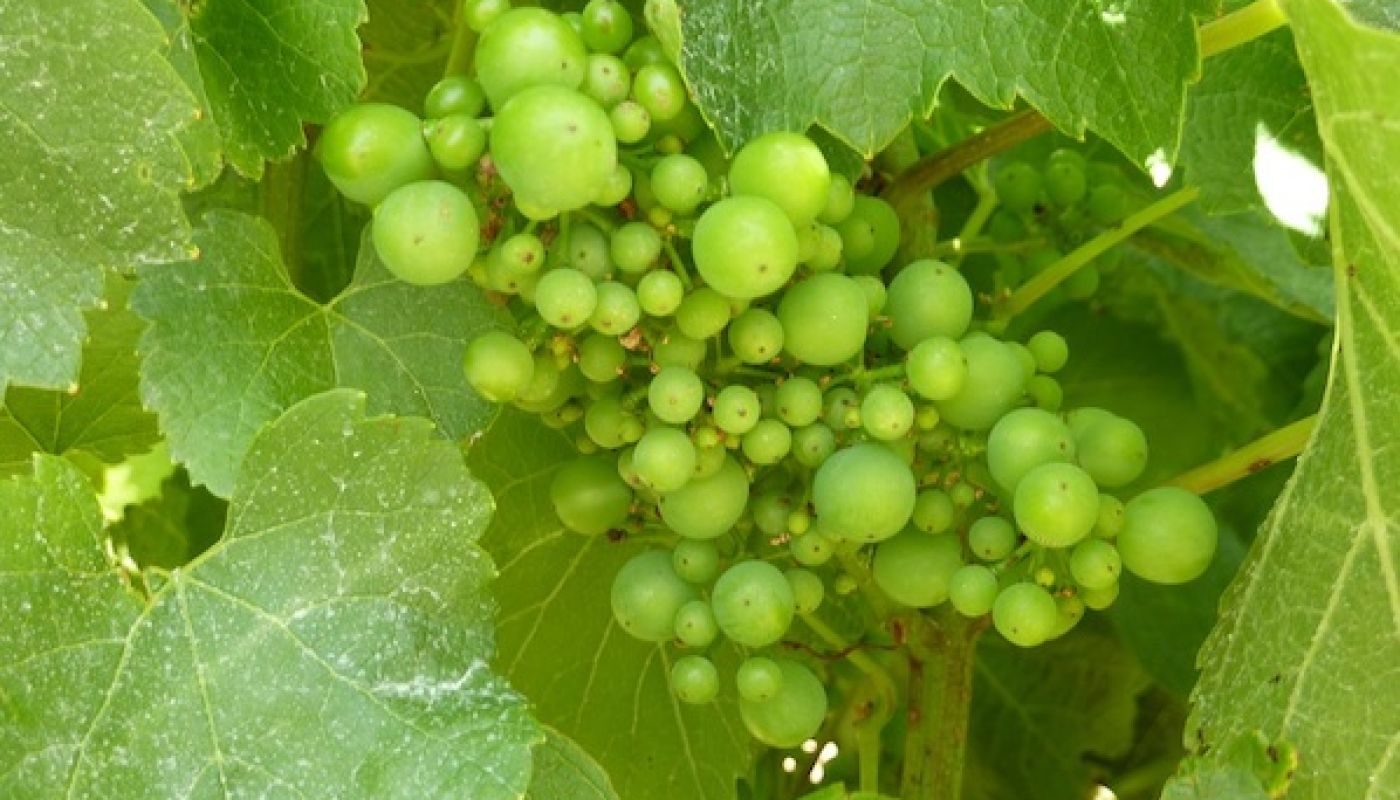
John Whiting supplied the image above of Chardonnay grapes showing the millerandage (hen and chicken) typical of the 'old Wente' clones such as Chardonnay-1.
Brian Croser, author of the original article, responds to the article above I think we are pretty much in wild agreement that OF is derived from Chardonnay 1 from the Armstrong Vineyard recorded in that Davis vineyard in 1930. Much more speculatively Chardonnay 1 came to Davis after it was founded in the early 20th century and probably from Wente’s or Gier’s Livermore Valley into Hilgard’s Vineyards in the late 19th century thence to Davis. We also agree Gin Gin could not be Mendoza because the latter was only imported to Davis from Argentina in 1964 and Gingin was sent from Davis by Harold Olmo to Bill Jamieson in 1957.
Apart from my apparently wrongful identification of the virused predecessor of OF (Chardonnay 1) being Chardonnay FPS 1, instead of just Chardonnay 1, the only other bone of contention is the Davis source of the Gin Gin clone. I speculate it is Chardonnay 1, the source of the heat-treated Chardonnay 02A or OF. John, you say there could not be enough wood from Chardonnay 1 for Harold Olmo to send it to Bill Jamieson. That is the hypothesis that I wish to see tested genetically. I pruned vines in the Davis Vineyard as a student and they were very big vines. Ironically Mendoza and OF were both imported into South Australia together in 1969. Thanks for the other points of clarification.
John Whiting responds I agree Chardonnay-1 is the source of FVF1V3/CX/UCD also known as OF.
My reference to not enough cutting material being available to send to WA in 1957 related to the Foundation Plant Material Service (FPMS; established in July 1956) vines, which were 'planted in 1956 in one of the first Foundation vineyards in Davis' (Sweet 2007). These particular vines were removed in 1967 before your time at Davis but there may well have been other old plantings of Chardonnay at Davis at the time.
I agree Chardonnay-1 is a strong contender as the source of IW576002, which later became known as the Gingin clone. Note the locality of the original Valencia vineyard is Gingin, not Gin Gin. The latter name are towns in both NSW and Queensland. The results of a recent project on the genomes of Chardonnay clones may well elucidate the usefulness of such an approach.
Brian Croser adds I suspect when Harold (knowing his cautious nature) planted the first FPS vineyard in Davis he would have ensured the original material in the Armstrong Vineyard survived long enough to ensure duplication if necessary. The WA material could well have been taken from the Armstrong Vineyard old vines. Maybe Nancy knows when the Armstrong Vineyard was pulled out? I look forward to the genetic testing results.
Tony Devitt, leading Western Australian viticulturist emailed
Dear Brian and John,
Thank you for your emails and the continued interest in Old Farm (Gingin) Chardonnay; IW 57-6002.
A light bulb moment suggested that I should try and locate the ex-manager of the Swan Research Station, Vlada Rakich. This I achieved with a minimum of effort and I now have an 81-year-old Vlada racking his memory.
Interestingly, Vlada started as a field assistant at the Research Station in 1956, a year before Gingin Chardonnay arrived into quarantine in WA. The practice was that imported grapevine cuttings would be grown in pots in the glasshouses at the Department of Agriculture in South Perth for a least a couple of years before the pots were transferred to the Swan Research Station where they were grown on. At this stage Vlada can’t specifically remember the Chardonnay but the practice was that he would receive up to six pots of each variety/clone from quarantine. Because of the limited space/resources, only six cuttings or fewer would have arrived from California, so only a small amount of material was sent. The source vine in California would not have needed to be very big to provide, say, the four to six cuttings that were sent to WA.
Vlada grew the pots on and was able to get a good amount of material from each plant. Some of this material would have been planted on its own roots in the Research Station variety collection and other buds would have been grafted onto rootstock to increase the rate of propagation. Material probably wouldn’t have gone to Gingin until sometime in the 1960s. We should be able to find out when!
We are all awaiting the genetic testing results.