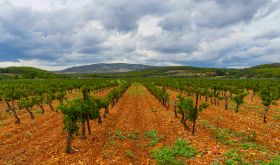

Last month, the Sustainable Wine Roundtable gathered an all-star cast of nearly 40 speakers for an online discussion of ‘How to turn climate mitigation and adaptation into business opportunity’. Panel discussions included real-life examples of climate innovation creating business opportunity, how to get started on tackling emissions, bottle-weight reduction, mitigation and adaptation in the vineyard, reducing impacts in the winery (from CO2 to H2O), carbon offsetting, transport and alternative packaging.
While it was physically impossible to take in all the panels, there were a few clear, strong takeaways common to all the panels I listened in on and participated in:
- It’s real, it’s happening, it’s urgent
- Audit, plan, measure
- Collaborate with a generous mindset
- Different roles, different strengths
- Educate, communicate, engage
- Make a start – just one thing
Before I start teasing these out, I just want to clarify that although the conference agenda incorporated both mitigation and adaptation, my focus here is on mitigation. And as sustainability jargon is often nebulous and misused, for purposes of this article:
Climate mitigation = reducing greenhouse gas emissions (GHGs) until we are functioning within the natural biochemical cycle limits of planet Earth, in which GHGs are at levels that are safe for the survival of life on Earth.
Climate adaptation = changing the way we do things in order to cope with the climate chaos and warming that is already a reality. Adaptation is a short-term measure.
It is for this reason that I focus on mitigation.
It’s real, it’s happening, it’s urgent
We cannot delay or bury our heads in the sand for a moment longer. In the words of Dr Kimberly Nicholas: ‘It’s warming. It’s us. We’re sure. It’s bad. We can fix it.’ As the main thrust of the conference was about turning climate mitigation strategies and adaptation into business opportunities, most of the discussions focused on practical aspects and actions; however, the underlying certainty across the board was that everyone in the wine industry must take action, and now. The only questions were what and how.
Julien Gervreau, founder member of International Wineries for Climate Action and previously VP of sustainability for Jackson Family Wines, emphasised that business opportunities cannot be our motivation for reducing emissions. At the same time, in doing so, we can ‘focus first on low-hanging fruit, where you can save money from emissions reductions’. Sarah Bräude, sustainability manager of Casella Family Brands in Australia, added that, ‘The cost of not doing anything is likely to be higher than the cost of doing something.’ Reducing emissions and mitigating climate change is not an optional extra, bonus points on the company scorecard or a way to get into the Scandinavian market – it’s business survival.
Audit, plan, measure
When it came down to the practicalities, it was salient how many speakers reiterated these three actions as the first, essential steps to take. Valentina Lira, who leads the sustainability division of Concha y Toro, said, ‘You have to have a clear path, a clear vision, a clear plan. Know what your main topics [areas of focus] are. And then, the most important thing – measure!’ And, she added, ‘You will have to continuously do it [measure, re-evaluate, set new goals]; over and over and over.’ Sandrine Sommer, chief sustainability officer of Moët Hennessy, agreed: ‘It is always important to think of the overall strategy. And while climate is one of the key pillars, you have to include people and planet in setting the strategy.’
Gervreau spoke about starting with an audit, an inventory of your emissions so that you understand where your impacts are and where the hot spots emerge. He also stressed the importance of measuring, but, importantly, using a standardised measuring framework so that it makes sense in a wider context. ‘It is critical to be tracking, monitoring, measuring, consolidating standards and ESG. Accountability is critical, as is integrating all sustainability efforts into the core of the organisation – everyone should have sustainability goals and targets within their day job. He suggested that wine companies use the framework of standards for measuring and reporting set by the International Sustainability Standards Board (ISSB). Taking it further, he told the attendees that it was essential that companies planned and budgeted for emissions reductions within their annual capital and operating expenditure budgets.
Bruno Guemes, environmental scientist working for Amfori (a global business association of producers, importers, retailers and others for open and sustainable trade) talked about the importance of capturing and validating data. Their measuring tool covers eight environmental performance factors but they don’t certify their members – the point is not to audit and certify, which is a snapshot in time, but to encourage continuous improvement cycles. All the panellists agreed on the value of capturing data in a systematic, standardised way, not only to measure and report on performance, but also for the benefit of the whole industry.
Collaborate with a generous mindset
Another theme to emerge across the discussions was the power of collaboration. The overarching message was that unless we are all working together along the entire length of the value chain – engaging with, connecting to, and sharing our learnings along all axes of the wine-industry matrix – we will not get there.
Lira raised the concept of a ‘generous mindset’ – taking the radical step of seeing others in the industry not as competitors but as fellows in a local, national and global movement. ‘The social aspect of your activities and transition cannot be outside the process’, she said. ‘You have to approach your suppliers, employees and fellow wine producers differently.’ She went on to give a direct example. Concha y Toro were the first wine company in the world to research, design and implement a carbon-reduction strategy and methodology. They then shared it in its entirety with Wines of Chile so they could share it with their members. Not only that, but they also used their financial clout and business influence to engage with Chile’s major packaging supplier in order to reduce the carbon footprint through the chain. They then began to engage with all their other suppliers. Today they have almost 50% of their key suppliers on board. Significantly, these are also the main suppliers for most of the wine producers in Chile. So, the efforts made by Concha y Toro have not only reduced emissions in their own company, but in the whole value chain and for other Chilean wine producers.
Sommer echoed this: ‘It’s important to work together, to create a sense of community in the wider sense.’ Marta Mendonça, manager of the Porto Protocol, added that the way to get things done, to enable action and meaningful change, is to ‘create a sense of belonging, which creates community, which creates opportunity’. She believes that community and opportunity inspire others. It creates a movement.
Kim Forsberg, sustainability manager of Vingruppen i Norden in Sweden, described how they’d launched a sustainability fund in 2021 to support their wine partners and producers in their efforts to become more sustainable, investing in projects such as technology, soil management and training. One of their producers became able to achieve a higher level of sustainability certification which then gave them access to a new market. Their initiative is inspiring others and connecting producers as well as moving funding to where it’s most needed.
Participants agreed on the importance of being generous with knowledge, time, connections, mentoring, data and relationships.
Different roles, different strengths
Lira counsels that once you’ve gone through your audit and benchmarked your organisation, you look at what you, as an organisation, can do, what is most important to you, and where you can make the biggest impact. Erica Löfving, chief sustainability officer of Vintage Wine Estates in California, doubles down on that. She used a term that was new to me: materiality analysis. What this means, in civilian speak, is that there are so many sustainability issues that it is overwhelming, not to say impossible, to tackle them all, at once, with finite resources. Materiality analysis means identifying the issues that are ‘material’, ie relevant, to the company, and then focusing the sustainability plan to prioritise these issues in terms of resource allocation, measuring and reporting. For example, water use might have high materiality value in California or Argentina, but low materiality value in the UK. Equal rights for workers might have high materiality value in South Africa, but low materiality value in Burgundy. If you’re running a massive commercial winery with high electricity use, your energy use has much more impact than it would for a tiny, low-intervention garage set-up producing 5,000 bottles a year. ‘Set your categories, the ones that are important to your company’, advises Löfving.
Mendonça provided some very exciting examples of companies doing what was within their power and influence to do, in different and often very creative ways. A handful of her examples include:
- LJ Crafted Wines, an urban winery in southern California that sells wine directly from barrel to customers’ recycled, reusable containers.
- A tiny producer in Portugal who collects empty bottles of his wine from restaurants and refills them. He also re-uses boxes.
- González Byass, who built a new winery entirely focused on minimising impact from the construction process and maximising water and energy efficiency.
- Ch Maris, a biodynamic estate in Minervois, Languedoc, that not only invested heavily in biodiversity on their estate but built an entirely biodegradable 9,000 m2 winery out of hemp. The certified B Corp winery is also entirely energy-self-sufficient.
- Sustainable Wine Solutions in the UK, who work only with sustainable-minded producers, and sell wine to consumers direct from the barrel, to their trade partners in barrel, and have a bottle-return scheme.
- Villiera in South Africa turned an unproductive vineyard into a wildlife sanctuary.
Educate, communicate, engage
Sommer talked about how essential it is to get people on board. ‘You have to raise awareness. You have to communicate.’ Löfving picked this up, saying that it’s really important to ask: what do our employees, families, trade partners and customers care about? ‘I need to get everybody engaged in one way or another’, she says. ‘We have to engage different stakeholders in different ways.’
Gervreau added that ‘Everyone has different motivations. Understand who is motivated by what and how you can leverage those motivations.’ Bräude described how she had to bring her board onside by making it concrete (spreadsheets, data, numbers, visuals) and using ‘a little bit of carrot, a little bit of stick’. Andrea Kaiser of Sustainable Winegrowing Ontario described how they started out as a small group of like-minded winemakers having a conversation, but through communication, engagement and simply becoming ‘good neighbours’, they’ve swelled to 200 wineries producing more than 300 million cases a year.
Training and educating employees; engaging investors, board members, trade partners; telling the transparent stories to customers – as Forsberg said, ‘Lead by example, and inspire.’
Make a start – just one thing
I believe it was author and agony aunt Cheryl Strayed who may be responsible for the scribbled card I have stuck to my monitor, which may be considered corny, but the advice holds true: ‘Real change happens on the level of the gesture. It’s one person doing one thing differently than he or she did before.’
Löfving said, ‘If you’re just going to do one single thing, tackle your packaging. Bring your 700 g bottles down to 470 g.’ For something else, it might be taking a deep breath and commissioning that carbon audit. It might be gathering your employees together to hear their thoughts, ideas, passions, concerns. It might mean raising pay to above living wages. For a wine writer or a marketing director, it might be one (or five) fewer flights to wine regions. For a retailer, it might be selling just one wine from barrel or keg into customers’ own containers. It might be two solar panels on top of your winery, your shop, your warehouse. It might be your first electric vehicle.
For a wine lover, it might be writing to your favourite producer to ask them to reduce their bottle weights or asking your local wine merchant to introduce BYO-container wine dispensers.
We can all do just one thing. Let’s get this ball rolling.
Interested in reading more about sustainability in the wine world? JancisRobinson.com offers more than 170 articles on the topic, and many more on the effects of climate change. To access them all, become a member now!
Image credit: Andriy Onufriyenko/Moment via Getty Images.