See this thread on food and wine matching on our Members' forum and some (free) practical suggestions on food and wine matching.
When, long ago, I wrote for the London Sunday Times, I used to say I wanted to be good times correspondent. My argument was that although the paper's writers tended to have specialities – wine, food and travel among them – readers in fact tend to experience all of these particular pleasures of life together, so wouldn't it be a good idea to have someone writing about all three in one glorious integrated amalgam?
I certainly love all three, and am sad that there isn't more blurring of the disciplines. Traditionally wine experts rarely strayed into the territory of solid matter, many of them viewing it as a distraction rather than healthy complement. And in my experience many authorities on food, and even many chefs, can find wine dauntingly complicated.
This has been changing, however, even if I wonder whether it is evolving in a direction that is truly helpful to the consumer. Chefs in France always seemed less intimidated by wine than most of their counterparts elsewhere – for obvious reasons perhaps – with the Troisgros family in Roanne being particularly respected for their connoisseurship. But it was Alain Senderens, chef-proprietor of the three-star L'Archestrate and then Lucas Carton in Paris, who first used wine to inspire his dishes, most famously a duck cooked in the Roman style of Apicius with Banyuls, Roussillon's riposte to port.
He is now 73 and, having handed back his Michelin stars, is still devising dishes at his eponymous Paris restaurant with a glass by his side. With each of his dishes he proposes a specific wine – something that was quite novel once but has become relatively common. I love this opportunity to try several different wines, and I would be confident with any Senderens choice that considerable thought and experience had gone into how the wines were selected.
But as 'specially selected' wines by the glass become more and more common alongside the dishes on menus, I can find myself cynically wondering how the wines were chosen. Real love and knowledge of both food and wine is still relatively rare, alas, and I suspect in some cases the wines have been selected because someone thinks they look as though they might work, or even because of which bottles are already open, rather than because the combination has been put to the test.
In the US, food and wine matching has become almost sacramental, perhaps as another way of reassuring the relatively high proportion of American newcomers to wine. Specialist writer on the subject Evan Goldstein has already written two books on the subject and Perfect Pairings is already in its seventh printing. His British counterpart is Fiona Beckett, who, most unusually, writes with equal competence about both food and wine and manages not to sound precious on her site www.matchingfoodandwine.com. Both of them are sure guides to the many wine drinkers, and especially hosts, who seem to worry enormously about what to serve with what.
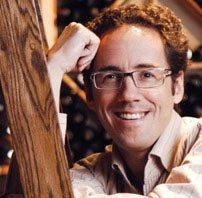
But I recently encountered someone who has taken the business of matching food and wine to a whole new level. Like Goldstein, François Chartier of Quebec (pictured above) was a very successful sommelier. (Believe it or not, there is an array of competitions and qualifications designed to measure sommeliers' performance.) And it is hardly surprising that restaurant wine waiters should take the lead in finding the right bottle for a specific food. He devoured the traditional literature of food and wine pairing and found it wanting. Some of the classic combinations worked but some, such as Roquefort and Sauternes (guilty, m'lud), didn't – or at least only sometimes.
He started to investigate the science of these pairings and, with a nod to the likes of Heston Blumenthal and Chartier's co-investigator Ferran Adria of elBulli, by 2006 had come up with something he calls molecular sommelry. The idea is that he identifies the dominant aromatic molecules in various wines and foodstuffs and matches them up. Sauvignon Blanc, mint and parsley are all long on anise flavours, so, with a couple of circles on a blackboard, the engaging Chartier is able to suggest Sauvignon as a suitable accompaniment to tabbouleh, the fragrant Middle Eastern salad (even if much of it is presumably eaten by teetotallers). The attractively named aromatic molecule rotundone is apparently easily found in both Syrah and black olives. Et viola! Encore une marriage faite au ciel. And as for sotolon, the characteristic molecule of the Jura's vin jaune, it apparently feels wonderfully at home in the cosy sensory world of (some) curry spices, maple syrup and walnuts.
As he says disarmingly in the introduction to his best-selling book Taste Buds and Molecules – The Art and Science of Food, Wine and Flavor, 'I would certainly need a good 20 years to scan all the foods and wines that are found on our table', but he fully intends to do so. His various suggestions include the bizarre likes of chocolate-dipped asparagus with lapsang souchong tea, and raspberries with nori seaweed. But he assures us that all these combos have a scientific basis. I just hope that this level of sophistication/complication doesn't put wine neophytes off altogether.
His was certainly the most stimulating presentation at a recent conference in Barcelona on wine and food organised by canny Catalan wine producer Torres. Several hundred of us gathered to listen to and taste a full day's deliberations by sommeliers and chefs. Oddly enough, it had been inspired by an article in the British Guardian newspaper last July calling for health warnings on wine bottles. The current head of the company Miguel A Torres had been so alarmed by this possibility, and was anyway keenly aware that the Catalan wine industry had done remarkably little to capitalise on the culinary revolution spearheaded by the region's chefs, that he moved swiftly to organise an event that would firmly distance wine from booze and underline its role as gastronomic ingredient.
What resonated most with me, however, was a rumination on the business of being a sommelier from Josep Roca, the winiest of the three brothers who run El Celler de Can Roca in Girona, which is, now that elBulli has closed, the leading light of modern Catalan restaurants. An hour's solo speech on any subject is generally 30 minutes too long in my experience. And on the business of wine waiting and food matching, without any real props, translated from a language I don't speak, looked potentially a complete yawn. But in the end it wasn't that Roca is distinctly easy on the eye that made it so compelling. It was his obvious humility, the most charming and essential ingredient in any gastronomic union. One phrase stood out. 'When recommending wines, remember that what you think is perfect may not in fact be perfect for the person or the occasion. We sommeliers have to learn to manage our vanity.'
He then sat on the front row taking notes throughout. What a star.