
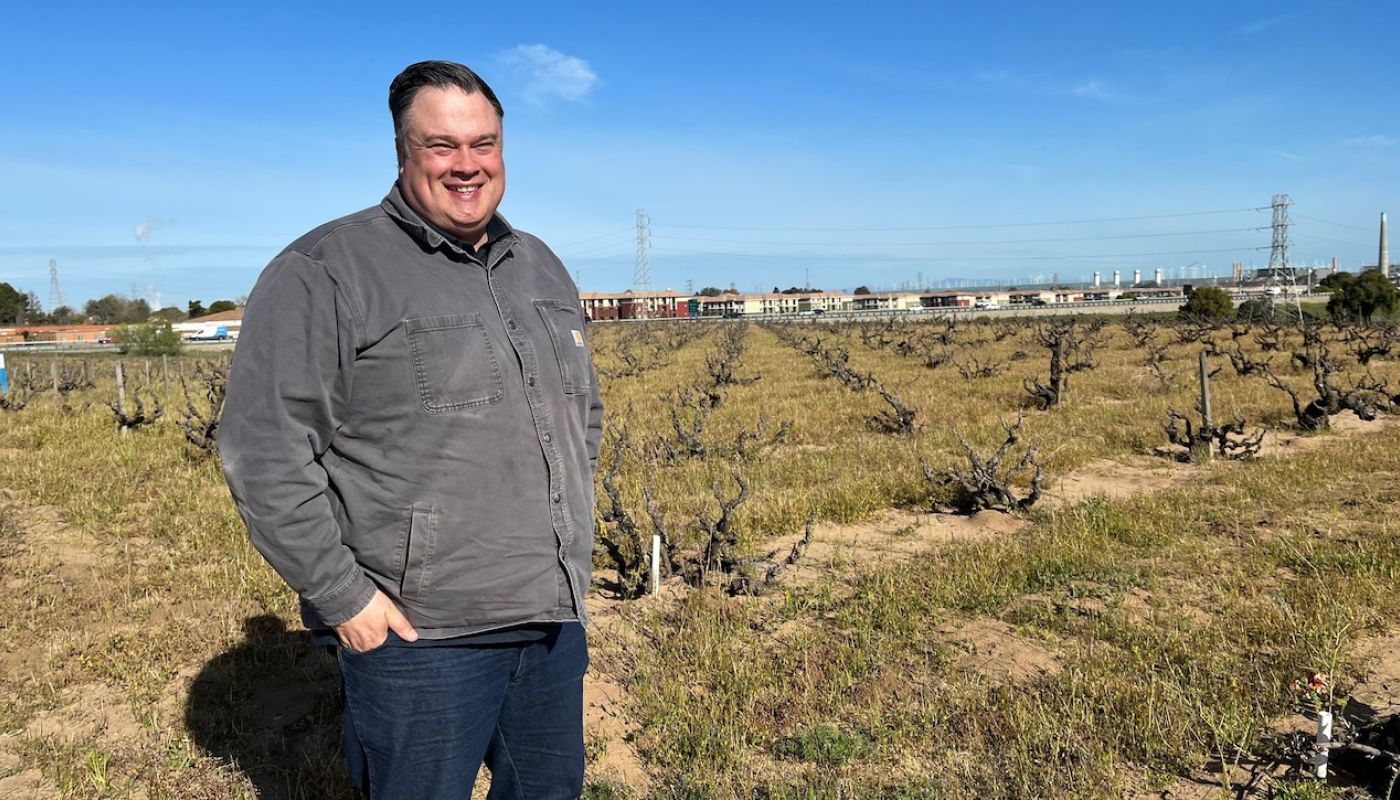
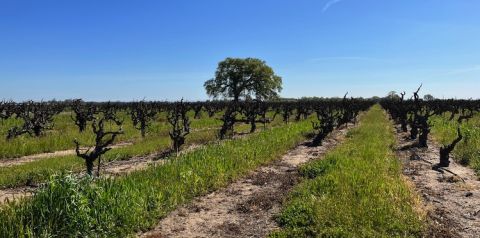
Napa native Tegan Passalacqua, seen above in Contra Costa County, is as unlike the stereotypical owner of a Napa Valley winery as you could imagine. His vines are not neat green rows tended by an expensive vineyard-management company, but forgotten stumps of ancient vines in appellations as unglamorous as Lodi, in the flat delta-land south of Sacramento in the San Joaquin Valley, as well as those that have so far managed to escape the predations of property developers in Contra Costa County east of the Bay Area. He’s also a repository of northern California viticultural history and geography, and a sort of unpaid grape broker. Some people know where the bodies are buried. He knows where the deepest vine roots are.
He promised to take me on a day trip to his personal centre of operations and picked me up in Napa’s Oxbow car park in his vast pick-up truck. Physically he is larger than life but most of the 19 wines he makes for his personal Sandlands label are made in tiny quantities, perhaps just 100 cases, from small plots of intriguing vines so old and long-untended that they are no longer very productive.
As we headed east out of Napa city he warned me about the transformation of Contra Costa since I’d last visited in the 1980s when it was a characterful sandy wasteland dominated by pylons between patches of vines farmed by the descendants of Portuguese immigrants. It’s still windy, as witness the forests of wind machines on the horizon, but is now soulless San Francisco commuter country. The freeway that used to be a two-lane highway is now a constant and noisy stream of commuters apparently doing their best to get somewhere with more somewhereness than these housing tracts. There is nothing like a town centre and only a sprinkling of neighbourhood stores.
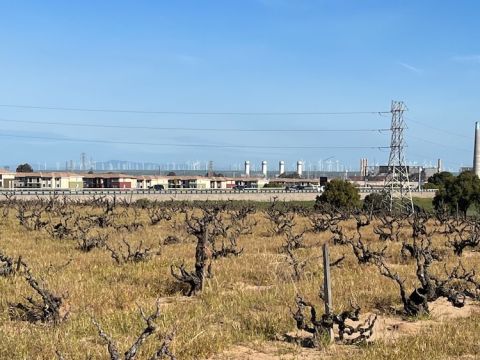
Perhaps because of the proximity to San Francisco, we saw several lost souls walking we knew not where, some barefoot, others with guitars and not much else. Passalacqua was careful to lock up his truck when showing me round the remaining vineyards. This is truly a very strange place whose only history seems to be embedded precariously in ancient vine roots that will doubtless be prey to bulldozers all too soon. ‘In 20 years the whole area will forget it had an agricultural past’, he predicted. There’s a new Contra Costa Logistics Center, for example, first tenant a vast Amazon warehouse.
As well as producing his own wine, Passalacqua has for 20 years been director of winemaking at Turley Cellars, another specialist in old-vine wine, founded by Larry Turley in 1993. But Turley’s second-oldest grape source, a six-acre (2.4-ha) plot of Zinfandel planted in Contra Costa in 1896 that was personally pruned by its 90-year-old owner until recently, is now covered with 57 (identical) homes. The development has been named The Vines.
Beneath another development, billed as The Ranchettes at Neroly, was an old Cinsault vineyard Passalacqua remembers well as producing ‘beautiful’ fruit. Old vines are easy prey because, unless tended extremely carefully, their yields are relatively low, and they are hardly ever today’s popular international varieties such as Cabernet and Chardonnay. But the wines they produce can be spectacular, even if unfashionable – especially if the vines pre-date, as many do, the advent of the phylloxera pest which threatened to wipe out the world’s grapevines at the end of the 19th century.
‘I tried to buy that vineyard’, Passalacqua said wistfully about the six acres of Zin, adding, ‘and I’d still love to buy land in Napa Valley but no employed winemaker could afford to now. Only those with big investors can do it, and then they’ll only own about 10% of it themselves. When I grew up in Napa, winemakers there could afford their own house and maybe a vacation home in Tahoe. But now it’s $3,000 a month to rent even low-income housing in Napa, so vineyard workers have to live so far away that massive single-occupancy traffic into the valley is a big issue.’
Instead Passalacqua has bought a small ranch house on the outskirts of Lodi where he stays a few days a week and directs operations for Sandlands as well as overseeing the Kirschenmann vineyard a mile away, which he acquired in 2012 after careful negotiation with the old owner. Fifteen of the 20 acres (8 ha) of vines, mainly Zinfandel, were planted in 1915 on their own roots – no grafting onto phylloxera-resistant rootstock. The first vintage for his Sandlands label was 2009 but he sold all the wine off in bulk because he didn’t think it was quite good enough. ‘I regret that now’, he admits, adding, ‘I’ve always been self-financed so growth has been slow.’
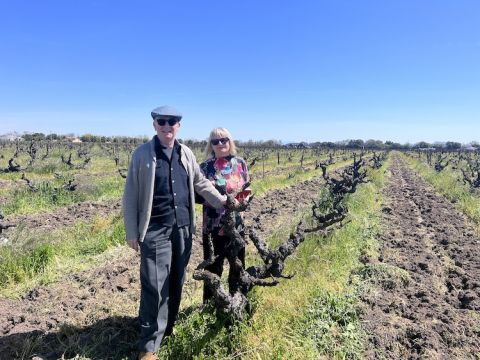
Passalacqua clearly revels in the contrast between increasingly bleak Contra Costa and the backwoods atmosphere of the much quieter, leafy town of Lodi, which was hugely important as a source of fresh grapes shipped east by rail to home winemakers during Prohibition but never really had a small-winery culture. There were big wineries, perhaps more accurately described as production centres – indeed the Roma winery, founded 1890, was the biggest wine producer in the country before Prohibition but moved elsewhere in the Central Valley after Repeal.
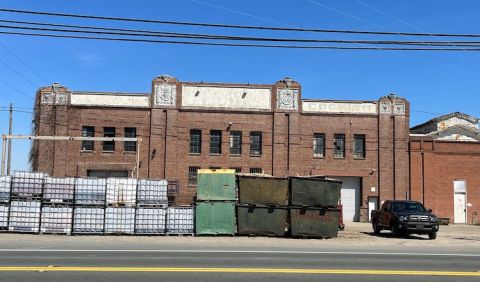
Today Lodi’s vineyards principally supply bulk wine to the behemoth Gallo and to wineries with smarter addresses. Napa Valley regulations, for example, allow the addition of up to 15% of non-Napa Valley fruit – and the total grape acreage of Lodi at 100,000 acres (40,470 ha) is more than twice that of Napa Valley. Even today there are all too few truly quality-oriented producers in Lodi, despite the careful delineation of the appellation in 2006 into seven sub-appellations, each with their own terroir.
Those who celebrate Lodi for more than its relatively low grape prices are few and far between, despite its rich trove of ancient vines. It was the hawks we saw wheeling over the Bechthold vineyard, planted in 1886, who seemed more interested in these Cinsault vines, the oldest in the world, than the wine-buying public. Both Sandlands and Turley Cellars make wine from these vines. Neither wine costs much more than $30 a bottle.
‘Lodi’s problem’, according to Passlacqua, ‘is that having California on the label is more valuable than having Lodi.’ This despite the fact that a rigorous set of Lodi Rules, California’s first such sustainable protocol, was drawn up in 2005 for vine-growing there and is followed by a good third of farmers, cutting overall pesticide use by 30%. Days may be hot but the heat of the Central Valley pulls in air cooled by its passage over the Sacramento Delta, while chill air blows down from the Sierras at night, all of which helps to keep fruit flavours fresh.
While on sabbatical from Turley Cellars, in 2005 Passalacqua worked with the Graillot family in the Rhône Valley (who now import his Sandlands wines) and in 2011 with Eben Sadie of Sadie Family in South Africa, who has successfully managed to persuade people to pay high prices for his wines made from old vines and obscure varieties. After our tour of ancient vine stumps, Passalacqua showed me his current Sandlands range before a lunch of local foods reflecting Lodi’s German heritage. We were joined by fellow enthusiasts of local wines: the urbane Darrell Corti, of celebrated Sacramento wine merchant Corti Brothers; and Stuart Spencer, executive director of Lodi Wine who makes wine himself under the St Amant label. Passalacqua quoted Sadie on what Lodi has to offer the wine world. Apparently, having studied the soil map of northern California, Sadie described Lodi as ‘one big sand squirt, like Ch Rayas’, a reference to the fabled Châteauneuf-du-Pape producer. Praise indeed.
But for the moment consumers seem prepared to pay much more for the produce of young vines with a familiar grape name on the label than for liquid evidence of California’s grape-growing heritage, although this seems to be slowly changing as younger wine drinkers seek novelty and authenticity. California wines from grapes as obscure as Trousseau, Carignane and Malvasia have developed a certain cult following. Passalacqua makes a Trousseau himself which he describes as ‘hipster catnip’.
‘Lodi grows more than 130 different grape varieties’, pointed out Passalacqua, adding hopefully, ‘That may help its survival in the long run.’
Favourites from the California boondocks
Delicato, Gnarly Head Old Vine Zinfandel 2019 Lodi 14.5%
From $9 in US, £16.50 Vino Fandango
Cline, Ancient Vines Mourvèdre 2017 Contra Costa County 14.5%
$19 in US
Post & Vine Carignane 2019 Contra Costa County 14.5%
$24 producer's website
Ferdinand Garnacha Blanca 2018 Lodi 12%
$25 in US, £23.99 Thorne Wines
Sandlands, Mataro (Mourvèdre) 2021 Contra Costa County 12.8%
From $30 in US
Sandlands, Red Table Wine 2021 Lodi 13.3%
From $28 in US
St Amant, Lodi Native Marian’s Vineyard Zinfandel 2021 Mokelumne River – Lodi 14%
$35 producer's website
Sandlands, Kirschenmann Zinfandel 2021 Lodi 14.3%
To be released in August
Turley Cellars, Kirschenmann Vineyard Zinfandel 2019 Lodi 15.2%
From $42 in US, £48.60 Four Walls Wine, £48.95 Uncorked, £49.99 Harrogate Wines, £53 Tanners Wine Merchants
Tasting notes, scores and suggested drink dates in Heading east to old vines. Some international stockists on Wine-Searcher.com.













