Those who have managed to pass the notoriously difficult Master of Wine exam almost invariably love the wines of Alsace on the border of France and Germany, and its signature grape variety Riesling. But they are in a minority.
Selling Alsace wines has become quite a struggle. The tall, thin green bottles they are sold in used to be a staple on French supermarket shelves but the supermarkets are buying less and less from Alsace.
Many wine producers depended on sales in their tasting rooms to the tourists who flock to this devastatingly pretty region from Germany and Switzerland to the south and the Benelux countries to the north. But now even the tourists are buying less. The big distinction between German and Alsace Rieslings used to be that Alsace Riesling is almost always dry. Perhaps the dramatic increase in the proportion of German Rieslings that are now dry has reduced demand from the tourists from across the Rhine.
According to Julien Schaal, a fairly new but ambitious Alsace wine producer, so many growers are giving up bottling their own wine that, contrary to the current trend in most other French wine regions, they are rejoining the local co-op, taking their grapes there rather than making their own wine. He recently converted an old farm shed into a smart new winery and claims that he can pick up all manner of second-hand winemaking equipment for a song.
(There must therefore be quite a number of disused wineries in Alsace – just as Bordeaux is full of wine estates and châteaux abandoned by the Chinese who invested in them when it was easier to take money out of China. Now could be a very good time to buy a winery.)
There are exceptions to Alsace’s wine woes. The two most famous Alsace wine producers who for years spearheaded the region’s export drive are Hugel and Trimbach, founded respectively in 1639 and 1626 and still very much family concerns. They make considerable quantities of wine and their wines can still be found all over the world.

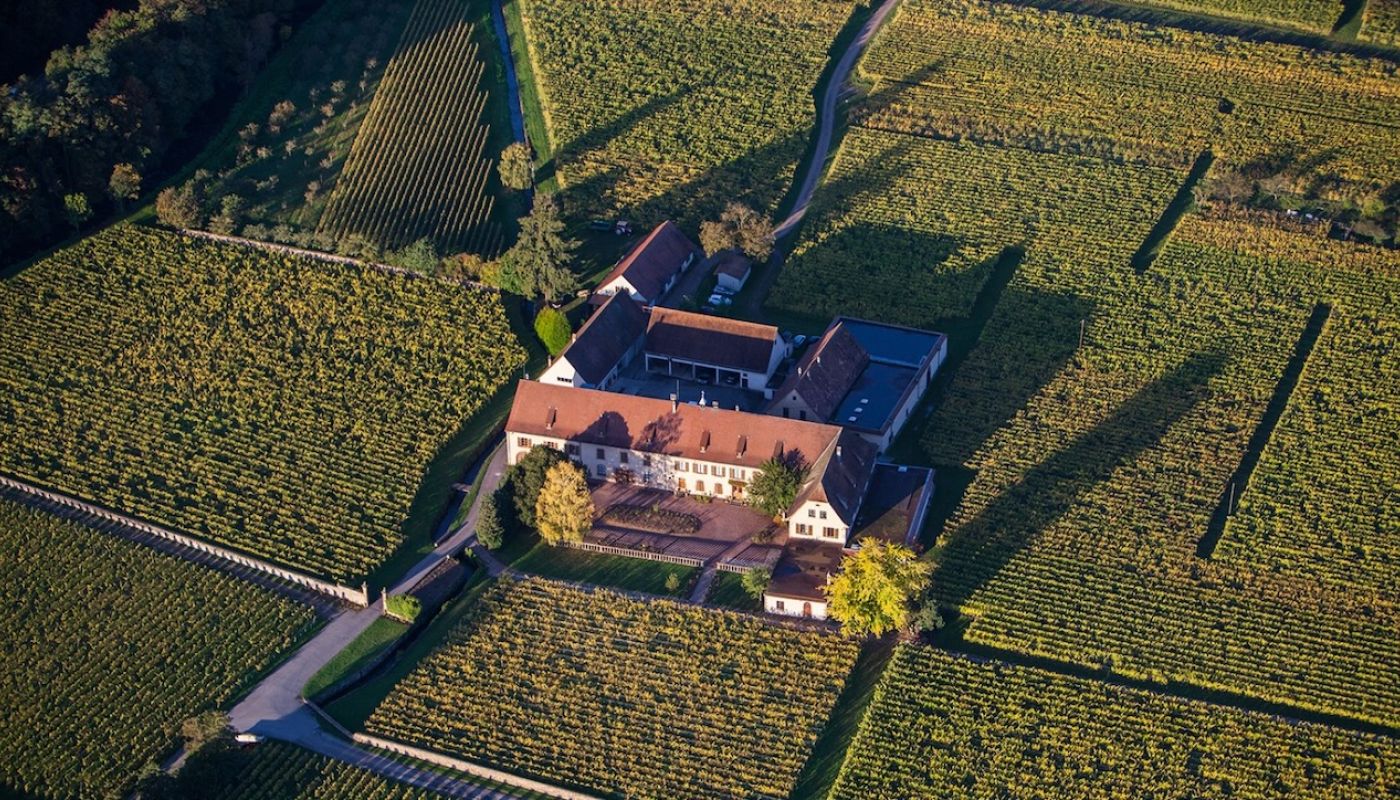
A more recent irreproachable source of fine Alsace wine is the Faller family’s Domaine Weinbach, a parvenu that dates only from 1898. It is now run by Catherine Faller and her sons – outspoken Eddy, and Théo, who does the crucial job of maximising quality in the vineyards. Eddy, based in the handsome family manor house, returned to the fold only in 2017 after being a banker in Brazil. He brings a very un-Alsace point of view to what is an extremely conservative wine region. In his view, the reason they have been discussing the introduction of a premier-cru level of vineyard that would be slotted between the superior grands-crus sites and regular Alsace appellation land is because ‘we’re too reverent towards the INAO [the national appellation institute] officials; other regions get things done by negotiation’.
Describing new wines designed to combat warmer summers, a co-fermented blend of the rich Pinot Gris with the fresher Pinot Blanc and a blend of warm-climate dark-skinned grapes Syrah and Grenache (neither of them officially permitted in Alsace), Faller admitted that labelling them according to the rules might not be straightforward. ‘But having lived and worked in Brazil, I’d rather be fined for not following the rules than feel sorry I didn’t do anything.’
The Pinot Blanc grape, which has vied with Riesling as the most-planted variety in the region but has nothing like its réclame, is now used mainly for the local sparkling Crémant d’Alsace, whose sales have recently been the one bright spot on the region’s balance sheet. But Faller thinks that still Pinot Blanc will be re-evaluated when more wine producers realise it can contribute valuable acidity. ‘We’ll all be making Pinot Gris with 17% alcohol in a few years’ time if we don’t do anything about it.
‘And I think you’ll see a lot more co-ferments in future. It’s a great way to deal with global warming. [At Faller] we’re separating ourselves from the single-varietal model. We’re one of few appellations to insist on the 100% [of the cited] grape rule. [When drawing up our regulations] we went more German than the Germans.’ Most other regions allow up to 15% of other grapes to be added to varietally labelled wines.
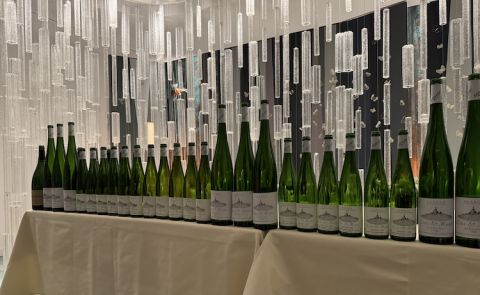
At a recent celebration of the centenary of Trimbach’s most famous wine (bottles and magnums for the dinner lined up above), Riesling Clos Ste Hune (arguably my favourite dry white wine anywhere), twelfth-generation Jean Trimbach claimed not to be worried about the effect of hotter, drier summers on the super-racy, steely Clos Ste Hune (which takes years to approach drinkability). He admitted that harvests were now two or three weeks earlier than in the past and that alcohol levels have been rising so that 14% and 14.5% are not uncommon today. But he argued that, to counterbalance this, total acidity levels have also been rising because his family’s sites are cooled by the wind that regularly whistles through the gap in the Vosges west of their base in the medieval village of Ribeauvillé.
Change is not something welcomed by the Trimbach family but even they cannot fight climate change. When showing Clos Ste-Hune 1979 (still in great shape, by the way), Jean Trimbach observed that the potential alcohol of the grapes when picked was probably only 11% but that would probably have been regarded as ‘great’ then, a fine basis for the sugar that used to be routinely added to the fermentation vat to beef up final alcohol levels. It certainly isn’t needed today.
A good 90% of all Alsace wine is white but there is increasing interest in red wine made from the one permitted dark-skinned grape variety, fashionable Pinot Noir, which can now be ripened fully to provide a better-value alternative to red burgundy. Faller, who on his return in 2017 instituted several single-vineyard Pinot Noir bottlings instead of blending the produce of their Pinot vines, some of them 50 years old, is vituperative about the prices asked by some Burgundy producers. When he came back from Brazil, he told me that he saw that they needed to increase prices to have a margin sufficient to allow future investment. 'On the other hand, I don’t think we should be gouging like Burgundy and Champagne. You can’t sustain drug-dealing-type profits. Now some people are making 90% profit when their production costs are half mine. Their land is less steep and their yields are higher.'
No diplomat, Eddy Leiber-Faller also criticises producers in his own region who will sell one bottle of Pinot Noir only if many more bottles of white wine are bought. Convinced that demand is always cyclical, he sees that as devaluing Alsace’s greatest asset. He’s doubtless referring to the stunning dry Rieslings such as those below.
Truly fine dry Alsace Rieslings
All but the Charles Frey wine are grown in grand-cru sites. Readers based outside the UK should look out for the wines of Julien Schaal and Muré, inter alia.
Cave Vinicole de Hunawihr, Rosacker 2021 13%
£22 Tim Syrad Wines
Charles Frey, Granite 2020 12.5%
£23 Must and Lees
Kirrenbourg, Schlossberg 2019 13.5%
£324 per case of 6 Christopher Keiller
André Kientzler, Geisberg 2019 14%
£42 Flint (previously Stannary Wine)
Domaine Weinbach, Cuvée Colette 2021 13.5%
£44.40 Justerini & Brooks
Domaine Weinbach, Schlossberg 2020 13.5%
£68.40 Justerini & Brooks
Trimbach, Riesling Geisberg 2018 14.5%
£71.03 Great Wines Direct, £75 Hedonism, £77.50 The Great Wine Co
Zind-Humbrecht, Clos Windsbuhl 2021 12.7%
£74 The Sourcing Table
Hugel, Schoelhammer 2009 13.5%
£84.67 in bond Grand Vin Wine Merchants
Trimbach, Clos Ste Hune 2015 14.7%
£265 The Wright Wine Co
Trimbach, Clos Ste Hune 2009 14%
£250 in bond World Wine Consultants
Trimbach, Clos Ste Hune 1990 14%
£843.20 Atlas Fine Wines
Tasting notes, scores and suggested drink dates in our tasting notes database. For international stockists, see Wine-Searcher.com.