
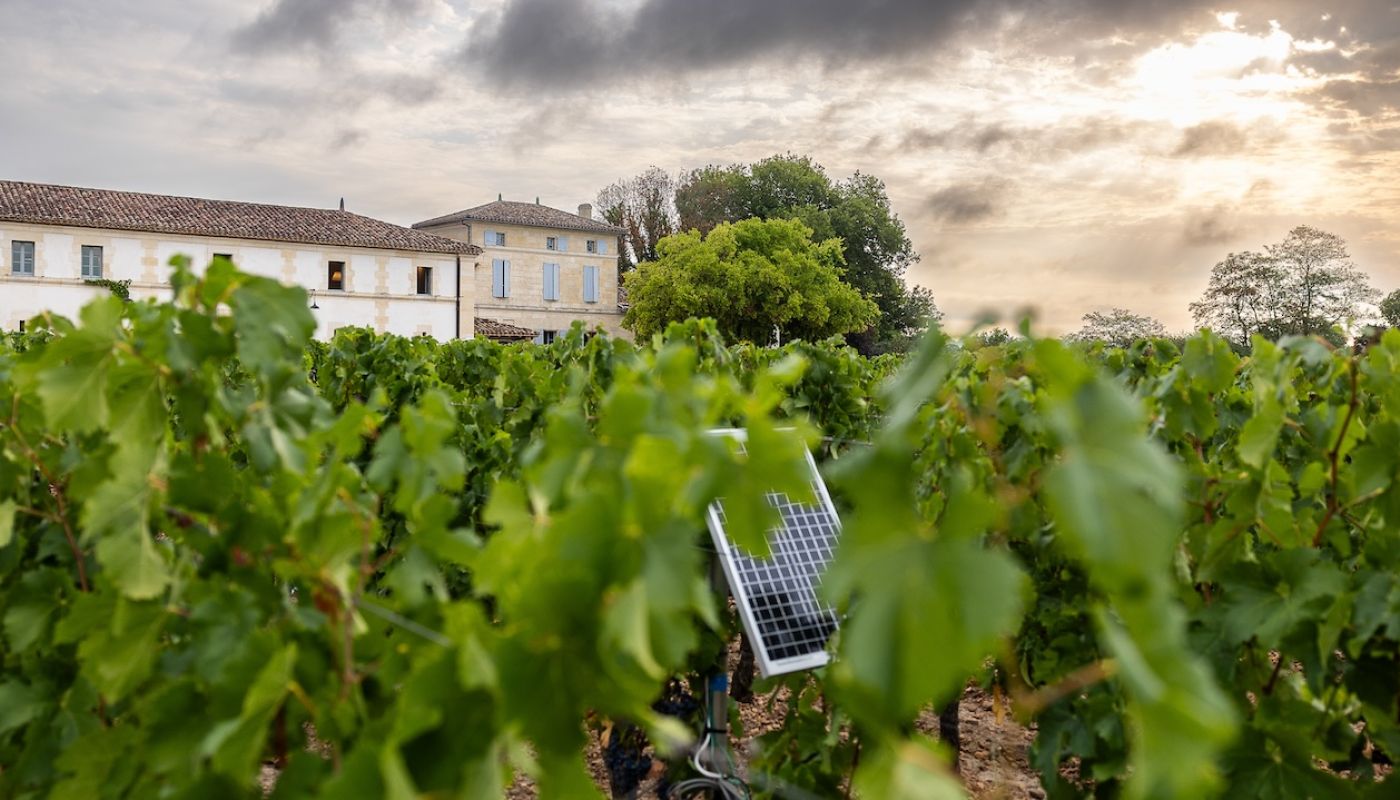
At an average of about £650 a bottle, Château Lafleur is one of the most expensive red wines of Bordeaux. It’s grown on a patch of less than 5 ha (12 acres) of Cabernet Franc and Merlot vines on the plateau of Pomerol just next to Petrus, the most expensive bordeaux of all.
Not many announcements in the world of wine cause such a stir as the one made by Lafleur’s owners, the Guinaudeau family, towards the end of last month on the eve of this year’s extraordinarily early harvest.
They announced that, after nearly 90 years, they have decided to leave the warm embrace of the Pomerol appellation for the wild and woolly Vin de France category, one more readily associated with the sort of quirky wines you find in wine bars in eastern Paris (see Sam’s Wine news in 5).
From the 2025 vintage onwards, the labels of Château Lafleur won’t give any precise indication of the wine’s geographical origins, nor suggest that Pomerol’s regulations have been obeyed. Instead it will join the swelling but decidedly heterogeneous group of wines made by people who have decided to turn their backs on France’s beloved appellation contrôlée system.
The initial announcement, perhaps foolishly, provided no explanation and was rushed out just before the first Lafleur 2025 grape was harvested. Social media went mad. Baptiste and Julie Guinaudeau had to turn off their phones on the first day of their Merlot harvest. And they are nothing if not hands on. These small wine farms on the right bank of the Gironde estuary are very different from the grand estates on the left bank where the manual work is done by employees.
Some of the wilder speculation was that they were intending to make natural wines. Or plant Syrah, the grape of the northern Rhône, virtually unknown in Bordeaux but a variety that can withstand hotter, drier conditions than Merlot.
Despite having to work until midnight in the cellar overseeing the reception of the first lot of Lafleur grapes from the exceptionally hot, dry summer of 2025, they realised they would have to issue a second, very detailed, three-page statement, in English and French, clarifying that it was not being allowed to irrigate or, as they put it, practise ‘assisted, early soil recharge’ with water, that was essentially behind their decision to exit the appellation.
Although irrigation is allowed and widely practised outside France, it has long been outlawed for most appellation contrôlée wines in France, apart from for just-planted vines which need water – historically because the authorities were worried that growers would use added water to swell the grapes and dilute the resulting wine.
From 2006 French vignerons have been allowed to ask for special permission to irrigate in their particular appellation, though the process is convoluted. Those in Pessac-Léognan with its sandy gravels that are not especially good at water-holding succeeded in being allowed to irrigate in 2022 and 2025. The punishingly dry summer of 2022 finally impelled the Pomerol authorities to permit a derogation, but it was issued too late to save many of the vines from sunburn and the grapes shrivelling to raisins. In periods of severe water stress, the vines’ stomata close to prevent loss of water from the leaves. But this also inhibits photosynthesis because of a lack of carbon dioxide. As a result, grape ripening comes to a halt while the vine concentrates its energy on survival. The resulting wines are typically high in tannin and low in flavour.
It was the heatwave vintage of 2003 that signalled a turning point for Baptiste, Julie and Baptiste’s parents Jacques and Sylvie Guinaudeau (and many other French vine-growers). And that was only the start of a series of ever hotter and drier summers, and weather that has become ever less predictable. Even such rain as falls is often less useful nowadays because it falls on rock-hard ground.
Since 2012 the Guinaudeaus have been monitoring humidity in their soil and their vines, learning to distinguish between heat stress and water stress and, defiantly, experimenting with adding water early in the growing season when it is most needed. They established a few small reservoirs; the rainy 2024 season was particularly useful in filling them up. And in 2021 they dug a 142-m (466-ft) bore-hole to Bordeaux’s aquifer. With much trial and error they also developed a tractor that can inject water 15 cm (6 in) below the surface and then restores the soil so as to minimise evaporation – an important consideration in these hot summers. At Lafleur they also collect water from the nearby River Dordogne, generally free of industrial inputs, that sometimes overflows into a non-wine property they own next to it.
Their irrigation experiments were conducted at night – to minimise evaporation, I was told. But it would also usefully have been relatively discreet even in the tight-knit parish of Pomerol that is less than three miles across. I asked whether they had asked the authorities for permission to irrigate this year and was told that their experiments showed that water was of most use, and the quantities needed smallest, in June and July and that they didn’t bother because they were sure that permission wouldn’t be granted swiftly enough.
The Lafleur news is just sinking in for other Pomerol producers but Fiona Morrison, Master of Wine and wife of Jacques Thienpont, whose Le Pin Pomerol sells for almost as much as Petrus, was the first neighbour to congratulate them on their stance. Asked whether her husband might irrigate too, she texted that he is ‘considering it for the future but not ready to stick his neck out!’
Christian Moueix, who for many years ran Petrus, told me he had discussed irrigation at length with Baptiste Guinaudeau and added ‘his decision will force all of us to attack the problem without delay’. His son Edouard Moueix agreed: ‘we now have to make sure the general rules of the appellations evolve with the climate’.
Gavin Quinney’s property Château Bauduc is 20 miles (32 km) south-west of Pomerol in Bordeaux’s less glamorous Entre-Deux-Mers region but he is a prolific reporter on the whole Bordeaux wine scene. He wrote to me, ‘My reaction over Lafleur was “good for them!” At the very least it opens the debate about irrigation – not just to help the vines cope but to manage alcohol levels – and perhaps some other rules which are plainly daft.’ (These include the very tight restrictions on which grape varieties are allowed and to what extent, and the lack of management of the thousands of hectares of grubbed up and abandoned vines.)
For a Burgundian view I asked Guillaume d’Angerville of Volnay, one of the region’s most thoughtful and respected wine producers. He is against what he views as technological tools or devices such as most anti-frost measures and anti-hail nets to fight the vicissitudes of nature, preferring to encourage differentiation between vintages. ‘Will irrigation alter the character of the terroir, or of the wines produced from this terroir? Intuitively, I would say yes, as it will make the vines lazier since they would be provided with water that they would normally have to find by growing deeper.’ But he does admit that summers are becoming hotter and drier. This year at Domaine Marquis d’Angerville, for instance, they most unusually started picking in August, as they did in 2020 and 2022.
He is keener on the supplementary measures adopted by the Guinaudeaus such as training the vines lower so that there is less evaporation and encouraging more leaves on the vine to protect the grapes from heat stress and sunburn.
Celebrated German wine producer Klaus Peter Keller of Rheinhessen and the Mosel is no fan of irrigation either and would prefer to adopt better rootstocks and more densely planted vines to encourage them to dig deeper for underground water.
Professor Edmund C Penning-Rowsell, an academic specialising in water management who happens to be the son of my late predecessor as FT wine correspondent, pointed out in this recently republished article that it would not be easy to find sufficient sources of suitable irrigation water in either Bordeaux or Burgundy. In Bordeaux the Gironde is too saline, and levels in the rivers leading into it have been falling steadily because of decreased snowfall on the Pyrenees. New reservoirs would have to be built and expensively lined to avoid leakage through the gravel below. The limestone that underlies the most famous vineyards of Burgundy presents the same sort of challenge, and in both regions land costs are high.
Even in those regions where irrigation is permitted, water is becoming increasingly scarce and expensive, not least in Australia where some of the inland wine regions responsible for the country’s mass-market wine are on the verge of collapse because rivers are drying up. Meanwhile in California the new badge of honour among growers is to boast that their vines are ‘dry-farmed’. There’s a certain irony in this while their European counterparts move ever closer towards irrigation.
Wines from rainy places
Irrigation is rarely needed in these wine regions.
England
Langham, Corallian Classic Cuvée NV England 12%
£33.95 producer’s website
Sugrue South Downs, The Trouble with Dreams 2020 Sussex 12.5%
£49 producer’s website, DBM Wines, £50.95 Lea & Sandeman
Domaine Hugo, Hugo 2021 England 11%
£62 Shrine to the Vine
Hundred Hills, Blanc de Noirs 2019 England 12.5%
£63.19 Atlas Fine Wines
Nyetimber, Tillington Single Vineyard 2014 England 12%
£83 The Wine Society, £87.95 Lea & Sandeman
Breaky Bottom, Cuvée Koizumi Yakumo Seyval Blanc 2010 England 12%
£90 The Sampler
Langham, Perpetual Chardonnay First Edition NV England 12%
£94.95 producer’s website
Wiston, Blanc de Blancs 2010 England 12%
£114 Cru World Wine, £130 producer’s website
Poland
Turnau Solaris 2020 Poland 12.5%
£32 Ad Hoc, Manchester
Friuli
Castello di Buttrio Ribolla Gialla 2020 Colli Orientali del Friuli 12.5%
£22.50 Wine Republic UK, £22.62 Wine Poole
Rías Baixas
La Val, Orballo Albariño 2023 Rías Baixas 12.5%
£14.20 Cult & Boutique Uncorked, £17 Woodwinters, £17.95 Secret Bottle Shop
Pazo Pondal, Leira Pondal Albariño 2023 Rías Baixas 13%
£20.99 Cockburns of Leith
Quinta Couselo, Rosal 2023 Rías Baixas 12.5%
£21 Terra Wines, £23 Vintage Cellars
Attis, Lías Finas Albariño 2023 Rías Baixas 13%
£26.95 Vin Cognito and Secret Bottle Shop
For tasting notes, scores and suggested drinking dates, see our tasting notes database. For international stockists, see Wine-Searcher.com.
Back to basics
| Where and how vines may be watered |
|
You can irrigate vines wastefully by spraying them (I am constantly amazed when I see vignerons in the Languedoc who still use overhead spraying with abandon). In Argentina the traditional method used to be to dig furrows for meltwater from the Andes. Much more precise and common everywhere now is drip irrigation from pipes run along vine rows just above the ground, but to counter evaporation, underground irrigation is becoming increasingly common. (See your Oxford Companion entry on irrigation.)
Irrigation of vines is now officially permitted in much of Europe, except for most of France. It’s allowed in the Languedoc and Roussillon in the far south and in Italy the irrigation systems installed for young vines may be used for older ones in emergencies – a system that’s difficult to define and police. There are moves afoot to encourage more dams, which some of the bigger Italian companies already have.
Irrigation has been allowed in most Spanish wine regions since the late 1970s, and is enthusiastically employed so long as there is water available. It’s also permitted in Portugal, Germany, Austria and Greece, so long as it’s employed to save vines rather than increase volumes of wine.
Outside Europe there are no controls on vineyard irrigation other than the price and availability of water, although in Nova Scotia and New York State, for instance, it is not needed – yet. |













