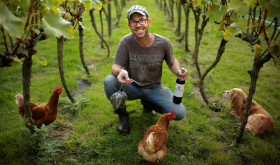
Richard writes about his new role talent spotting among younger wine writers: Introducing Harry Haddon, a South African wine blogger who caught our eye recently with his trendy sunglasses, long hair and entertaining writing. We invited him to share some thoughts about the current South African wine scene. You can read more about Harry here. As a wine region, South Africa is starting to feel like a teen coming-of-age movie. In the classroom of wine regions, it’s the kid who sits alone at lunch, wears weird clothes, but is still strangely confident, and manages to answer the teacher’s questions with aplomb.
You see, down here at the pointy end of Africa we’ve been making wine for rather a long time. But owing to inexperience, lack of industry cohesion, the ravages of apartheid and the isolation that resulted, we’ve turned out to be rather slow learners. Of course there are always exceptions, and along the way we’ve managed to produce some stonkers – although if I read about Vin de Constance being served to Napoleon one more time I’ll drown myself in a vat of Pinotage – but on the whole, wines of South Africa have not generally been worthy of the world’s best cellars.
Recently, however, it is as though someone has cued the montage, and with some upbeat 80s synths in the background, we’ve bought new clothes, run up some stairs, waxed on, waxed off, and the odd kid is starting to gain some popularity.
South African wines have been in the international wine press for all the right reasons lately. British wine writer Tim Atkin MW published a generally positive report on our wines,
Wine Spectator slapped us on the cover with an optimistic feature, and Purple Pages has seen more and more encouraging reviews of our wines over the last year (see
South Africa's next generation and
South Africa turns a corner, for instance).
In the classic three-act story structure, this is called 'training and making new allies'. It comes after the end of the first act, just as the protagonist enters a new world. The story of South African fine wine is really just beginning.
While the rest of the world sees a montage, us Saffas have seen the change slowly, vintage after vintage, and have known how awesome our wines are for some time. Here are three major reasons South Africa has started to emerge as a source of wine for those grand cellars of the world.
Reason one: well travelled winemakers who love wine
I honestly believe that one of the greatest steps South African wine has made over the last 10-15 years is the expansion of our young winemakers’ imagination. Of course there are great, older winemakers who have tasted and travelled extensively – I am generalising to make a point – but there have been far too many who have gone through a training college and come out being able to reproduce what has been made before, but not explore, expand and create the new fine South African wines that garner all the praise.
Here’s an anecdote to show what happens when younger winemakers’ scope is limited to older views, and trapped by local preconceived ideas. I was at a winery interviewing a young winemaker. I asked what her favourite wines outside South Africa were; if not wines, then at least regions. Her response surprised me. She mumbled, unsure, and I realised that she didn’t really have any. Which is fine, one’s winemaking is not judged on tasting experience alone. But later on in the interview we were talking about acid adjustment, and the wine maker quite clearly told me that you couldn’t make wine in South African without adding acid. I scooped up my jaw from the cellar floor. How could young winemakers hold this view?
It happens when they are railroaded from their studies straght into a job at a winery with little international exposure. When their idea of South African wine and what is possible is hemmed in by lack of experience. It is the start of what is derisively called a ‘cellar palate'. And if what’s in your cellar is not very good, it becomes almost impossible to create anything better.
Craig Hawkins, Chris Alheit, Andrea Mullineux, Alex Starey and Rudiger Gretschel are just a few of our young winemakers producing brilliant wines without any added acid, and there is one thing that they have in common. They have made wines all over the world, they drink wines from all over the world, and their total love for wine in all forms is obvious to anyone who meets them. They know that we can make world-class wines, but to ignore the world’s greats is to put themselves at a vast disadvantage.
When Chris Alheit launched his Cartology 2012 (Julia's
wine of the week last October) in South Africa he poured his wine next to weird and wonderful wines from across the globe. Craig Hawkins imports even weirder wines, and I am constantly envious of the
tweets Andrea puts out, as she tastes one great Rhône wine after another. The only way for South Africa to start competing properly on an international stage was for our winemakers to have assured, knowledgeable, and international palates. It is happening, and the results are showing.
Reason two: focus and scale
Another way that South African producers have been shooting themselves in the foot, arm, kneecaps, and sometimes the head, has been a desire to produce wines from as many different varieties as possible on their property. In the hope of making more cash, and serving as many different palates as possible, South African producers have compromised on quality. It’s that simple.
For older estates it is proving a challenge to cut back their portfolios, but newer producers are choosing what they can make best and sticking to it. Over the last couple of years, there has been an influx of small, high-quality producers into the local industry: winemakers who have launched their own brands while working for larger producers, or have struck out on their own. Their small-scale production has forced them to focus on producing a limited number of blends or varieties. Peter Allen Finlayson of Crystallum, David Sadie of David Wines and Francois Haasbroek’s Blackwater Wine are three that come to mind. There is also proper focus at larger producers such as Vilafonte, Glenelly and Chamonix among others.
Another benefit that we’ll see if we keep up the focus is that regions are going to work together making and marketing their top varieties. The Swartland Independent group is a great example of a region that has banded together, focused on certain grapes, and marketed their wine as a team when possible. Nobody can argue that is has not paid off handsomely.
Reason three: old vines and Rosa Kruger
You may not have heard of Rosa Kruger, and to add her as a reason for South Africa’s fine wine coming-of-age may be seen by some as controversial, but many of our recent headline-making wines have Rosa lurking in the background – or, more accurately, in their vineyards. Rosa has been largely responsible for finding, recording, and preserving many of the old vines being used in South African fine wine today. She is involved with Alheit’s Cartology, Callie Louw and Boekenhoutskloof’s Porseleinberg, Cape Point Vineyards, and Eben Sadie’s Old Vine Series. They alone make an impressive client list, but there are many more.
It’s not just her passion for old vines, but her ability to act effectively as a communicator between the farmers who own the vineyards and the winemakers desirous of their fruit. That Rosa is consulting with more and more producers shows not just her value but also that more producers are shifting their focus – and resources – to their vineyards.
That old vines make better wines is not agreed upon, and is not for this article. They are, however, part of South Africa’s vinous heritage and the preservation of them alone makes Rosa a vital industry figure. The wines they have produced, especially some of Eben Sadie’s Old Vine Series, have been spectacular.
These three reasons alone have not caused South Africa’s fine wine resurgence. Wines of South Africa’s (WOSA) marketing, better vineyard material and cleaner cellars are examples of others. But I think the three represent the biggest steps forward for a new chapter of fine wine in an old industry. Our first act has taken a long time to come to an end. With new, imaginative winemakers and viticulturists, the rediscovery of old vines and a renewed focus on quality, our second act begins. Progressive complications, further experimentation, and of course, confrontation await us, but the trajectory of South Africa’s fine-wine story now points to a happier ending than it did when all the world could smell was burnt rubber.