
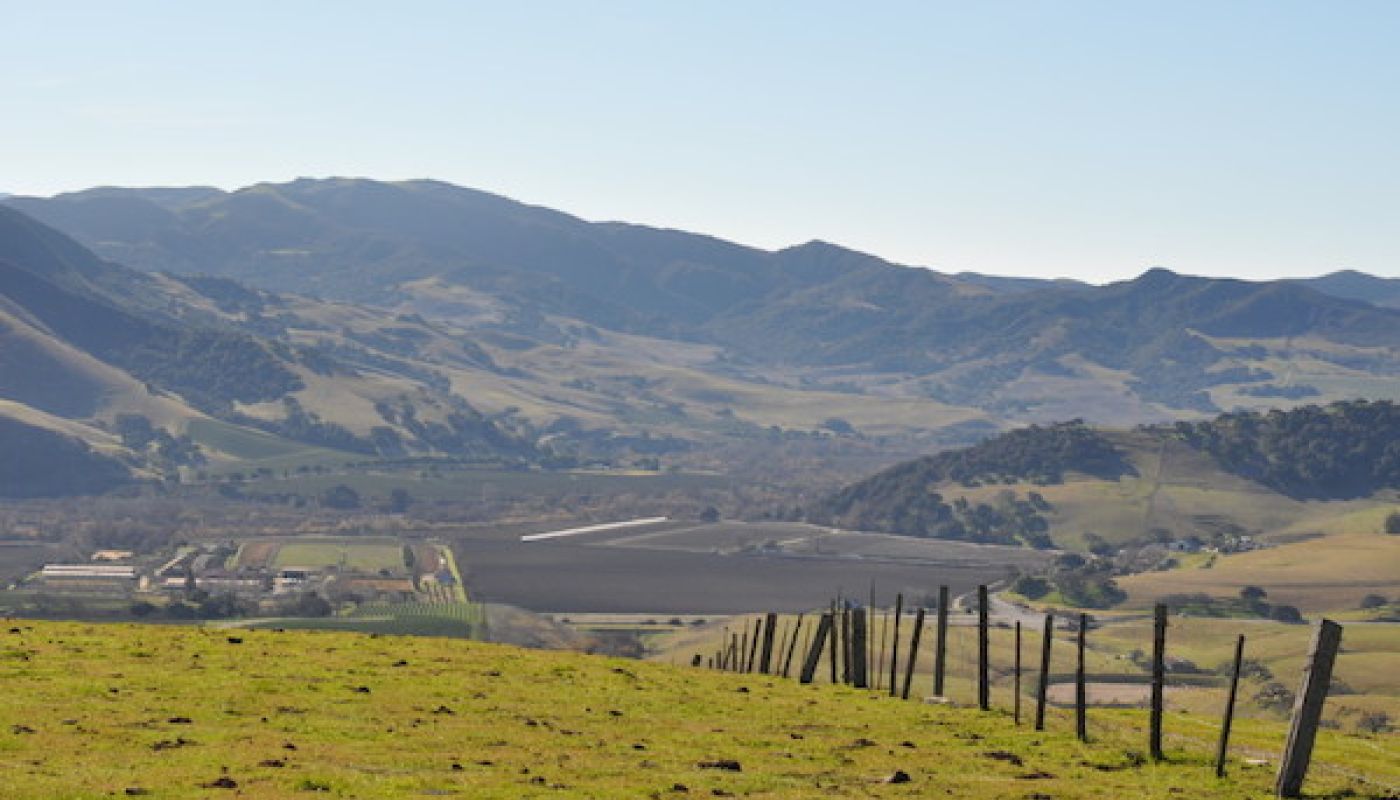
The TTB, the American wine regulatory body, today announces the official expansion of the Sta Rita Hills AVA by 2,296 acres (930 ha). The controversial ruling will become effective on 21 September.
The expansion of this highly successful appellation comes as a result of a petition filed by geographer Patrick Shabram in March 2013 on behalf of the owners of Pence Ranch and John Sebastiano Vineyard, both of which will be fully included within the newly expanded area. Sebastiano Vineyard sits largely within the original AVA boundaries but a small portion of the property, currently planted largely to Rhône varieties, is currently outside the eastern border. Sebastiano Pinot Noir is planted entirely within the already established appellation. Sebastiano Vineyard has been a fruit source for numerous vintners from throughout Santa Barbara County. Pence Ranch, to the east of Sebastiano Vineyard, sits entirely outside the current appellation and will now be included in the newly expanded Sta Rita Hills AVA. Seen above right is the view from the top of Pence Ranch, which operates its own Pence winery and also sells fruit to vintners throughout the extended region. As a result of the approved expansion, any vintners who bottle wine on or after 21 September 2016 from vineyards within the expanded area will be able to label those wines with the Sta Rita Hills AVA. Previously they would have been labelled Santa Ynez Valley.
The request for expansion was met with intense opposition within the Santa Barbara winemaking community. The Sta Rita Hills Winegrowers Alliance unanimously spoke against expansion, releasing an official statement to that effect. During the TTB approval process, two comment periods were met with extensive and divisive commentary, an unusual response to appellation requests in the United States, which are often a matter of course rather than dissent.
The conflict over the appellation expansion originates partially with how the petition was filed. The vintners of the Sta Rita Hills and Santa Barbara County more broadly have largely been a tight-knit community. The appellation for the original AVA, for example, was submitted by a group of vintners who worked together to understand the unique growing conditions of the region. But the expansion request submission to the TTB came only from Blair Pence and the owners of Sebastiano Vineyard and served as the first notice to any other vintners in the region that such a request was being considered. For many, the lack of communication between Pence and the other vintners of the region was troubling and marked a change in ethos for the community. Below is the view north towards Sea Smoke from Sanford & Benedict, one of the pioneers of the appellation.

The quality of Pence Ranch and its surrounding area was never in question. Pence Ranch primarily grows Pinot Noir, with some Chardonnay, and a very small portion of Grenache. The Pence team is also in the process of establishing Syrah. Pence has quickly established the quality of the estate and its farming.
What is at stake in the disagreement was whether or not the acreage in the expansion is congruent with the rest of the Sta Rita Hills. For those concerned about the expansion, it was a question of preserving the integrity of a globally recognised grape-growing region. Most locals recognise the area just east of the original Sta Rita Hills as its own distinct zone, colloquially known as the Buellton Flats. The Buellton Flats have not seen many vineyards planted there and so there has been no reason to establish it as its own sub-appellation.
Sta Rita Hills was officially approved as an appellation in 2001. (The name was changed from Santa Rita Hills to the shorter Sta Rita Hills in 2005 to avoid a name conflict with the Chilean producer Santa Rita.) Nestled within the larger Santa Ynez Valley AVA, the Sta Rita Hills was delineated originally in order to distinguish the cooler growing zone circling the Santa Rita Hills on the western side of the long Santa Ynez Valley from the warmer climates further inland. The original appellation application was submitted by a group of long-standing winemakers in the region. They determined the boundaries of the subregion in relation to the eponymous Hill formation at the centre of the AVA and circumscribed by the surrounding mountain peaks of the Purisima Hills to the north and the Santa Rosa Hills to the south. Part of what makes this area unique is the intensity of the maritime influence and its cooling effect on the growing conditions of the subzone thanks to its proximity to the Pacific Ocean.

The Sta Rita Hills, seen above from Domaine de la Côte, in conjunction with the ocean influence generate the unique growing conditions of this distinctive appellation. The hills effectively hold both fog and cool temperatures, concentrating the maritime influence of the neighbouring ocean, thus creating a cool-climate growing area. To the east of the appellation, the hills open into a more open valley formation and the intensifying effect dissipates. The rest of the valley still receives fog and wind from the ocean but in a less concentrated manner. Generally speaking, temperatures are warmer travelling east. Locals often reference a shorthand equation that proves more-or-less accurate: for every mile travelled east the temperature increases by 1 ºF (0.5 ºC). While the maritime influence does venture the full length of the Santa Ynez Valley, the impact diminishes as it travels further inland to the east.
For vintners opposed to the expansion, the acreage to the east of the current appellation represents warmer temperatures as well as differing growing conditions outside the nestled hill formation of the original AVA. Vegetation and soil conditions outside the original formation also change, a consideration used to determine the boundaries for the original appellation.
Geographer Shabram, however, has argued these differences are minimal and that the expansion remains congruent with the original goals of the Sta Rita Hills. In order to justify his position, Shabram gathered data from weather stations located both at and near Pence Ranch and at sites from within the original appellation. According to Shabram, temperatures at Pence Ranch remain below those just inside the current appellation boundaries to the south west of the Ranch.
Shabram’s petition for expansion rested primarily on temperature and climate analysis. Those in opposition to the expansion also emphasised the relevance of soil and vegetation data. While Shabram acknowledged soil and vegetation are relevant to appellation definitions, he saw them as less definitive in this case than climate data. The soils that sit within the Sta Rita Hills are less prevalent as one travels east into the Santa Ynez Valley, and the sort of oaks that grow there are also different. For example, the oaks that grow within the original Sta Rita Hills can be found precisely and only within the current appellation boundaries.
Appellation adjustments are generally meant to fine-tune designated boundaries as greater insight of the growing conditions arise. Indeed, Shabram argues the vast increase in knowledge thanks to the implementation of weather stations justifies the now-approved expansion of the Sta Rita Hills.
What remains to be seen is whether or not this expansion will lead to applications for further expansion. Central to the notion of AVAs under the TTB is the idea that the growing conditions of an area within the AVA boundary must be distinctly different from those areas immediately outside the boundary. However, the TTB’s approval process depends entirely on submitted data and arguments for how to interpret that data. That is, the TTB does not do any of its own research but instead depends upon the congruence of applications submitted and the reasonableness of the research included in those applications. Comment periods are designed to allow discussion of that information and its appropriate interpretation. Shabram’s argument for expansion rested on showing that the newly included acreage was not distinct enough from the already established Sta Rita Hills to be excluded. However, examination of the data would seem to indicate that the there is greater distinction between the newly amended area and that within the original appellation than there is between the new acreage and any of its immediate surroundings. That is, it is not clear what distinguishes the newly expanded region from that immediately outside it. If that is true, then, in theory there is nothing to stop other developers from submitting successful arguments for further expansion into the Buellton Flats. At the same time, the TTB is unlikely to continue accepting a cascade of applications and so logistics will presumably limit what the TTB is willing to consider and will certainly limit any actual expansion in the future.













