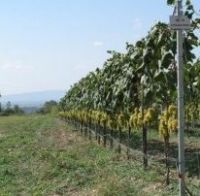
From a special wine supplement published by the Financial Times today. This photograph of a row of Tsulikidzis Tetra vines was taken by José Vouillamoz, co-author of Wine Grapes, at the ampelographical collection of Georgia established in 2009. This is just one, one of the rarer, of the 425 Georgian, Russian, and Moldovan varieties planted there. José thinks this variety may well be more widely planted in the future.
What a difference a decade makes. In the mid 1990s I made a television series for BBC2 shot around the world of wine. I ended it in Chile forecasting glumly, 'I have seen the future and it's Merlot, Cabernet and Chardonnay'. At that time it really did look as though the world's vignerons were determined to uproot their local grape varieties and replace them with the perceived glamour of an 'international' vine, one that everyone had heard of.
Just 10 years later a hearty swing of the pendulum in the opposite direction was already in evidence and today's professional wine buyers will hardly touch a Merlot, Cabernet or Chardonnay unless it's grown in one of the few places in the world where it has been grown traditionally. They are much more interested in sniffing out so-called 'heritage varieties', the vinous equivalent of heirloom tomatoes, grapes that are incontrovertibly local.
This is not just a wine trend. It's in tune with our general desire for natural harmony, traceability, the locavore food movement, and our increasing realisation of the importance of biodiversity.
It began, perhaps counter-intuitively, in New World countries, countries whose wine industries are just a few centuries old or less so don't have their own indigenous vine varieties. Australia, as so often, was in the vanguard. In the 1970s Australian wine producers and consumers had fallen in love with all things French. The produce of ancient Shiraz vines in the Barossa Valley was spurned in favour of fruit from baby plants of Cabernet Sauvignon, revered because it can make such classic and expensive wines in Bordeaux, first growths and the like. In fact, so low was demand for the ubiquitous Shiraz that its fruit was blended into fortified wines and even had its colour removed to be used for the white wine that was so fashionable then.
It was not until the mid 1990s that Shiraz began to earn newfound respect. Australians realised that this vine, much longer established in most of the country's vineyards than the newfangled Cabernet Sauvignon was much better suited to most Australian wine terrain. Today in Australia the more recent French import is largely relegated to a handful of the most suitable regions for this late-ripening variety.
A few years afterwards, the Argentine wine industry went through a very similar process of re-evaluating the familiar. Malbec had long been the most commonly planted red wine grape in South America's most important wine producing country by far. As such it commanded only a fraction of the respect that the very much less common Cabernet Sauvignon with its glamorous associations with Bordeaux did. Cabernets were routinely priced much higher than Malbecs. But slowly there was a realisation that, while by now every wine producer in the world was trying his or her hand at Cabernet, ripe, velvety Malbec seemed to be distinctively and uniquely Argentine. The huge success that Argentine wine exporters have enjoyed in the US has been almost entirely built on Malbec's offering something very different from California Cabernet or anything from Europe.
This set Argentina's great rival across the Andes thinking. If Australia was doing so well with its Shiraz and Argentina with its Malbec, shouldn't Chile have its own signature grape variety? And indeed many Chilean winemakers have been encouraged to maximise the appeal of Carmenère, an old Bordeaux red wine grape that was imported across the Atlantic in the 19th century but, having almost died out in its homeland, is today a Chilean speciality.
Although the sensory quirkiness of South Africa's very own 20th-century crossing Pinotage has been a bit too much for Cape wine exporters to promote this variety above all others, with white wines they have certainly played the Chenin Blanc card for all they are worth. There is now twice as much Chenin planted in the Cape winelands as there is in its homeland on the Loire. South African vintners are with reason particularly proud of the intense, ageworthy produce of their country's old Chenin bushvines.
Within Europe this century and at the end of the last we have seen a very similar phenomenon of celebrating the local. Sicily, currently one of Italy's most dynamic wine regions, provides a particularly vivid example. In the early 1990s the most admired Sicilian wine producer was Planeta in the west of this historic Mediterranean island which did a great job of putting it on the world wine map via a series of particularly well-made Merlots, Cabernets and Chardonnays.
But as pride in indigenous vines began to swell, perceptions began to change. Suddenly the most talked-about Sicilian wines were those made in the east of the island from such local grape varieties as Nerello Mascalese, Nero d'Avola and Frappato. Their flavours provided a welcome diversion from those of any of the famous international grape varieties with which wine consumers and, especially, producers were becoming bored. Planeta, ever responsive, have diversified east and now also make fine wines based on Sicilian grape varieties.
Similarly particularly on the Italian mainland, but also throughout southern France and Iberia, there has been a complete re-evaluation of indigenous v international vine varieties. Whereas a typical, well-funded, new wine operation in Spain in the early 1990s might have put all its eggs into a basket marked Cabernet and Chardonnay, its equivalent today is much more likely to be researching almost-forgotten local varieties that have shown real aptitude for the region. I call as witness the explosion of interest in the wines, whites and now reds, of the far north-west corner of Spain where wine lovers are drooling over not just Albariño and Mencía but the more obscure likes of Loureira, Treixadura, Godello, Merenzao, Juan García, Espadeiro and Caíño. Many of these are also grown in Portugal, one of the country's that most obviously withstood the late 20th-century trend to pull out local grape varieties to make way for international ones. It deserves to benefit from this.
When we put together our recent book Wine Grapes – A complete guide to 1,368 vine varieties including their origins and flavours, we were very aware of heightened and increasing interest worldwide in indigenous varieties and even, in relatively new wine cultures such as Australia, in what they call 'alternative varieties', something to tickle the fancy of a palate now jaded by too much Shiraz and Chardonnay. We arrived at the number 1,368 by limiting our detailed analyses to those grapes responsible for, as far as we could ascertain, wines in commercial circulation. The panel shows how many genetically distinct varieties we found using these criteria for the top 10 countries in terms of their viticultural biodiversity.
Italy 377
France 204
Spain 84
Portugal 77
Greece 77
Germany 76
USA 76
Switzerland 39
Croatia 39
Hungary 34
Wine Grapes – A complete guide to 1,368 vine varieties including their origins and flavours by Jancis Robinson, Julia Harding and José Vouillamoz Allen Lane/Ecco RRP£120/RRP$175, 1,240 pages
⁞