I’m a bit cross. Cross about the word craft. How come all these niche beers and spirits attract the word craft as a prefix that bestows artisan virtue on them whereas no one talks about craft wine*?
I’d guess that well over 90% of the wines I write about would qualify as craft wines on the basis that they are made by relatively small-scale, independent producers who put their heart and soul into how their wines are grown and made, all of them being essentially determined by local conditions and a single ingredient, home-grown grapes. I know of no craft brewer or distiller who grows all their own ingredients.
Furthermore, there is one very important way in which wine production is very much less industrial than brewing or distilling: the quintessentially finite nature of how much is produced. If craft brewers or distillers run out of stock, they can just make a bit more – and beer and spirits are much, much quicker to produce than wine. But the vine grower and winemaker have just one production run a year, its volume decided by the area of vineyard, what is planted on that land (a commitment that is generally made for decades) and the vicissitudes of a single growing season culminating in the autumn grape harvest.
If I sound somewhat querulous it may be because, as a lifelong wine enthusiast, I am feeling increasingly under threat. In the US, craft beer sales are increasing much more dramatically than those of wine – up more than 20% according to Neilsen. And for me, based in the British Isles, I am becoming increasingly aware that the wine space is being encroached on by other drinks, particularly craft beer, craft spirits and cocktails.
It began at last year’s Kerrygold Ballymaloe Literary Festival of Food and Wine in southern Ireland when one of the most entertaining speakers was Garrett Oliver, editor of The Oxford Companion to Beer and a leading light of America’s increasingly powerful and successful craft beer movement. He could not have been cooler, and was effectively badmouthing wine, explaining how it was time for fermented grape juice to move over and make way for fermented malted barley.
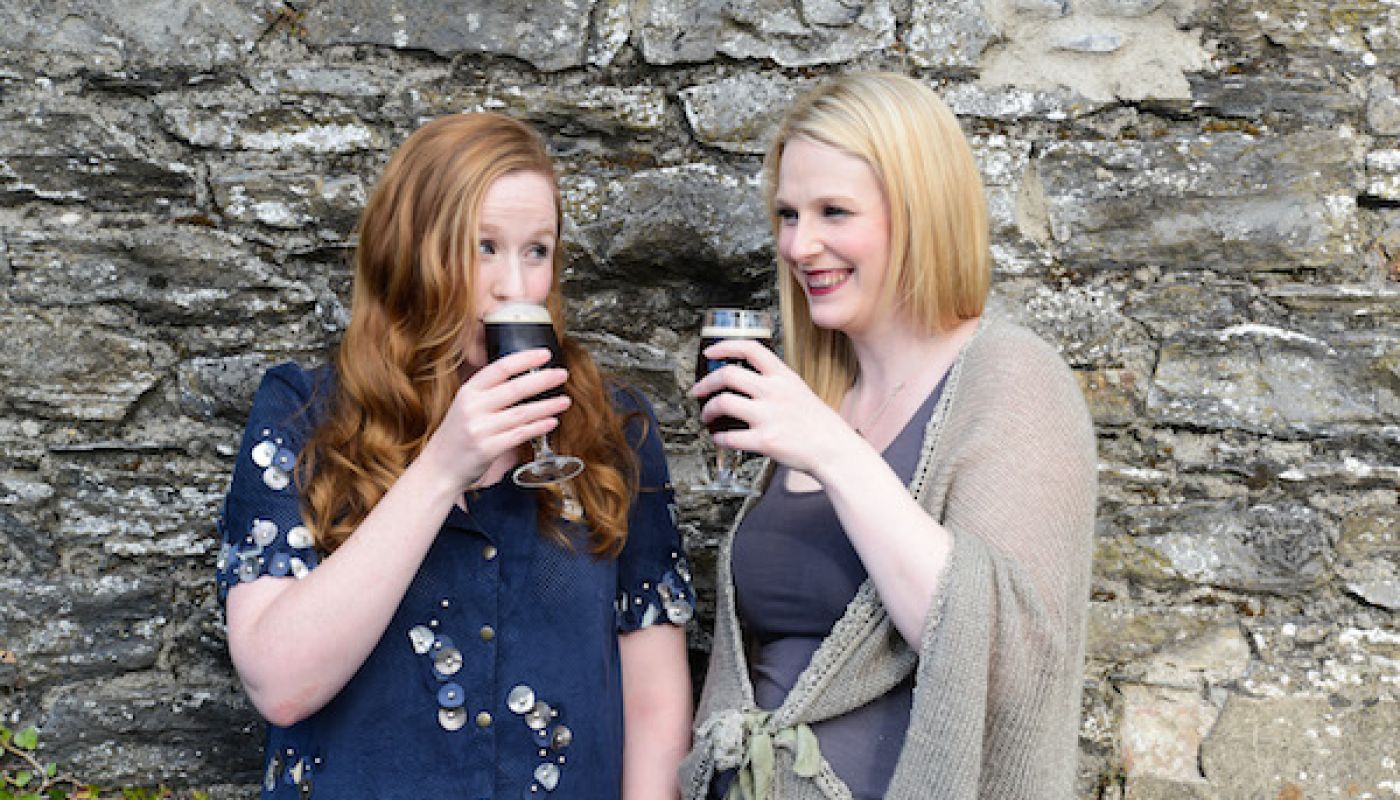
Then this year at Ballymaloe I met the Boyle sisters, glamorous women in their thirties. They are big fans of wine and are very knowledgeable about it. But they are also brewers. Susan and Judith Boyle (pictured above, left to right, by Dawn Broughan) were brought up in a pub and now produce Brigid’s Ale, named for the patron saint of brewing, from strictly local ingredients in their native County Kildare.
In the mid 1980s there were just five big breweries in Ireland. Today there are more than 60, most of them tiny and run by hipsters, or at least young enthusiasts. This flowering of interest is mirrored in the spirits business too, with distilleries mushrooming in the Emerald Isle. (Admittedly all this activity is encouraged by the fact that Ireland is too cold for viticulture.)
Susan Boyle’s career path began at university where she fell in love with wine. She trained as an actress and now tours with a show called The Tales of Ales. I asked her whether there was tension between the wine and beer factions in Ireland. She claims not ‘because Irish wine doesn’t exist’ but, as well-travelled wine lover, she is quick to point out that ‘Australian and New Zealand winemakers couldn’t exist without beer’.
A highlight for her last year was a dinner in Dublin curated by Garrett Oliver, who showed some very special non-commercial beers made by maturing them on different lees, those of wine and cider, for instance.
Of course there need not necessarily be a conflict between wine and so-called craft beer and spirits. Indeed there is a small trend among wine producers to start brewing and sometimes distilling as well. But the fact is that there is only so much alcoholic drink any one consumer can, or at least should, drink.
My friend Dave Broom is an acclaimed British writer who now specialises in spirits but only after wanting to produce wine in Margaret River and finally realising it would be easier to make a living in the much less populated field of pontificating about the strong stuff. I asked him what he thought about the growing competition between wine and craft beer and spirits for what in the trade is called ‘share of throat’.
He told me, ‘I don’t believe that wine is becoming less cool. Rather I think that beer and spirits are learning some lessons from wine and are now using some of the same cues. The movement started in America with the rise of craft beer, very much a reaction against the ersatz beer the massive breweries were pumping out. In time, this spread to spirits – many of the craft distillers are former brewers. Some are also winemakers. The spirits movement, however, was less anti big brand and more an attempt to widen the offering. This has now spread across the globe.’
But like me he is aggrieved at the misuse of the term ‘craft’ that for many consumers links high quality exclusively to small scale and relative obscurity. ‘There is an element of emperor’s new clothes about “craft” in both beer and spirits', according to Broom. ‘Initially, people buy into the concept and refuse to engage their critical faculties because the story is so good. I think we are now at the stage when consumers are looking at the “craft” products and asking themselves the question, “is this really worth twice the amount of an existing brand?” ‘
I know for a fact that many of the most famous spirits, even those made in quite substantial quantities, are the product of ingredients and expertise that could hardly be bettered anywhere, and certainly not by a cottage industry.
But it would be difficult to think of a really big-volume wine that is as good as the tens of thousands of small-scale, ‘craft’ versions. First-growth red bordeaux may be made in surprising volumes – perhaps 40,000 12-bottle cases a year at Château Lafite, for instance – and has become justifiably, if regrettably, a true luxury product. But the really mass-market brands such as Yellow Tail, Gallo and Blossom Hill are not craft but truly industrial products that sell millions of 12-bottle cases each year.
It is notable, and to me sad, that the world’s second largest wine company Constellation Brands, which has admittedly always been involved in a wide range of drinks and not just wine, announced recently that it is shifting its focus – from wine to beer.

* Mind you, only yesterday discount supermarket Aldi unveiled the bottles above to the London wine media. This is their attempt at 'craft wine', distinguished chiefly by its packaging rather than its taste. I'm indebted to my colleague Victoria Moore of the Daily Telegraph for the image and to Charles Metcalfe for the report on the quality of the wine. Andrew Howard MW attended the tasting on our behalf and will be reporting in more detail on Aldi's current wine range.