Like many, I suspect, I am rethinking my attitudes to travel. Just as lockdown should have ended executives’ transatlantic hops ‘for a meeting’, I am now feeling much more wary of flying in general, ever mindful of my carbon footprint. (The Maldives trip I described recently was a once-in-a-lifetime experience.) Rail travel looks increasingly appealing – even if still criminally expensive relative to budget airlines. Recent rail journeys between London and Bordeaux were only about an hour longer than the total time involved in flights between those cities. But on the basis of a recent week in London, I’m even wondering whether as a wine writer I need to travel at all, especially to wine estates I have already visited.
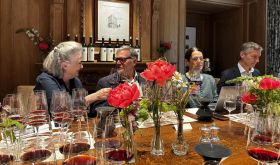
The week before last I had the chance to sit down, on six different occasions, with leading wine producers from Bordeaux, South Africa, Montalcino, Napa Valley, Bolgheri and Barossa. They virtually all had the same preoccupations: climate change and vineyard labour.
Monica Soldera and her husband Paolo Franco came over from the family’s legendary Case Basse estate in Montalcino. They mentioned the effects of climate change on their Sangiovese vines no fewer than three separate times, though maintained that the scientific research programmes instituted by Monica’s late father Gianfranco on the terroir he carefully selected back in 1972 had armed them well for hotter summers.
The 2017 vintage of their Toscana Sangiovese (so labelled since 2006 when Gianfranco left the official Brunello di Montalcino producers’ group) was the latest release they wanted to show off but the harvest, which began on 26 August, was the earliest ever, and the grapes had had to fight off sunburn in 40 °C (104 °F) temperatures. Crafty leaf strategies were needed.
As for employees in vineyard and cellar, they work with the same team every year from a local company, most of whose staff are, rather unexpectedly, Bangladeshi. They hoe, pick and do the vital selection in the winery of grapes deemed perfect enough to produce their wine (which sells for around £600 a bottle). Rejected grapes are put into large bags and disposed of way outside the wire fence that surrounds this hallowed property.
Torbreck enjoys a similarly exalted status in South Australia’s Barossa Valley. Winemaker Ian Hongell of Torbreck confirmed that many grape growers in less favoured Australian wine regions had to leave grapes unpicked this year, and may have to next year too, as a direct result of the punitive tariffs on Australian imports imposed by China, until recently Australian wine’s most important market.
This was especially painful since South Australia, the country’s wine state, has experienced two very good-quality vintages in 2021 and 2022 when, rather to everyone’s surprise, the weather has not been too punishingly hot and dry – as it was in 2020 and 2019.
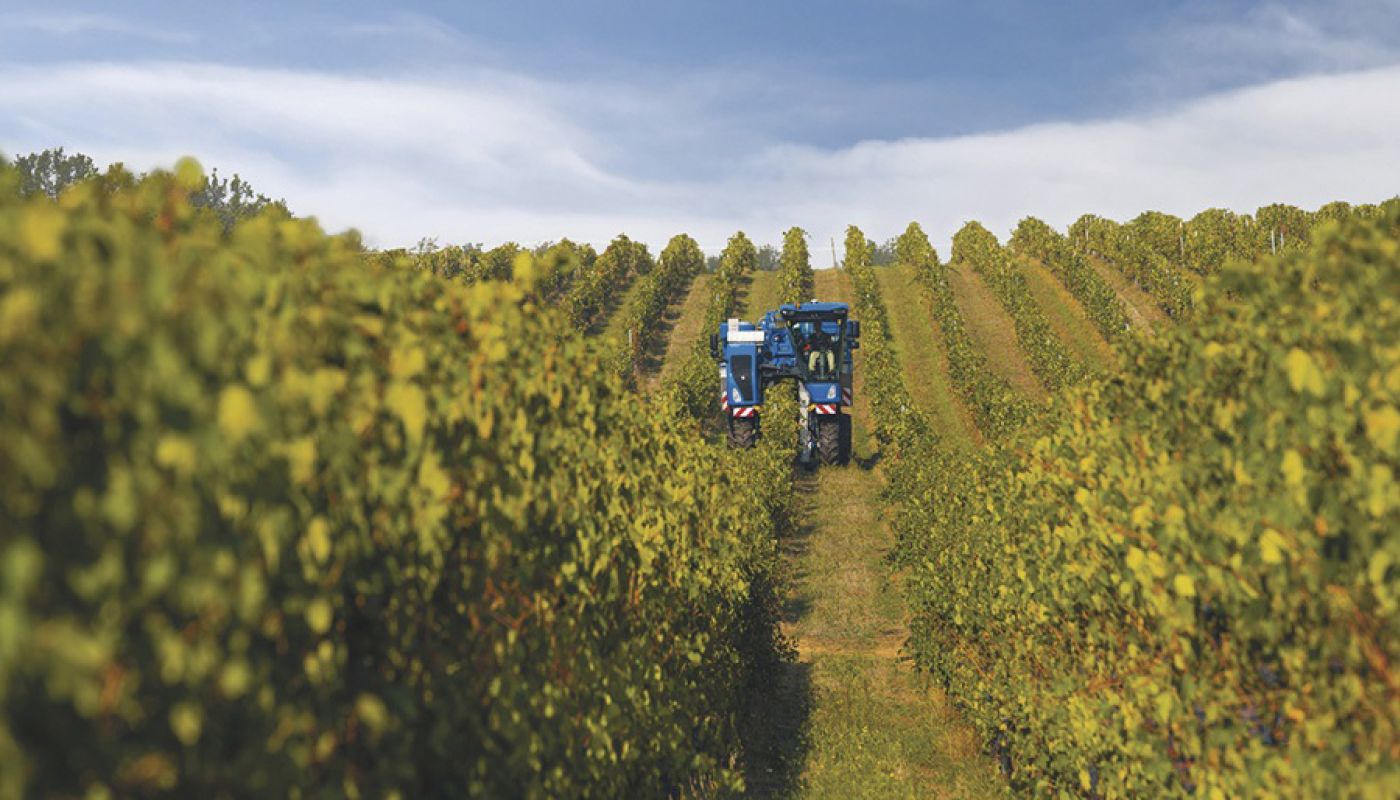
The real problem recently for Australian vintners has been labour. Closed borders kept out the usual backpackers, interns and Cambodian and Vietnamese itinerant workers (traditional Asian conical straw hats have become commonplace in Australian vineyards). And such labour as was available tended to find more congenial alternatives, often in hospitality. Being a barista beat coping with blistering sunshine, ‘bee stings, sticky hands, spiders and snakes’, according to Hongell, who admitted that ‘the smell of coffee is more appealing than the smell of a diesel tractor’. The result was a sharp increase in machine-picking (pictured above) in the Australian wine industry, which is already much more mechanised than most. Although the old vines in which Torbreck specialise have to be hand-picked.
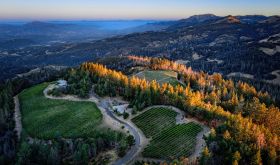
COVID also affected the launch of a new Napa Valley Cabernet with impeccable credentials. DVO is a joint venture between Ornellaia, one of Tuscany’s most glamorous estates, and Dalla Valle, a cult Napa producer based on a hillside above Oakville. Axel Heinz, 51, represents the Italian faction on behalf of the Frescobaldi family while 34-year-old Maya Dalla Valle, currently taking over management of the estate from her Japanese mother, oversees the blend for DVO from several hand-picked vineyards other than her family’s. Both of them, coincidentally, trained and worked in Bordeaux, Heinz working for some time at Ch La Dominique, Dalla Valle for shorter periods at Petrus and Chx Latour and Canon La Gaffelière, as well as interning at Ornellaia in 2013.
The 2018 was the first commercial vintage of DVO (after a trial in wildfire-affected 2017) and was scheduled to be launched in 2020 but COVID put paid to that. It was hugely frustrating for Heinz that he was unable to travel to California to oversee the harvest and blending of recent vintages and had to make do with couriered sample bottles and Zooms instead. The 2018 was finally launched in the US last autumn, with Heinz kicking his heels in Bolgheri between February 2020 and November 2021.
Both Ornellaia and Dalla Valle are located in wine regions notable for their alcohol levels, which have tended to increase thanks to our warming planet. Heinz admits that in 2008 Ornellaia was ‘a bit much’, so since then they have instituted various changes in the vineyard, including increasing yields a little so that sugar (and therefore alcohol) levels accumulate a bit more slowly.
But the effects of climate change have been most marked in Napa Valley, which has been seriously affected by wildfires in two (2017 and 2020) out of the five vintages of DVO so far made. And the water shortage in Napa Valley is so marked that in 2021 some grape-growers who wanted to irrigate were unable to.
Maya Dalla Valle is able to rely on a permanent workforce of nine for their 8.5 ha (21 acres) of vines, with going rates of $30 to $75 an hour being probably the world’s highest for vineyard workers. Heinz is responsible for an annual production of 50,000 cases (16 times more than Dalla Valle) and also has a stable workforce, in his case including Senegalese, Moroccans and Eastern Europeans.
The most dramatic response to climate change was described by South Africa’s pioneer new-waver, Eben Sadie of Sadie Family, on his first visit to London for five years. ‘Our wines have changed a lot. The acid meltdown is real’, he said, shaking his head over rising alcohol levels as acid levels in grapes plummet. ‘And it’s not just in Swartland but also in Burgundy and the Mosel. My Grenache moving from 13 to 13.5% is not a disaster but Pinot Noir [in red burgundy] at 15% is.’
His response has been to import from Europe, from 2002 onwards, Mediterranean grape varieties that hang on to their acidity and are much better equipped to cope with hot, dry climates. Their produce is not yet included in his superstar blends Columella and Palladius but they will be once the vines are old enough. He is particularly thrilled by his microvinifications of Assyrtiko from the island of Santorini. ‘Poor Greeks!’ was his comment. ‘My children’s wines will be incredible. And we have the cold Atlantic right there [next to the vineyard].’
There is presumably no shortage of vineyard workers in South Africa; the challenge is to effect real social change for them. (I always give a wry smile when I read the proud boast ‘hand picked’ on the back labels of South African wine.)
The exception to this obsession with rising temperatures? Emmanuel Cruse of Ch d’Issan in Margaux, who hosted a rather magnificent dinner for 70 in Kensington Palace to celebrate the 870th anniversary of the marriage of Eleanor of Aquitaine and Henry II of England, at which Issan was apparently served.
After a run of hot, fully ripe vintages Bordeaux, like much of France, experienced an unusually cool, wet growing season last year. Cruse railed against a new generation of ‘engineer’ Bordeaux winemakers who seem to him to apply a winemaking recipe, but who have ‘no experience of poor vintages. We have everything we need in terms of equipment in the cellar but what we need much more of is work in the vineyard.’
This is presumably of even greater importance as vines combat ever less predictable weather.
Recommended wines
With (high) prices per bottle in the UK and US.
Gianfranco Soldera, Case Basse 2016 Toscana 13.5%
£525 in bond World Wine Consultants SA; $599–$889 various US retailers
Torbreck, Descendant 2018 Barossa Valley 15%
£114.06 Vinatis UK; $100 approx various US retailers
DVO 2018 Napa Valley 15.4%
About $320–$400 various US retailers
Sadie Family, Palladius White 2019 Swartland 12.5%
£69.90 Hedonism, £70 The Sampler; $120–$189.99 various US retailers
Sadie Family, Columella 2018 Swartland 13.7%
£90 in bond Wine Owners Exchange; $119–$199.99 various US retailers
Ch d’Issan 2015 Margaux 13.8%
£55.50 in bond Grand Vin Wine Merchants; $78.59–$141 various US retailers
Tasting notes in our tasting notes database. International stockists on Wine-Searcher.com.