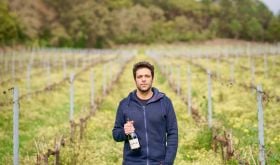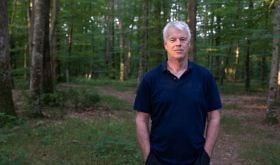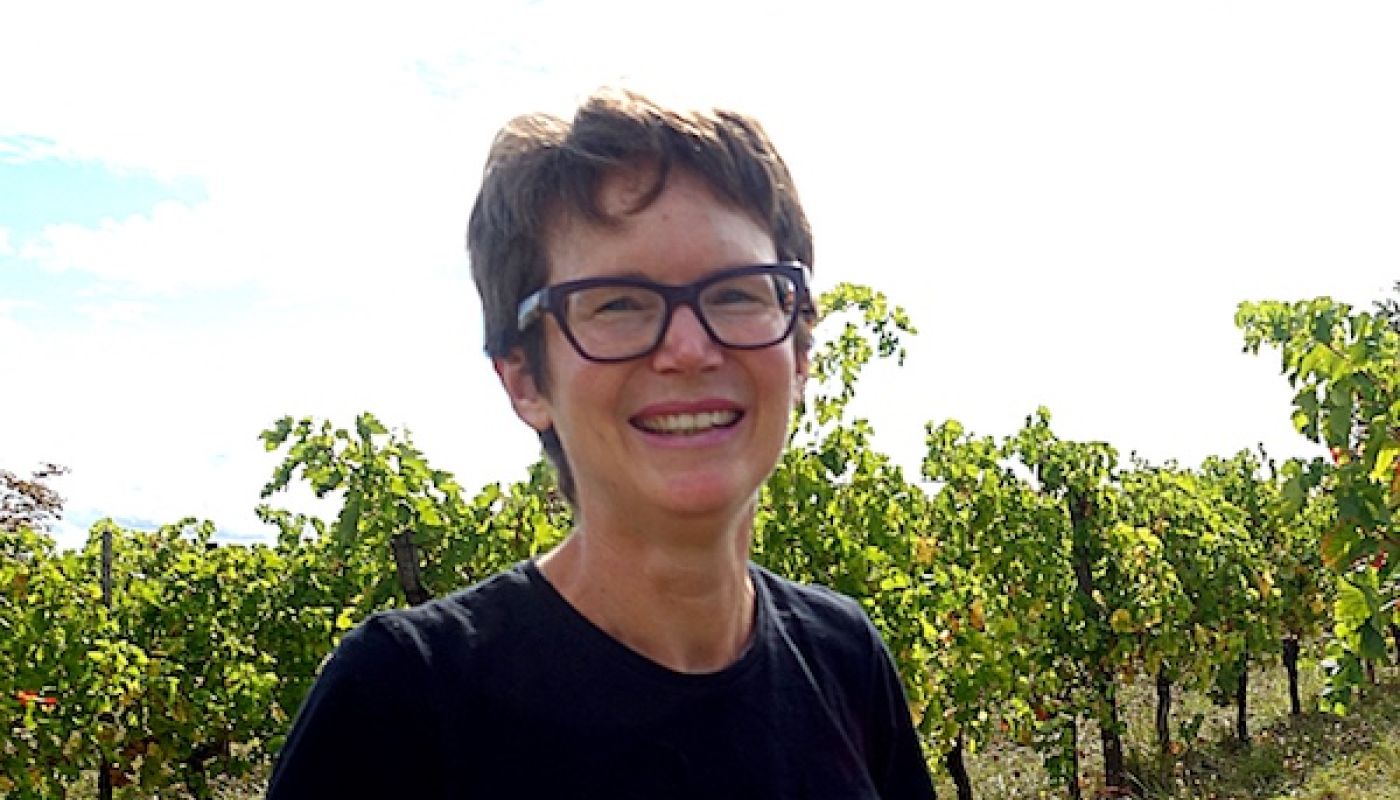
... an organic and biodynamic vigneronne, wine teacher and writer who has published three books: Grape Expectations, Saving our Skins, and Wine: The Essential Guide to Wine-tasting and More. A fourth, Glass Half Full, is due out in April 2017.
I am 48 and share my passion for wine and ecology through wine classes, vineyard walking tours (www.frenchwineadventures.com) and ecological accommodation at Château Feely an hour from Bordeaux in the Dordogne in south-west France.
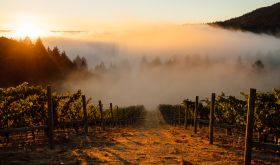
Her vineyard is pictured below.

Wine professionals need education on organic wine
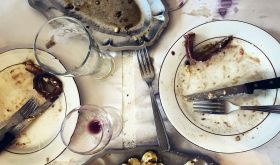
A few weeks ago I dined at a restaurant in Paris listed in a Condé Nast Top 50. After perusing the wine list I asked the sommelier to indicate the organic wines.
'We only have one organic wine', he said. 'I don't like to have organic wines since one out of two bottles are bad. I can't take a risk like that with my wine list.'
I had to use self-control not to over-react, electing silence as the best response.
'But half of the list is biodynamic', he said, filling the gap.
'Oh, that's interesting', I said, biting my tongue.
'Yes', he continued, 'a lot of the biodynamic growers don't want to follow the organic rules and be certified, they don't want to risk their crop.'
My tongue was in agony, I had to wade in.
'A grower has to be certified organic before they can become certified biodynamic so if half are biodynamic then at least half are organic', I said.
He looked shocked, realising he had effectively told me more than half of his wines were 50% bad.
'Mais oui', I continued in French. 'Perhaps you have more organic wine than you realise. This idea that the biodynamic growers don't want to follow the organic rules is false. In biodynamic we have to follow even stricter rules than organic. I am an organic and biodynamic winegrower here in France so I know the rules inside out.'
I gave him a quick organic and biodynamic 101. Eyes wide, he raced off to find the one white wine he thought was organic. It was, and en plus, it was a fine Viognier from the Rhône, one of the lucky ones in the good 50%.
Our starter salads arrived, tomato and goat's cheese for me, langoustine for my sister. We slurped them up, delighting in the conversation, food and wine. It was two years since we had seen each other; she lived way across the yawning Atlantic in California. It was great to be together.
At the interval between courses I requested the carte des vins, my main of duck called for a red. In the selection of affordable wines by the glass was a Bourgueil that looked tempting. I had a soft spot for the appellation as it was where my partner Sean and I fell in love with France and decided to follow our vineyard dream. Since my sister had shared that fated holiday, it seemed fitting.
I flagged our sommelier down and asked for a glass 'if it's organic'.
'I will check', he said, slightly harassed, then returned with a delighted smile.
'In fact, it is organic!' He turned the bottle to the back label to show the organic EU leaf logo, the guarantee of organic practices in the winegrowing and also in the winemaking.
In a wine shop in Tunbridge Wells in England back in the spring, the proprietor told me most of his wines were organic but they didn't have the logo because the producers didn't want the excessive cost and administration of the certification. Like this evening in Paris, I had to bite my tongue to avoid over-reacting.
I quietly explained that in the EU it is illegal to say you are organic if you are not certified organic. In France the fraud squad could put you in jail for such a statement. As for the first argument put forward by these growers that the paperwork is too onerous, the documentation required for the organic control, the accounts, the spray-treatments file and the winery-entrants file are legally required for all winegrowers not just for organic so the administration is no more onerous. As regards certification fees, in France for the first five years 80% of these fees are covered by the state, making it a fee of around €100 per year for a 10-hectare estate. There is no excuse for a vineyard truly working organically not to be certified.
In Kent I had had a similar eyes-wide reaction as I had from this sommelier. The gentlemen believed what they were saying; I don't think they were trying to dupe me. The wine-shop proprietor had been misled by growers so both sides of the profession were to blame. I didn't get out that much but when I did I was shocked by the lack of knowledge about organic (and even more so about biodynamic) and what it meant.
Our Parisian sommelier, meanwhile, delighted that he had organic wine he didn’t even realise was organic, poured the Bourgueil.
As I leant into the glass I was transported back to our holiday 20 years before. The wine was such a strong connection to the place I felt like a time traveller. I passed the glass across to my sister, who took a deep sniff then a sip.
'Incredible. It's like we are back in Bourgueil', she said. 'My martinis don't do that.'
My sister had gone over to the other side. She drank martinis rather than wine since she found wine gave her a bad hangover. I had heard that from a few people. I always asked 'was it organic wine?' The pesticide residues in some chemically farmed wines are sure to have a bad effect that goes beyond simple alcohol excess.
We took a few moments to revel in the magic spell of fine wine in its ability take us places with a simple sniff then our mains arrived and we got back to catching up on two years missed.
By the time we finished our cheese course the sommelier had defrosted and was chatting with me about where we were, what we made and where our wines were available. Before leaving we exchanged emails and he asked if I would consider sending him samples. I came away with a potential new client in Paris and the realisation that there was a need for education on organic wine.
Biodynamics – about harmony and results not weird stuff
As I wandered the Musée d'Orsay in Paris a few weeks ago a quote on the wall of the back staircase stopped me in my tracks. I don't remember who said it but its essence was:
'Harmony in nature is when the means to get there is in perfect balance with the end result.'
It captured the notion of terroir-driven winemaking, seeking harmony from what nature gives us, not trying to create a product that is the same all the time. We seek equilibrium with the vintage, the weather and the work that has taken place throughout the year.
Biodynamics can aid this quest, but when we started applying biodynamic teas a decade ago it was not an effort to seek harmony, it was a solution to downy mildew in our vineyard. In our first two years of organic conversion we used the maximum dose of copper allowed in the EU, six kilograms per hectare (kg/ha), and still had fungal disease, not bad enough to lose our crop but enough to give us sleepless nights.
Now, ten years later, our copper dose over a five-year average is a quarter of the EU maximum and we have no fungal disease. We put this result down to our vines' disease-resistance increasing – their immunity grows with each year of natural farming – and to the biodynamic anti-fungal teas and wider practices. Biodynamics offered a practical point solution to disease but over time it has delivered more, including a better balance, a harmony to our wines.
A conventional winegrower said to me recently, 'I tried biodynamics and it didn't work.' He had continued to use systemic pesticides at the same time, thus completely missing the point. To go biodynamic a farm must already be certified organic. Biodynamics is essentially organic plus; good organic farming precedes biodynamics.
Organic certification is legislated at the EU level so there is a minimum standard. Biodynamic certification is not yet standardised so each certification body sets its own standards – always stricter than the EU organic standard. For example, the biodynamic certification body Demeter's maximum copper dose is half the EU organic level, that is 3 kg/ha instead of 6 kg/ha. For the sulphite maximum it depends on the wine type; as an example, for dry red, the EU maximum is 150 milligrams per litre (mg/l), the organic is 90 mg/l and Demeter is 70 mg/l.
Biodynamics is not only about these doses that are quantifiable and easy to understand, it is a philosophy and a way of working on the farm that respects life. I usually explain it as three core ideas:
- Thinking of the farm holistically as a sustainable entity, ideally able to be self-sufficient.
- Working with plant- and animal-based preparations and teas to solve problems and increase health.
- Working with the biodynamic calendar.
Point one explains itself. For point two the two key preparations are the 500 cow horn compost spray and the 501 silica spray. Despite their tiny doses (a small handful per hectare for the 500 and less than a teaspoon per hectare for the 501), usually twice a year, these are powerful preparations to be used with care, not products to apply by rote.
My partner Sean has always been wary of the silica spray 501 given the rude summers of South West France. At the start of 2016 with the cold, rainy spring, I convinced him to do a second spray of 501 on part of the vineyard, taking the cue from a biodynamic colleague in Jura who saved his crop in 2013 with 11 passes of 501. But from a cold wet spring we catapulted into hot summer with a peak of 40 ºC (104 ºF) within ten days of our silica spray. The 501 magnifies heat and light forces, something we could have done without at that moment. When I walked past our young Cabernet Sauvignon the following day, parts of it were burnt, as though someone had passed through with a flame thrower. I felt sick, culpable for their pain, and Sean gave me a 'told you so' look. Fortunately the vines survived but it was a close shave and I was wiser for the experience.
The third part of biodynamics, the calendar that plots the lunar, planet and constellation cycles, helps us to plan our work at the ideal time. Most farmers used a calendar like this, called the farmer's almanac, until chemical farming took over in the 1970s. Like any farming we follow the seasons and the weather. The biodynamic calendar is a plus; we use it to fine-tune our activities rather than following it slavishly.
Alongside the categories of organic and biodynamic is the fashionable 'natural' wine category generally understood to be wine made with nothing but grapes, no additives at all, or at most 30 mg/l of sulphites. Since it is not a regulated or certified term, it can be abused. Once a winegrower is working organically, natural winemaking is easier, an almost a 'natural' progression. With higher natural acid and antioxidants we can forgo sulphites with less risk. With chemically-farmed grapes the juice is lower in acidity and antioxidants than it would be naturally because of chemical fertiliser and systemic pesticides and the winemaker is obliged to intervene, to compensate, whether it is added acid, added sugar, more sulphites or something else, in the process creating a finished product that jars, that has lost its harmony in nature.
When the word biodynamics is mentioned, sometimes I see people's eyes roll. They instantly think of crazy stuff, perhaps dancing naked with the fairies at full moon. We don't do that – although it sounds like fun. We are hard-working farmers seeking to bring health and vitality to our land. We are seeking to create terroir wines in balance with the means to get there, wines that have that natural harmony so perfectly described on the wall of the Musée d'Orsay.
© Caro Feely, 2016