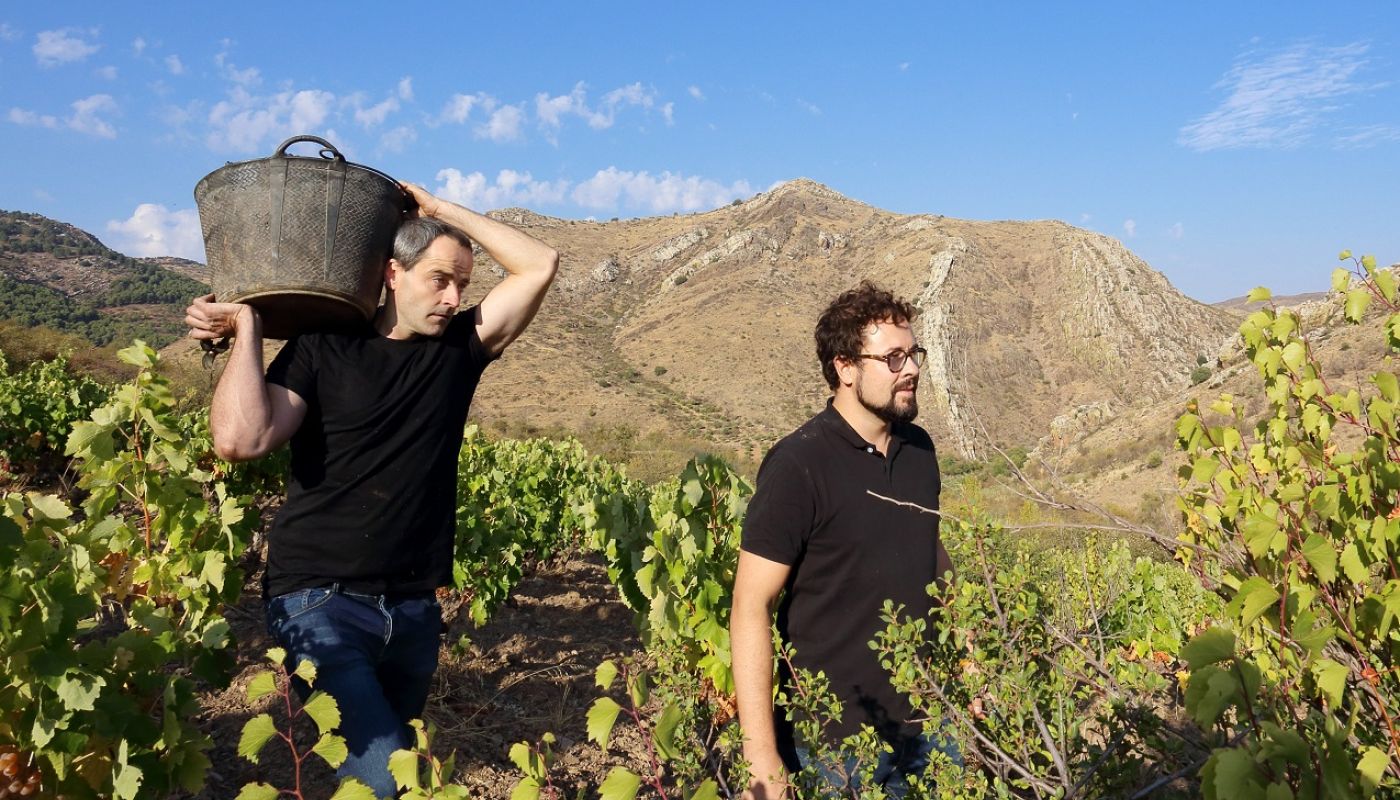
It is hard not to get swept up in Fernando Mora’s enthusiasm for old-vine Garnacha from Aragón. We are talking about an engineer – notably in renewable energy – who fell in love with wine, started to ferment grapes in his bathtub and became a Master of Wine in record time, primarily to raise the profile of Garnacha from Aragón. Every move he makes with and his business partners – local winemaker Mario López (pictured above left with Fernando in one of the Alpatir vineyards) and lawyer Francisco Latasa – is based on a 360-degree vision of sustainability. This goes far beyond simply using manure rather than chemical fertilizers or recycling the water. This is a story of the revival of traditional farming methods, the rescue of ancient vines and efforts to ensure the sustainability of an entire wine industry.
To put such bold claims into context, I must first explain something of the history of the area in which Frontonio is based. Aragón is one of Spain’s and Europe’s most depopulated regions, with just 28 inhabitants per km2, compared to 93/km2 for Spain as a whole and a whopping 432/km2 in England. Over the past century, people have abandoned their rural lands to move to cities –in 1900 around 68% of people lived in villages with 5,000 inhabitants or less, now 73% of Aragón’s inhabitants live in its largest city, Zaragoza, with the younger generations shunning the back-breaking work of tending vines to find better paid employment in industry and the service sector.
This means that some of Spain’s oldest Garnacha vines have been abandoned or grubbed up to be replaced with more profitable cherry and almond crops or to be replanted with other varietals, such as Tempranillo, often grown on trellises on lower, flatter areas where they can be irrigated and worked mechanically. In the DO Campo de Borja alone, almost 1,300ha of Garnacha vines were lost between 2009 and 2015.
This is a travesty not just in winemaking terms, as it is known that old vines produce more concentrated and flavourful grapes, but also in terms of the environment. This is an area where rainfall is in very short supply, and old vines cope much better with drought than younger ones, as well as needing fewer treatments to protect them from pests and diseases. This is particularly true of Garnacha, a local variety adapted to the dry, barren terrain.
So what is Bodegas Frontonio’s role in all this? Firstly, Fernando has taken on the task of proving that ‘Spain offers a lot more than cheap wine’ in order to ensure that wines from the hand-worked, old parcels of vines are sold at a price that ensures their future survival. His MW research paper proposed a new system of classifying vineyards in the Campo de Borja in order to price grapes according to their quality and ultimately improve the prestige of the region, which has historically sold its wines at unsustainably low prices. He is not the only person working towards this goal, of course, the Scottish MW, Norrel Robertson, and Zaragoza native, Jorge Navascués, have also done much to raise the profile of Garnacha in the DO Calatayud and DO Cariñena respectively, but Fernando’s boundless energy and enthusiasm drive the cause forward.
In terms of saving these hard-to-work plots of old vines in the Valdejalón area; Bodegas Frontonio has been working on acquiring them from their – usually octogenarian – owners and restoring them to their former glory. In the absence of family members willing to take them on, most are happy to sell, especially after seeing the respect and care given to them by the Frontonio team. This is a long-term project and patience is often required; Fernando recounted the tale to me of the descendants of an elderly owner who have promised to sell his beloved plot, but only when he no longer has the strength to tend to them himself, as ‘without his vines he would have nothing to live for.’
Once acquired, Frontonio works on reinvigorating the soil of the vineyards with natural manure and replanting vines where necessary, using cuttings from existing vines, planted directly on their own rootstock. The winery follows the less aggressive pruning methods advocated by Simonit and Sirch, respecting sap flow to build the plant’s natural defences.
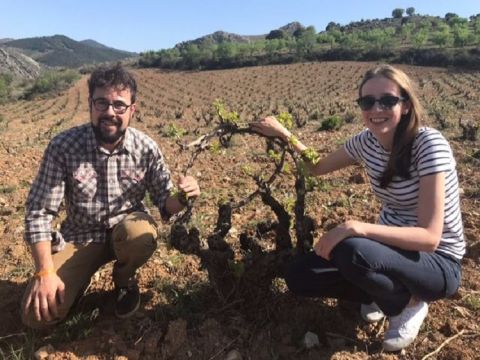
One of my favourite parcels is ‘Cestas’, where cover plants of thyme, fennel and other native plants grow freely between the vines. The name, meaning ‘baskets’ comes from the curious form that some of the vines were plaited in. But the jewel in the winery’s crown is El Jardin de las Iguales – The Garden of Equals. Located just outside the village of Alpartir, my first visit to this mountain idyll took my breath away.

Alpartir is one of many small-but-not-quite-invisible Aragonese villages where the elderly inhabitants stop and eye you curiously as the jeep drives through the almost desolate village square, hugging the curves of a hill as it passes the remains of an ancient silver mine before stopping at the stone cross crafted by local stone masons to mark the valley.

The land suddenly falls away, tumbledown shards of slate, an inky-grey, followed by rusty-red earth before rising up again sharply in a shadowy mountain peak. The scents of almond blossom, fennel and thyme drift through the valley. These two hectares of century-old vineyard at an altitude of 750 metres have been rehabilitated painstakingly by hand, including the ancient stone walled terraces that evoke the steep vineyards of Priorat.
As recently as 20 years ago, the whole area would have been covered in vines, and those that have survived are gnarled old grandmothers producing barely a kilo per vine, a mixture of Garnacha and Macabeo, some of which date back to the 1890s. To ensure natural diversity, more than 240 different clones from a massal selection of old vines have been used to replant the areas that were grubbed-up, replanted with almond trees or left in a semi-wild condition. In these times of global warming, the northwest facing slopes of the valley, which in the past were abandoned for being too cold and shady to ripen grapes, have been replanted once again with Garnacha and Garnacha Blanca. Green corridors of native plants grow between the vines to mitigate the risk of erosion on these steep gradients. The traditional polyculture of the area has been respected, with ancient fig and almond trees dotted among the vines.

Fernando explains their work in the vines: ‘Respect for the local environment and encouraging the vines to build their own natural resistance is part of our ethos. We’ve used organic methods to manage our vineyards since we started ten years ago: the old vines are not ploughed; we leave natural crop cover, which is hand managed, and all our vines are dry-farmed and hand-harvested. In many of our old-vine, mountain vineyards, we have retained other crops such as almonds, which helps encourage biodiversity, as well as leaving green corridors so insects and animals can cross. We’ve been working on the organic certification process for all of our 55ha of vineyards for the last three years and the coming 2020 vintage of Botijo and Microcósmico will be certified organic.’
Mario López gives further details of their disease and pest control methods: ‘As this area has little rainfall, disease pressure is low and we have no reason or desire to use any artificial pesticides or herbicides, we just use a little sulphur if and when we have issues with oidium, and pheromones for sexual confusion of grapevine moths. Our dogs are good at keeping larger pests such as wild boar away from the grapes!’
As for the winery, after scaling up from a bathtub in a garage, Bodegas Frontonio moved to Mario’s parents’ modest winery in Épila before opening their own in 2019, located in a restored cave with over two centuries of winemaking heritage. It is extremely energy efficient as it uses the effects of gravity to move musts and wines, as well as benefitting from the natural cooling effect of working underground. It proves that traditional methods are often the most environmentally friendly, as is the case of the ages-old terracotta ‘botijos’ used by vine growers to cool water, which lend their name to the winery’s simple yet delicious range of vibrant, fruit-forward Garnachas, ‘without make-up’ as Fernando puts it.
It is worth highlighting the fresh style of all Frontonio’s wines and the reasoning behind their move to higher altitude parcels. After starting with bush vines at around 400 metres, they started to purchase parcels at 700m and even 1,000 metres. This means that the vines, as well as coping better in increasingly common hot vintages, produce grapes with higher natural acidity and lower PH levels, meaning that less SO2 is needed to make them microbiologically stable.
Winemaker Mario underlines their hands-off approach: ‘In the winery, we use minimum intervention techniques and native yeasts. We recycle our waste and instead of sending lees and skins to the distillery as we did in the past, we have started using them as organic compost on our vineyards.’
Given the international acclaim that this winery has already achieved in its first decade, it would seem that, at least in this small corner of Aragón, the traditional wine industry has a bright and sustainable future.
















