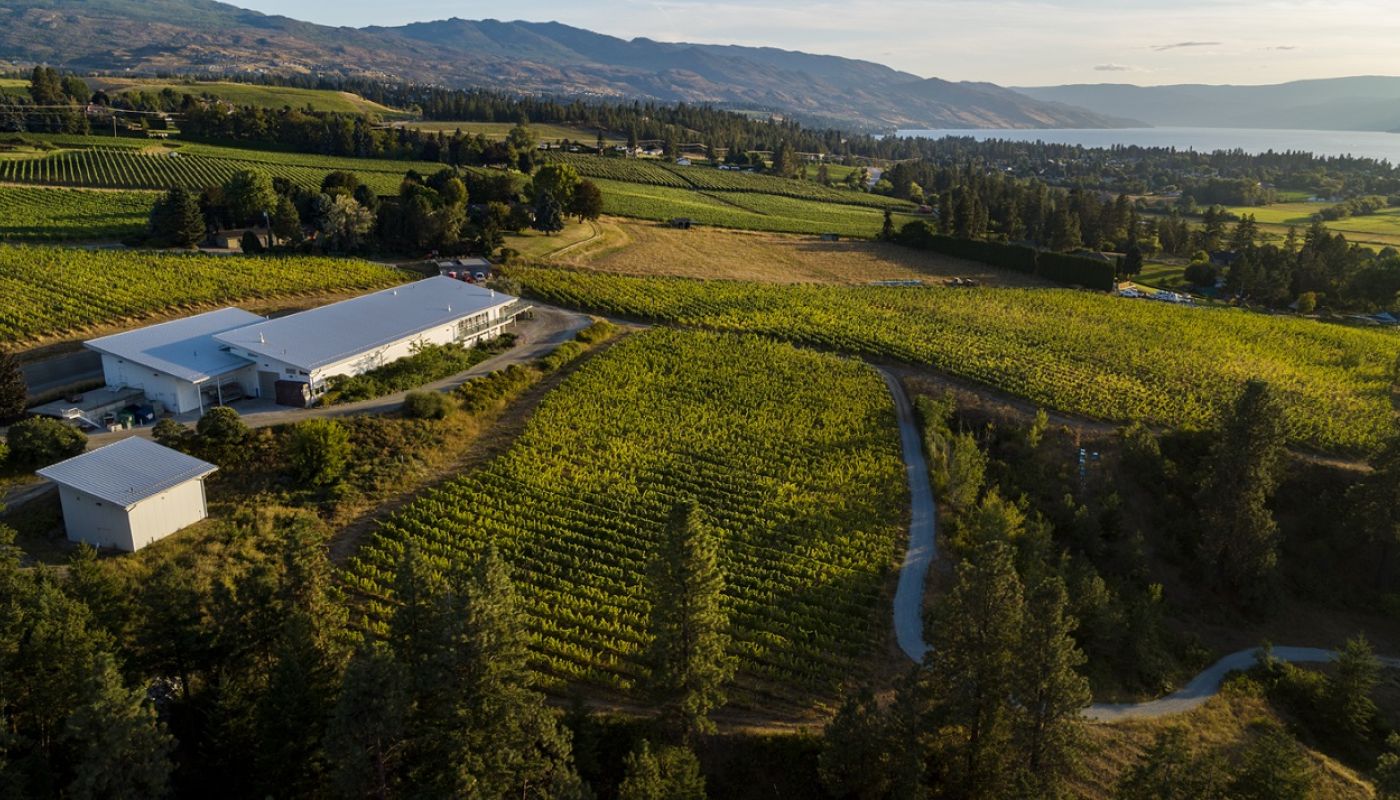
The building looks like the home of an erstwhile Bond villain – all hard angles and what must be structural panes of glass. It’s nestled precipitously atop a sage covered hill on the outskirts of an otherwise non-descript town from which a dashing hero departs. His Jaguar spews dust skywards from its rear, blocking out the Mediterranean sun that casts its oppressive gaze on the parched slopes that betray themselves in small parcels of vinous extravagance. The hero ascends not for retribution, nor is the clime that of Italy, Spain, or any other balmy Southern European locale; rather, our hero – I myself believe workaday life and childcare to be heroic – ascends for a glass of award-winning Riesling and a stunning view, down onto the city of Kelowna, the Mecca of Canada’s wine industry.
We have Tantalus Vineyards to thank for that meandering introduction. Perhaps the reader finds it laughable that I pass on the blame for my overly-verbose writing to a building, but I can’t help it, Tantalus’ headquarters inspires a propensity for the grandiose. And it is not only in looks that Tantalus Vineyards headquarters impresses, it is British Columbia’s first LEED certified winery, putting use to all of its efficient geometry and honouring the similarly eco-conscious vineyards and their liquid by-product. And beyond their headquarters on which this whole piece could be focused, Tantalus has compiled of laundry list of attributes and qualities to satisfy the most green-greedy of wine lovers. Their grapes are farmed following natural principles, the vineyards void of harmful herbicides; the land on which they sit is exceptionally biodiverse, with bee-hives and nesting boxes dotting the rows; and as founding members of Sustainable Winegrowing British Columbia, an online tool aimed at amalgamating and spreading the doctrine of environmentally friendly winemaking, they display both internet-savviness and transparency in their desire to be as environmentally friendly as possible. This radical sustainability transparency, embedded within that very building which it calls home, is reflected in the name Tantalus, a word fixed in the center of the alcohol-environment-transparency triumvirate.
The root of the hedonically intonated 'tantalize', in the context of a winery the name Tantalus seems a pointed one. It can be originally attributed to the figure from Greek mythology – Tantalus faced eternal damnation in Tartarus wherein he was made to stand in a pool of water that he was unable to drink from while simultaneously sitting in the shadow of fruit-bearing trees that he was unable to gather nourishment from. What better parable could there be for a society that consistently sins against the environment? The second derivation of Tantalus appears in a more, shall we say, tipsy context. An old-fashioned cabinet made for storing two or three decanters, the tantalus served to openly display its alcoholic contents while keeping them under lock and key. Designed by the poet John Betjeman’s grandfather, George Betjeman, the tantalus (or would it simply be tantali?) is representative of that thief-weary priggishness only the British could impose upon liquor. Like Betjeman’s tantalus, Tantalus Vineyards encases itself within a frame that betrays its interior appearance while still having a cloistered, somewhat imposing, character about it, in the way that modern architecture tends to do. But what comes out of Tantalus’ stunning artifice is in no way as unavailable as the fruits and tinctures of the two preceding tantalus’.
Anthony Gismondi, godhead of the court of British Columbian wine writing, has stated in some publication, I know not which, at some time, I know not when (I read about wine when I imbibe), that Riesling is set to be the king of grapes in British Columbia’s Okanagan Valley, a locale that has too frequently tried to emulate more renowned terroirs in lieu of individualizing itself. He has further suggested that ‘there is nothing regular about the “regular” Tantalus Riesling’, the disarmingly affordable entry-level offering from Tantalus. And it is in Riesling that Tantalus – along with many others – has established its wheelhouse. Along with their ‘regular’ offering, Tantalus produces a series of single-block bottles, as well as a surprisingly versatile bubbly and a ‘Lab’ wine that – honouring their German-Engineered-esque home – lists exactingly the facts and figures of the wine’s makeup. In contrast to their broad portfolio of Rieslings, Tantalus only produces wines made by two other varietals, Pinot Noir and Chardonnay. Similarly focused on covering the spectrum between ‘regularity’ (read: affordability) and ‘exceptionality’, Tantalus, while not once veering too far from its comfort zone, has a bottle for every type of wine-lover. The one commonality amongst all these bottles, outside of the grapes, is the engrossing labels, donning masks that evoke a certain new-world liberality at the same time as they are representative of the Okanagan regions most ancient culture.
And these labels represent the true nature of Tantalus’ impressively focused land stewardship. Considering the current climate of relations between Indigenous Canadians (often called First Nations peoples in the Canadian context) and those descended from former settlers, Tantalus’ choice of label art signals explicitly its politics in a way that very rarely any normal winery would. The striking – sometimes menacing, other times jovial – masks that adorn Tantalus’ bottles are designed by Dempsey Bob, a Tahltan-Tlingit (two of British Columbia’s many indigenous groups) artist whose work has been exhibited widely both in Canada and abroad. Utilizing the work of an Indigenous artist for a brand identity is political, in the postcolonial and environmental senses, considering the controversies that have marred Canada-Indigenous relations both historically and presently. Over the last few years Indigenous groups, not only from British Columbia but across the country, have been protesting the planned expansion of the Coastal GasLink Pipeline, a natural gas pipeline designed to expediate the delivery of Alberta’s massive fossil fuel stores through British Columbia to the coast, where oil tankers will retrieve it and deliver it to international markets.
These protests came to a head last winter when the RCMP (Royal Canadian Mounted Police) conducted a raid on a camp of Wet’suwet’en land defenders, with reports of the former brandishing sniper rifles. Much of Canada watched these events with a feeling of bewilderment. It goes against that hard-earned image of ourselves that we try to project onto the world; our nature is vast and sublime, the people are unyieldingly kind and diverse, our politics are liberal, a healthy blend of American individualism and Scandinavian socialism. We could no longer go on pretending – hoping beyond all hope – that this was true as we watched armed men dismantle a peaceful camp aimed at, above all else, environmental protection.
I am not here to suggest that, in their choice of labels, Tantalus is aligning itself with the Indigenous land defenders of British Columbia. But they do, with their use of Dempsey Bob’s beautiful masks, align themselves with the preservation of Indigenous heritage, at the heart of which is the preservation and stewardship of the nature that Canada is so well known for. So, that hero that drives up to Tantalus Vineyards on top of that hill covered in sage? I’d like to think that that’s Dempsey Bob, out for a glass of wine and a view of British Columbia’s splendor. He’s no James Bond, but he’s the hero we need at the present moment. And he deserves a glass of Riesling. Having enjoyed that same Riesling myself many times over, I’d imagine that he’d at least take syntactical inspiration from Mr. Bond – saying that it’s good, damn good.
















