Charlie Leary writes Charlie Leary lived in Andalusia for 18 years and currently resides in Panama. He earned a PhD in modern Chinese history from Cornell University in 1993 and went on to direct restaurant wine programs in New Orleans, the Dordogne, Costa Rica, and Nova Scotia. He is in the process of opening a wine bar in Panama City’s historic centre, El Casco Viejo.
Retama and regeneration: a memory of the desert of Almeria appellation
We all stared, fixed on the computer screen displaying the rural Andalusian landscape – in Lucainena de las Torres, to be particular – from an aerial photograph. “This is protected forest,” declared the official from the environment department. The image exhibited in fine detail my farm’s long-treeless slopes pockmarked with occasional bushes, called retama, and lower vegetation, including fragrant native thyme and sage. “No, this is agricultural land, classified as vineyard,” shot back the agriculture official, whose office lay a few doors down the corridor in the squat, 1980s Junta de Andalucia government building. As far as I could tell, the two bureaucrats had never met before.
I had just delivered the paperwork declaring new vine plantings, an integral part of capturing a few approved hectares of Andalusia’s quota of Spain’s quota of the European Union quota for vineyards destined for wine production. Mine was one of two official Protected Designation of Origin sites in the perhaps ironically-named “Desert of Almeria” viticulture region of Spain’s most arid province. I had provoked the inter-departmental consultation and at that moment hoped that my over-cautiousness did not spell disaster for the first-year garnacha bush vines flourishing there.
The controversy between native “forest” and vineyard, beyond its bureaucratic battlelines, crystalized the issues confronting my winegrowing efforts in 2017, including concern for the soil, the native plants, water resources, biodiversity, entrenched 20th century Spanish farming methods, and seemingly inevitable desertification pitched against the Andalusian government’s penchant for creating new wine regions (or reinvigorating traditional ones). The planting approval already granted, the vines already installed, I pointed out that both were possible: classified vineyard and classified “forest,” as it were. Neither saw my point, and the ag representative stormed out with no resolution, though now the government’s right hand knew what the left one was doing.
Admirably, retama’s presence qualified my new vineyard as forested, and I hadn’t touched them when planting, much to the consternation of local grape-growing “experts”: those whose families had cultivated the vine there for centuries. A bit of prior research showed that retama species combat desertification, creating micro-environments for generating topsoil, their roots holding together dirt, attracting rodents and their manure, and preventing classic erosion patterns during torrential rains. Why would I remove them?
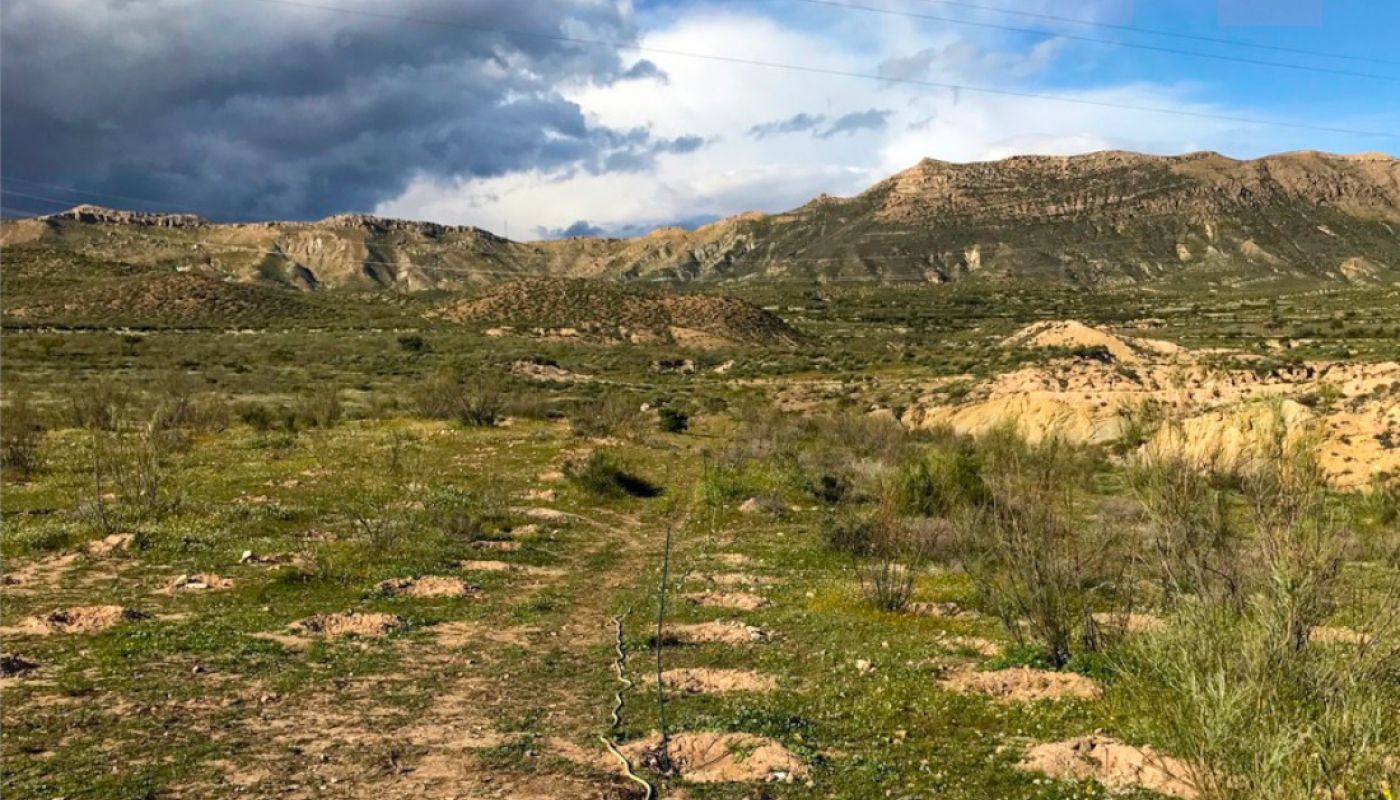
To get an idea of this peculiar terroir, picture the classic Spaghetti Westerns, like “A Fistul of Dollars”. This was my part of Almeria, next door to Europe’s only true desert, Tabernas. During the 1960s and 70s, Franco’s regime festooned Sergio Leone’s stars like Clint Eastwood and Lee Van Cleef in this spectacular ochre, brown, and red panorama with big blue skies and flat-roofed, white-washed houses. Not a tree in sight, just the occasional retama, whose spindly arms never grow higher than about two metres. Since Sergio’s time, it’s only gotten drier, water resources scarcer, in part because of vast modern olive plantations sucking subterranean deposits dry and the damned practice of “labrar.”
If two psychological and practical battles must be waged with rural Almerians over regenerative viticulture, the front lines are retama and labrando. Convincing employees not to rip out every retama in sight sometimes required sprinting outdoors upon spying the orange Kubota’s front-end loader headed straight for the trunk of an ancient retama. Relatedly, labrar refers to the idea, fixed like a Jungian archetype in farmer’s minds, that the ground must be broken at least once a year, typically with a heavy tractor and disks. Between them, the soil dies, denuded, with no chance of regeneration.
Returning to the Good, the Bad, and the Ugly landscape, the appellation Desert of Almeria indeed once produced wine, and more. Stone threshing circles throughout the countryside spoke of long-practiced wheat cultivation. Ancient terraces told of erosion control. Aged, stuccoed deposits and nurias, or water wheels, spilled the story of carefully-planned irrigation. Crumbling cortijos (country houses) testified of winemaking facilities including traditional jaraiz. Through careful planning and reference to regenerative ag and permaculture principles, returning the ecosystem to such a state remained possible.
Nothing evidences the important viticultural past of the region more than the jaraíz, a permanent architectural vessel for crushing grapes formed by stacked stones united with mortar, usually attached to a cortijo’s façade on a covered porch. Inside kilos of trodden grapes converted to must, which exited through a lateral hole with an inclined ceramic pipe at the vat’s base. The construction measured approximately two meters long by one wide and high. A second pressing occurred by placing the pulp in esparto grass baskets, or serones, stacked in the jaraíz and covered with a board. A wooden beam articulated in a hole in the wall above the jaraiz, acting as a lever on the board, compressed the serones. Jaraíz is of Arabic origin, remains of a Yemeni fortress lay just down the path, so in Almeria as elsewhere in Al Andalus, the prohibition on alcohol may not have meant “no wine” in Arab times. The tradition in Almeria continued into the 20th century.
Such wine, however, is scarcer than ever; so too is vital rainwater. The appellation is drier than, say, Languedoc, Provence or even Jerez. If we received 12 inches of rain a year, that was lucky, and mostly in winter. Grass or nitrogen-fixing cover crops refused to be sustained. Topsoil did not exist, and what’s there was so fragile that mechanization killed brittle native plants struggling for survival and produced a dust layer, which blew away.
This is not to say the region doesn’t possess great potential for wine. At 400-500 meters in altitude, with excellent diurnal variation, and well drained, mineral-laden soils, Garnacha, Monastrell, and Cabernet Sauvignon excelled, officially-approved Merlot and Syrah less so. Site of an ancient sea next to the Mediterranean, the soil is alkaline from pre-historic calcium-rich deposits, but careful rootstock selection cures that. Like many other viti-vini regions on the Iberian Peninsula, the dry air, winds, and hills make for care-free fungal management (the pesky hairs, rabbits, and tusked javali are another story). Organic cultivation is a snap.
Regenerative viticulture, however, must go beyond the organic baseline and take biodiversity and the full terruño (terroir) into account. It must be appropriate to the locale and consider the resources at hand. The Junta de Andalucia established at least 17 Protected Designation of Origin (Vino de la Tierra) appellations between 1999 and 2009, four in Almeria, including the Desierto I inhabited. This presented the opportunity for new, high quality wines, and some appellations like VC Granada have rapidly fulfilled that promise. But this cannot occur without the kind of attention to all the factors that regenerative viticulture propounds, especially recreating soil biodiversity and looking at the big picture ecosystem. This, too, would require the environment and agriculture departments to put their heads together.
For instance, not only the robust retamas, but also the extremely tenuous thymes boasted legal protection, but had I wished to uproot every plant in my approved vineyard space and put in 10,000 vines per hectare with no irrigation rights that was (illogically) legally okay. Even after that meeting, Environment never showed up at my farm to kibosh the vineyard of widely spaced bush vines. Pursuing “standard” viticulture, like ripping up the retama in such fragile regions, could accelerate desertification; pursuing appropriate regenerative viticulture techniques could have the opposite effect.
Retama doesn’t hold all the answers for both vineyard soil regeneration and anti-desertification in Andalusia, but it’s vitally important. The plant neatly embodies a lot of regenerative viticulture’s goals. It not only has the attributes listed above but is also a leguminous shrub. Extremely tolerant to drought prone, nutrient-poor and alkaline soils (sound familiar?), it creates a micro-climate in which a diverse understory may thrive. As with nitrogen-fixing plants in more verdant climes, a symbiotic interaction between natural soil bacteria and the legume roots form nodules, a cosy home for nitrogen fixation, which transforms atmospheric nitrogen to ammonia. The bacteria receive sugars from the retama while simultaneously providing nutrients in return. The mycorrhiza community expands as the root network grows and can colonize other plants in the area. “It has also been shown that succession underneath the Retama sphaerocarpa can over time improve soil structure, nutrient and water content, moderate humidity and temperature in air and soil, increase plant diversity and boost microbial activity in the soil,” says a report on retama mycorrhiza trials by Sunseed. They also provide a bit of shade in summer. What more could I ask for in a vineyard?
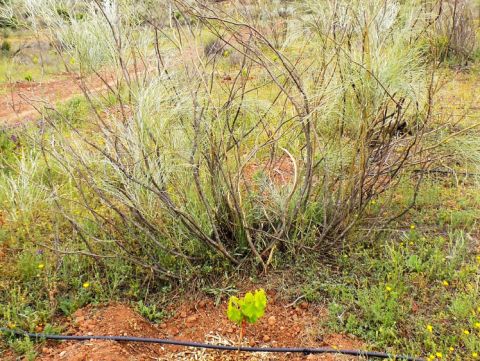
Did I at times have to adjust the vine planting scheme to accommodate a neighbourly retama? Of course. Did I plant vines right next to retama (and thyme and other bushes)? Of course. That was the nitrogen-fixing point.
The bigger point is to look for appropriate solutions in regenerative viticulture, which means biodiversity- and ecosystem-appropriate, and retama is one excellent example for Andalusia, but the same general lesson should be applied in any terroir. For new sites, this goes beyond companion planting to first take stock of what’s already there: bacteria, plants, animals, drainage paths, adjacent forests, old irrigation infrastructure, and so on. This also means understanding local culture and history, leaving the bad, like labarando, behind, and taking the good, like the vast native knowledge of bush vine management in rural Almeria. It may mean, too, getting the agriculture and environment departments to see eye to eye! Regenerative viticulture can indeed help (re)establish a healthy ecosystem, which in the end will produce superb grapes and better wines, including new ones expressing their unique sense of place!
###
(With sorrow, I lost the Almeria vineyards in a divorce in 2021, and no longer have any economic interest in promoting the venture.)
The main photo above is of retama and first-year Syrah vines in Lucainena de las Torres Almeria, credit Charlie Leary.
















