Valeria Tenison writes my name is Valeria Tenison, I am a sommelier and a journalist based in Bordeaux, France. I was lucky to work and study in many different countries and meet a lot of exciting people. So I would like to share this story with JancisRobinson.com readers…
Pico – Reloading
I met Ines and José during my viticulture and winemaking internship in Austria. They were the youngest of our motley crew of adventurers and nomads. José is from Madeira, while Ines is a “Portuense”, but both had travelled quite extensively before coming to Austria, having worked in Thailand and journeyed around Asia. We worked together in the summer of 2020, a short period of freedom between the two waves of Covid. I remember taking them to Schützen-am-Gebirge for a train to Vienna when the 2020 harvest was over and the future was again unclear. The next time we will meet in the Azores...
The lost world
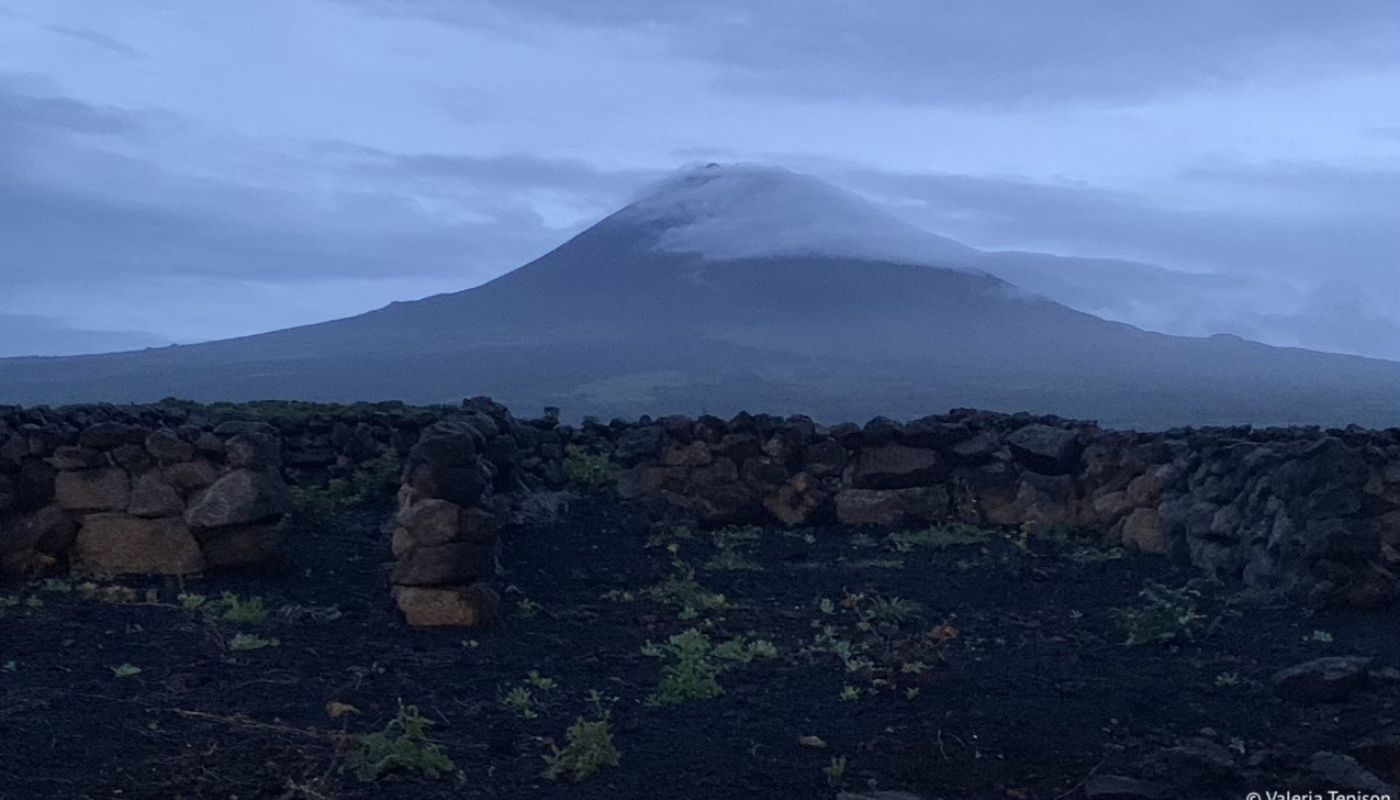
Where are the Azores? Literally in the middle of nowhere, lost in the blue of the Atlantic ocean, somewhere on the way between Lisbon and New Jersey. They are nine volcanic islands scattered in the sea. The easternmost island, Santa Maria, is around 750 km away from the most western Corvo. The Azores have another geographical peculiarity. It is Pico Mountain which is in fact a stratovolcano. It is the top point of Portugal with its 2351 m above sea level but it hides most of its mightiness underwater. With 6098 m below the sea surface, it is the highest underwater mountain in the world. The Pico Volcano erupted last in 1720 and nowadays is dormant.
The treasure island
Pico island is the most famous of all the group not only due to its landmark mountain but also thanks to the winemaking traditions. The islands were discovered (or re-discovered as the historians still argue about earlier Azores inhabitants) by the Portuguese in the XV century. Due to their strategic position on the way to the New World they immediately became a transit hub. As sailors needed food and drinks to continue their journeys first settlers started planting grain and grapevines. The vines were probably brought from Madeira, another Portuguese island inhabited earlier. No wonder today there are still a lot of similarities in grape varieties and winemaking techniques of the sister islands.
The history and the lost glory
Living on a “monstrous, hideous and uncultivated” island (Chagas, 1717) was never an easy thing. Pico was the last island of the archipelago to be inhabited as there were no quiet harbours and, most importantly, no fresh water available. History says that the first settlers were forced by the church and the king to move to the islands from a much more hospitable and fertile Faial. Were these people prisoners or just poor peasants that had no other choice? We don't know exactly. What we know for sure is that their life was, frankly speaking, rather miserable. To have some fresh water they created an extensive system of tidal wells. During the high tide the groundwater is pushed closer to the surface by the seawater, so a thin upper layer of potable but still salty liquid can be collected and used for drinking and cooking.
The legend says that the first vines on the island were planted around 1450 by a monk called Frei Gigante (Big Brother, pun not intended). The soil was brought from Faial as it was completely impossible to cultivate even such an unfastidious plant as a grapevine on this rocky, completely infertile lava slab. The first years should have been disastrous as all the crop was probably destroyed by the salty sea sprays and ocean winds. The Picarotos as the locals now started to call themselves understood that they need to protect their vines from the vicious nature. This is how the construction of the famous Pico “currais”, walls whose length might go twice around the Equator line, commenced. They were erected not only to shelter the plants (vines and figs, mostly) but also to clear the terrain of big stones of solidified lava as it was just impassable. But they were still too numerous, so even today the weird pyramids somewhat resembling the Mayan ones can be found on the island. The “maroiços” were built without any particular purpose, apart from just putting the unnecessary stones together.

The walls had been constructed and the vines started to thrive. The microclimate created inside the "currais" gave powerful and heady wines, much appreciated in those times. Pico wines got notoriety and reached the tables of the kings, czars, and, later, presidents. The prosperity of the islanders did not last too long. In the middle of the XIX century, the disasters began. First, is oidium, followed by phylloxera. Many locals abandoned their ravaged land and fled to the Americas. Those who stayed switched to the American species and hybrids that saved their lives but could not revive the glory of the local wines.
The revival
The Pico cooperative was established in 1949. From the beginning, its goal was to produce wines from the traditional varieties – Arinto dos Azores and Verdelho. This initiative helped to preserve many old vineyards which elderly growers were nostalgically keeping despite the minuscule yields and harassing labour. In 1962 Professor José Duarte Garcia bought a vineyard in Criaçao Velha, the oldest plot on the island which existed continuously since 1690. His dream was to restore the historical wine, “passado”, which used to make the glory of Pico. In 1970 Garcia sold his first "Czar" wine, an unfortified wine that reached naturally up to 20% of alcohol. I was torturing Fortunato Garcia, the son of José and the current owner of the winery, and other winemakers on the island to explain to me how it is technically possible. The common answer is “The miracle of Pico”… but digging deeper and studying some scientific papers I found out that the local yeast during the centuries might have developed an outstanding tolerance to high levels of alcohol. These “bodybuilder” cells work slowly but surely. Fortunato’s fermentations might last a few years, so the current release of the regenerated “passado” by Czar is 2013!
Terrantez – lost and re-found
This rare variety is not the same as the namesake from Madeira. The renowned ampelographer José Vouillamoz thinks it is an offspring of Verdelho and Bastardo which both oddly trace their origin to the Jurassic Savagnin and Trousseau. At some point, there were only a few plants of Terrantez left in Pico and it is mostly due to the efforts of Antonio Maçanita, the locomotive of Azores Wine Company, the island’s most famous producers, that the grape was saved. Maçanita partnered with the Agricultural Services Station of San Miguel island (SDASM) to start the regeneration project. The scientists were chasing the vineyards of Pico hoping to find an occasional Terrantez plant. In total, 89 vines were discovered, cuttings taken, and planted in the agricultural station. Susanna Mestre, the specialist responsible for the project, highlights that without this initiative the cultivar would have been definitely lost as “the growers did not like it”. Terrantez is extremely sensitive to fungal diseases which proliferate on the island. In 2010 Maçanita produced the first wine from the grapes harvested by the Agricultural station. Since then, the image of Terrantez has changed. From an ugly duckling, it turned into the most expensive grape on the island. In 2019 the price for 1 kilo reached 7,05, a level comparable to the Champagne grapes!
The wines from Terrantez that I had a chance to try in Pico were absolutely delicious with a full-bodied, powerful structure, zesty acidity, and floral profile, finishing with a salty, refreshing, almost manzanillesque note.
The UNESCO World Heritage
In 2004 the wine landscape of Pico was classified as a UNESCO World Heritage site. The protected zone of 987 ha covered the western side of the island where most of the “currais” were located. This event changed a lot of things in Pico. The growers received access to funding to restore the abandoned vineyards but as the island life is like a video at a 0.75x speed, an outsider was needed to give it a stimulus. Antonio Maçanita is 50% Azorean but was grown on the mainland and it's due to his energy and entrepreneurship spirit, that things started to change quickly in the Azores.
Filipe Rocha, a partner of Maçanita in Azores Wine Company, recalls, “In 2004, when Pico vineyards and wine culture were classified as UNESCO World Heritage, there were only 120 hectares [of vineyards] left. So less than 1% of the area that used to produce in the golden age of Pico wines. During 10 years the Azorean Government had subsidies to support the recovery of vineyards. After that time, Pico reached 250 hectares of planted vineyards. By the end of 2014 new VITIS subsidies were launched by the Azorean Government. Azores Wine Company, that was established by April of the same year, was the one leading the process of the new projects for recovering vineyards. In December 2014 we started the recovery of 30 ha in São Mateus. No-one ever before was doing a recovery of that scale on the island… usually no more than 3 hectares… We kept our goal of doing more and until 2019 we recovered more than 12 ha. With some interruptions it took us about 4 years with more than 20 people on average: cutting the forest that invaded the abandoned vineyards; putting the stone walls back and planting again… More than 800 km of walls and more than 20km of gravel roads inside the vineyards [were restored]…”
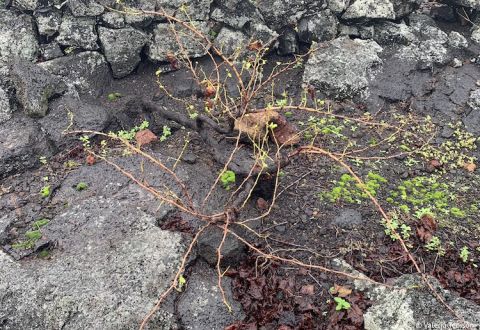
The new missionaries, if I may call them like this, faced many problems. Some plots were abandoned more than 100 years ago. People left without leaving anything or anyone on the island, no official register existed about the exact allotment, so it was difficult to investigate the ownership of certain parcels. The costs were drastic. Rocha estimates that restoring 1 hectare including the three first non-productive years will touch 40.000-50.000 euros.
The example of Azores Wine Company inspired many. Today there are more than 1000 hectares recovered, 10 times more than existed in 2004, but still less than 10% of the historical area.
The new re-generation
Azores Wine Company also became a nursery for the young winemakers. André Ribeiro and Ricardo Pinto from Entre Pedras, Cátia Laranjo from Etnom and Lucas Amaral from the eponymous winery worked or still work with Antonio Maçanita, Filipe Rocha and Paolo Machado. These youngsters make the future of Pico.
Between the rocks
Neither André Ribeiro nor Ricardo Pinto was born in the Azores but André's family roots and the strive for challenge brought them both here. Now the two call themselves Picarotos, the natives of Pico. They work for Azores Wine Company during the day and in the evening it is the time for their own small project – Entre Pedras (“Between rocks”). It started in 2019 when they made their first Arinto dos Açores from André’s father’s grapes. Restless and enthusiastic, they also restored 0.6 ha in the south of the island and 0.5 ha in the north. They had to deforest the abandoned plots, raise the collapsed walls and plant the stocks to which they will graft the scions of Terrantez do Pico. It is amazing to follow the project on Instagram, where André and Ricardo talk about all the challenges of the truly heroic island viticulture. They dare to do everything differently than the old generation was doing: pruning earlier, using no herbicides, de-weeding manually… They proudly claim, “We believe that wine is made by rocks! It is on them that we work and it is from them that we make wine. So we continue... Between rocks!”
The youngest island’s winemaker
I meet Lucas Amaral in his family's tasting room. He still works on his English skills but his mother helps to translate the difficult parts and my poor Portuguese is just enough to understand the essentials.

Lucas is 21 years old now and he started his winery in the municipality of Madalena at the age of 19 after having studied winemaking on the mainland. Lucas tells me that he was brought up in between the family's currais and from his young years he understood the severity of Pico's wine growing. The youngster wants me to see the terrain with my own eyes, so we jump in his red pick-up and take a rough road to the site being restored. First, the trees (beeches and incense trees mostly) must be cut with a chainsaw, then the stone walls can be rebuilt. Lucas' mother is the family’s specialist. The walls bear no cement or glue, the rough angles of lava stones attach to each other and the remaining holes allow some wind to pass and dry the vineyards after the rain. Then, vines can be planted. The process is extremely labour-intensive. Mechanisation is not possible. I have not seen a single tractor during my visit to the island! And Lucas' family is doing everything on their own. Picarotos are indeed hard as a rock!
José and Ines
My friends José and Ines are also here, in Pico, under the shade of the sacred mountain. They work for Azores Wine Company. José is a head chef in the winery's restaurant, absolutely the most refined on the island, and Ines is a sommelier/tasting room host. They tell me about the difficulties and the pleasures of the island life and I listen to them enchanted…
According to the 2021 Census, the municipality of Madalena, on the island of Pico is the only one in the Azores to register a slight (4.7%) growth in population since 2011. Today it counts 6.332 residents. During my trip I might have met a good dozen of them and looking at these young, enthusiastic faces makes me think that Pico has not only the past but as well the future.
All photos are the author's own.
















