Xeniya Volosnikova writes Xeniya Volosnikova is a wine marketing and communication professional from Kazakhstan. Her interest and passion for wine brought her to Europe, where she earned MSc in wine tourism management and is currently in the process of acquiring WSET Diploma in Wines. Xeniya enjoys writing about wine and has a bold dream of becoming the first MW from Kazakhstan.
ReGENerating Portugal: wild pigs and the ‘alma’ of the vineyard
When thinking about renewal and regeneration in the wine world, Portugal is one of the first countries that pops into my mind in terms of its history and current trends. Anyone, who has recently visited Portugal or talked to its winemakers, has certainly noticed the shift in the country’s viticulture from highly invasive to one with the least possible intervention, with particular attention to saving biodiversity and caring for the soils. You can somehow draw a dotted line between this shift in viticulture practices and a younger generation of winemakers emerging in the last decade.
The parents and great parents of the current winemakers in Portugal have witnessed the emerging mass commercial production of synthetic fertilizers, herbicides, and pesticides, which allowed them to get high volumes of crop every year and secure their incomes from harvest to harvest. Even if most of Portugal, with its fertile soils and sufficient sunlight during the year, did not require high levels of pesticides and herbicides, it was too good a solution to all their problems not to use it. The moods have changed since, and nowadays farmers make more conscious choices of what they put into their soils. A clear and strong trend for low-intervention viticulture has emerged among the wine producers in Portugal. Most of the wines from Portugal that made a lot of noise outside the country are produced by so-called ‘new wave’ of winemaker.
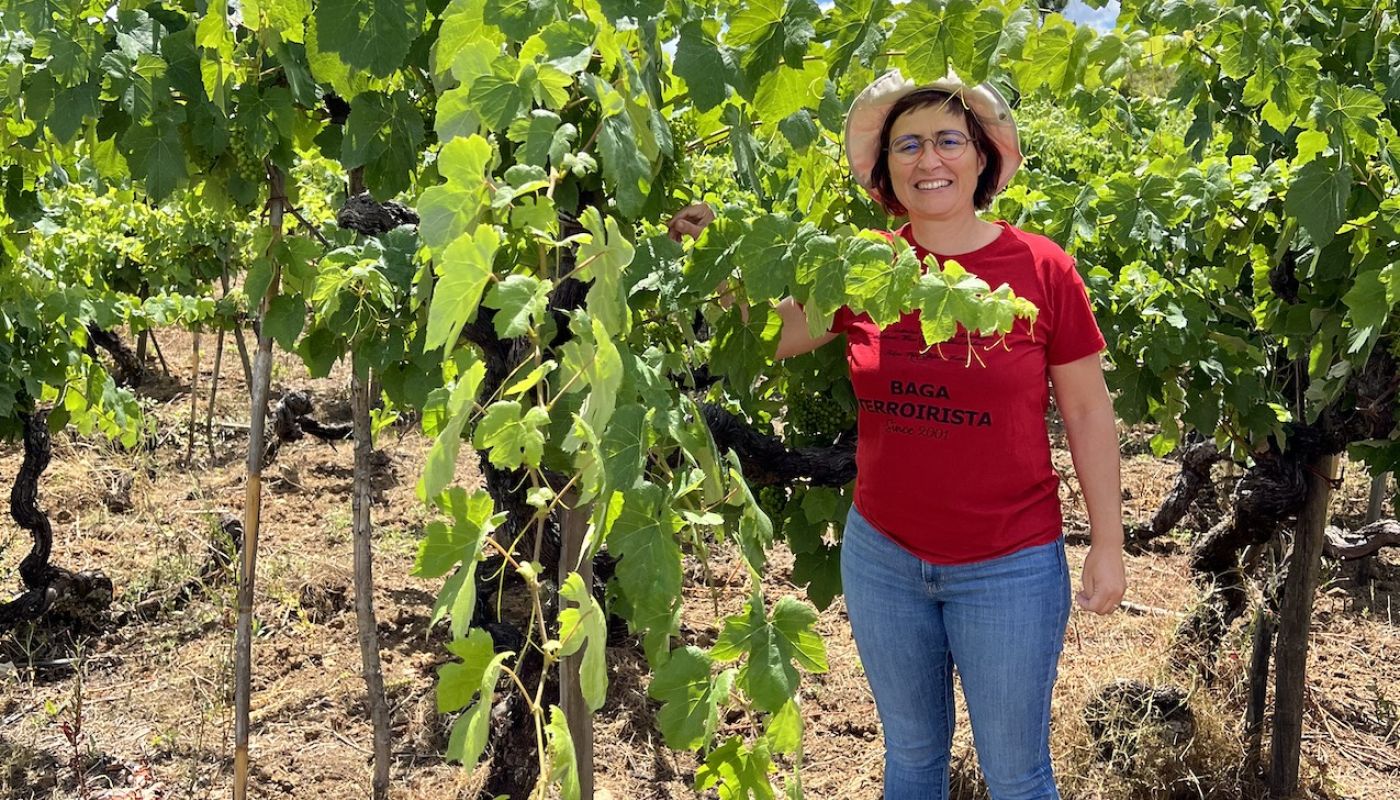
One of ‘new wave’ producers are Filipa Pato [pictured above] and William Wouters, based in Bairrada, Portugal.
When asking Filipa about regenerative viticulture and if she is familiar with the practices, she couldn’t be more excited about the subject: “This is what we do in biodynamic farming, give life to the soil, create biodiversity with not just vines, but other local trees like olive trees, fruit trees, different kind of local bushes, create a balanced ecosystem where the vines can live a happy life!”
It is clearly still a struggle for many, including myself, to differentiate between biodynamic practices (or more accurately, philosophy) and regenerative approach. They do mean slightly different things: for example, in regenerative approach there are no deadlines for implementation of certain practices, no audit or certification body, the farmer is free to choose which tools from the regenerative approach they can adopt. Most importantly these approaches do not contradict each other, they can compliment each other, and in many cases, as in the case of Filipa and William’s vineyards – many of the practices are already being implemented, like integrating different cover crops, trees, bushes, animals, etc.
Curious about what could urge a farmer to change the way they work their land, it seemed important for me to understand what stands behind it, apart from the personal choice. Is it financially beneficial? Does it involve the community more? Is it a more sustainable business overall?
Filipa’s way to biodynamics and regenerative approach was not straightforward: she started as organic first, evaluating her options and trying to balance being a mom of two boys with her brilliant winemaking career. For me it is not a coincidence, but rather something natural of many winemakers who say how becoming parents made them think about what kind of land and what kind of ecosystem they are going to leave behind.
Many of the winemakers who are practicing regenerative viticulture speak about the soil and vineyards as about something alive; Filipa, for example, uses the word ‘alma’ (meaning ‘soul’ in Portuguese) when she speaks about her vineyards. The connection and understanding she built with her vineyards cannot be better illustrated than in this phrase: ‘I don’t go to church every weekend, but I try go to the vineyards every day, and the connection that you build as a farmer with the nature around you, became a great passion, I learned to observe and analyse nature in a lot of small details’.
Do not be fooled – converting to a more soil-focused approach (let it be regenerative, biodynamics, organic, etc.) is not an easy process. Nor it is a cheap one. For example, biodynamic farming is obviously more expensive that organic, it should be seen as a philosophy of life, rather than a business approach. From Filipa’s experience, when taking over a new vineyard and converting it directly to biodynamics together with introduction of some regenerative practices, it takes minimum 5 years with some reduction of crop in the beginning. Also, considering the climate in Bairrada with its foggy mornings and depending on the weather, it can be extremely difficult in more humid springs. If you haven’t done so, feel free to check William Wouters’ Instagram account with a daily ‘Good morning from Bairrada’ image featuring the famous morning fogs! Thanks to the winegrowers’ patience and resilience, after some years the vines get purified, and the soil gets alive. After some years of practicing biodynamics and regenerative viticulture, the root system gets deeper and widely spread, and the vines are getting more balanced, and they suffer much less with dry summers, the maturity tends to be more regular, and the wines get more succulent and vivid. Seems like an easy choice to make – convert to biodynamics and incorporate regenerative viticulture practices immediately, right?
From the financial point of view, it is more expensive to rehabilitate a vineyard, because the process is more expensive and the production per hectare is lower. But if you are focused on quality like Filipa and William, the volume is less important. As the root system of a newly established vineyard takes many years to develop, they also prefer to recuperate old vineyards and bring them back to life. It also allows to save the ecosystem within and around the vineyard, as replacing it will involve rather invasive manipulations with the land.
Even taking into the account the decrease in costs when there is no need to buy any chemicals, it is the manpower that makes the difference in cost due to more labour-intensive viticulture. The dedicated team at Filipa Pato and William Wouters’ winery is much bigger than that of a conventional or organic farmer. On top of that from the beginning the goal was to pay the team fairly to motivate them even more to take care of the beautiful centenary vineyards. The result now is the team of people working more than 10 years with them. Filipa mentions: ‘They believe as much as me that the vines feel this positive energy’. In this case, it is obvious that building teams that care about the work they do at the vineyards, not only helps them appreciate the soil and the plants, but to create a more engaged community overall.
Speaking about positive energy, when Filipa took over Missão, their most famous pre-phylloxeric vineyard, it was like a jungle abandoned for more than a year. It was a lot of work to recuperate this vineyard because it was impossible to use the machinery. After many years of manual hard work, Filipa and William decided to adopt some small pigs. They work very well the soil, and the vines look more alive than ever. According to Filipa “nature always provides best solutions”. The idea was to find a local animal adapted to Bairrada, so they are part of the ecosystem. It is amazing how nature is not only able to regenerate itself, but indeed present the best suitable solutions for farming.
Clearly, most of the farmers converting to biodynamics or adopting regenerative approach do not do it for certifications. Of course, having such allows to understand and benchmark wines from across the world. More importantly, converting to various practices that involve more conscious approach to the soils, shows us that more and more wineries take sustainability seriously in all aspects, not only the environment aspect of it, but also social and economic one – making sure the local community is involved and fairly treated.
I love how the words ‘regenerative’ in terms of viticulture and ‘generation’ in terms of human life are interconnected. They do not only share the same root but the same philosophy of renewal – in some cases it comes very naturally, in some cases it’s a conscious choice which involves a lot of though behind it. But it doesn’t matter how we come to this decision, for future generations to be able to enjoy any crop at all (not only speaking about grapes), we rely entirely on the farmers embracing the philosophy of regeneration of soils.
The easiest way to spread the philosophy is leading by example. Of course, each generation has its vision of how to work soil better, Filipa and William’s main reason to work biodynamically and care for the soil and ecosystem of their vineyards is to have a heathy environment for their two sons. Starting as the only biodynamic producer in Bairrada, Filipa now has neighbours asking her to help them to convert their vineyards. She really believes that for small farmers that have pride in their work and have a heart for nature it is easier to find common ground, support each other, share ideas and information, and we couldn’t agree more. Building more profound and meaningful relations, whether it is between humans or between a farmer and their vineyard, takes more time and requires more effort, but as in human relations, it is worth it!
Image credit: William Wouters.
















