See recent tasting notes on Some of South Africa's best wines, the much-anticipated CWG auction wines and Iona Sauvignon Blancs. Picture by Maureen Downey.
Bidding is always fierce for the most distinctive lot in the annual Cape Winemakers Guild auction, the giant 18-litre bottle filled with a special blend of the best wines of the most recent vintage produced by members of this elite club of South Africa's top vintners. At this year's sale, held three weeks ago in Stellenbosch, the winning bidder, Czech wine merchant Zdenek Lang, declined to take his booty back to Prague. Instead, he declared, he was leaving it with the Guild, to be opened only when the first black winemaker is elected as one of their members.
The 2009 blend will probably last a good 20 years but even that may not be long enough to see the cork pulled. Equal opportunity, black empowerment and transferring expertise to the previously disadvantaged may be the convoluted names of the Cape restitution game but, 17 years after the creation of the rainbow nation, there are still pitifully few black or Cape coloured winemakers. The Guild has a highly publicised protégé programme, but so far a total of only five particularly promising students at the local wine college have been sponsored (although admittedly their first graduate, Howard Booysen, is already making waves).
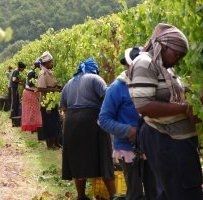
It's different in the vineyard, of course. The Cape's beautiful vines have never been tended by whites but have depended for their existence on a supply of cheap if not willing labour. A report last month by a Human Rights Watch researcher drew the world's attention to some scandalous tales of living conditions on a handful of (unspecified) wine and fruit farms on the Cape. Farm and vineyard owners were supposed to have cleaned up their act. Many of them have. Farm workers' living conditions have in general improved immeasurably over the last three decades, but there is still considerable room for improvement.
Guild member Andries Burger runs Paul Cluver, one of the first wineries to set up a black empowerment scheme and encourage some of their workers to establish their own wine label Thandi, widely distributed in the UK. As he puts it, 'in my personal opinion, even one bad example is one too many – but the problem is that by not naming the farms in question, it has been counterproductive, because how can we rectify it? Let's name and shame, I say.'
Human Rights Watch said that they did not want to name and locate their informants for fear of reprisals, and would not even specify which of their more horrific reported examples were wine rather than fruit farms. This unfortunately has given those too complacent or mean to bring their workers' living conditions into even the 20th century, and the Western Cape government, the perfect excuse for continued inaction.
There are various well-meant official initiatives in the Cape wine industry that can be quoted, but few signs of a real desire to clean things up once and for ever. Every Cape wine producer I have asked admits that there continue to be examples of maltreatment of vineyard and winery workers, or 'a few bad apples', as Senyane Rangaka of M'hudi, the first South African wine farm to be owned by a black family, describes them. 'It's a sad reflection on the industry that there are still some bad guys out there', she told me at Cape Wine Europe, a vast generic tasting in Earls Court exhibition halls last week. Her proposed solution is that every producer who wants a piece of the valuable export market should be properly inspected and screened. Barely 100 producers were represented at this tasting in the UK, South African wine's biggest market by far. Surely it wouldn't take that much more than a deep breath and a certain amount of agreement on minimum acceptable standards to inspect all exporting farms? And once a farm met those standards, that would probably be enough.
The report certainly stirred a few consciences on export markets. The B-word (boycott) was breathed for the first time in years although, as Andries Burger maintains, ignoring the South African section in British supermarkets would hurt the most vulnerable, the vineyard workers, the most. Marc Kent of Boekenhoutskloof immediately had to field calls from his importers. '"Guys, you've been here". I told them. "You've seen the satellite television in our manager's house."' And of course he cannot help mentioning the Mexican vineyard workers on whom the California wine industry is utterly dependent.
Su Birch, the hard-working CEO of Wines of South Africa since 2000, has had to answer publicly for the industry in the face of the HRW revelations. She knows that they have provided yet more ammunition for American importers to continue to virtually ignore South African wine. As for the reaction back home, 'the good wine producers, the ones that have really been making efforts to improve their workers' conditions, are feeling hurt, indignant and upset. As for the others, they're mumbling about cost. In fact because the law increasingly protects workers, and makes it extremely expensive to evict even the most disruptive employee, farmers are moving away from housing workers – but meanwhile the government isn't building new housing as an alternative.'
Under pressure from the liquor monopolies such as Sweden's Systembolaget, who buy considerable quantities of South African wine, Wines of South Africa is trying to draw up some sort of ethical charter, and Fairtrade is quite big on the Cape but, as Su Birch admits, these don't always represent a solution to the fundamental problem of those bad apples.
All is by no means doom and gloom, however. South Africa continues to make some great wine, especially whites as far as I am concerned, and the wines, while still excellent value, are better than ever. There are some good reds, but too many red wine vines continue to be affected by leafroll virus. Perhaps if every farm cleaned up its employment policy, the mealy bugs that spread the leafroll would pack their bags and leave.
According to Su Birch, 'There is one way to end all this. It's to get our house in order. But we can't do it all at once'.
SOME CURRENT FAVOURITES
Hermanuspietersfontein No. 5 Sauvignon Blanc 2010 Walker Bay
Mullineux, Kloof Street Chenin Blanc 2011 Swartland
Mullineux white 2010 Swartland
Mullineux Syrah 2009 Swartland
Mullineux, Schist Syrah 2010 Swartland
Mullineux, Granite Syrah 2010 Swartland
Mullineux, Straw Wine 2010 Swartland
Newton Johnson Chardonnay 2009 Overberg
Radford Dale, Renaissance Chenin Blanc 2010 Stellenbosch
Thelema Chardonnay 2010 Stellenbosch
Tokara, Director's Reserve White Sauvignon/Semillon 2010 Stellenbosch
Uva Mira, Single Vineyard Chardonnay 2010 Stellenbosch
Vins d'Orrance, Kama Chenin Blanc 2010 Western Cape
Vondeling Chardonnay 2009 Voor Paardeberg
See recent tasting notes on Some of South Africa's best wines.