I went on a train journey recently that was eight parsnips better than my bedside table. Not the most lucid measurement, but it does at least follow a fine tradition of nonsensical rating systems masquerading as obdurate fact.
Within wine, such systems flourish proudly, marching blithely onward with the deluded confidence of a doomed army, each of them finding solace in their own convolution. To score wine is to capture the uncapturable, like trying to catch clouds with a sieve. I like Jamie Goode’s summation that ‘the score is not a property of the wine, but of the interaction between the wine and the taster'. Any sensible person who tastes wine agrees that objectivity in taste is chimerical, yet our collective human desperation to impose order on things prevails, and scores have become unassailable despite the pious protestations of those of us who churn them out interminably.
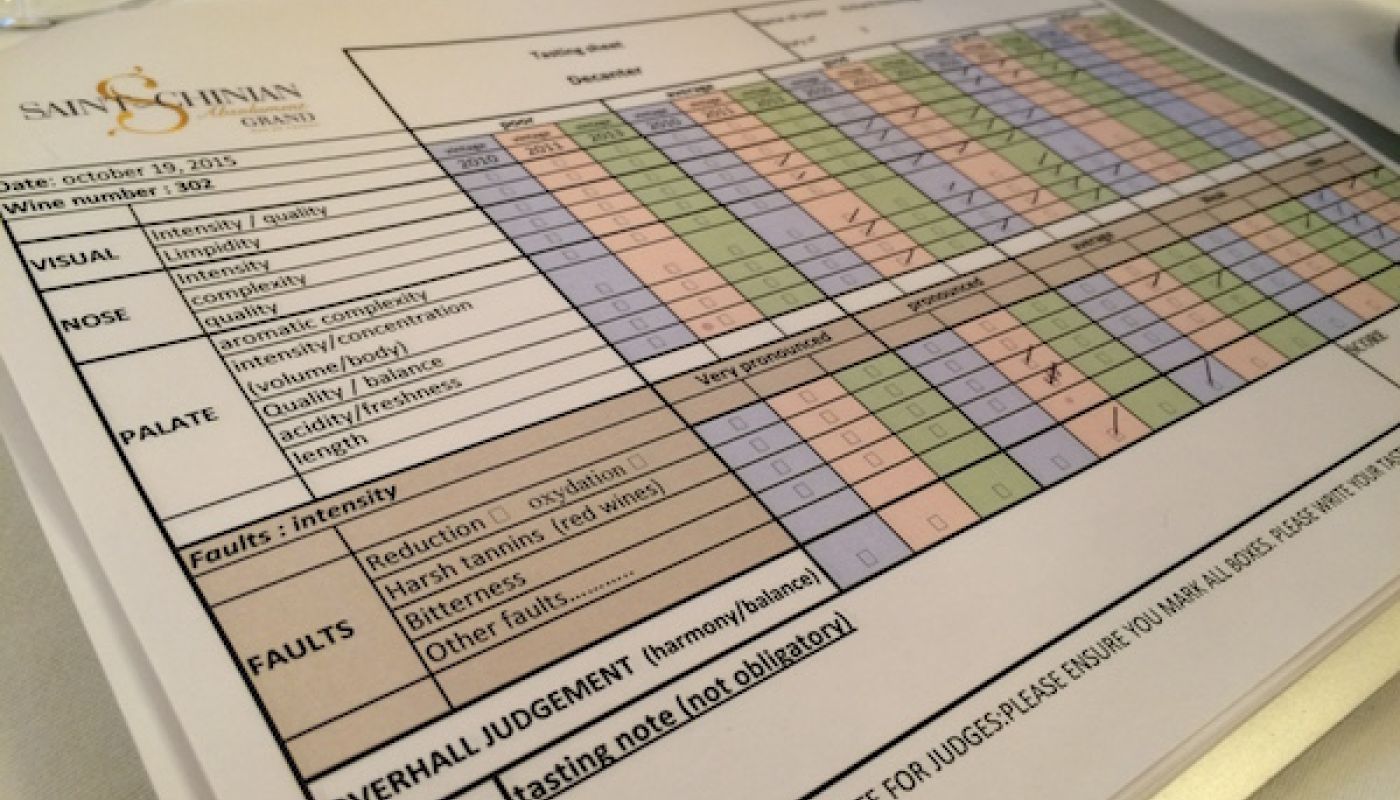
Prince among fools is the OIV system. Much has been written about this enduring work of fantasy already (including this autopsy by Walter in 2012) so I will add only that if it is a truth universally acknowledged that scoring a wine is an act of silliness, then scoring individual components under such headings as limpidity, positive intensity and genuineness is surely the full three-act farce.
No less than 27 pages of jargon is necessary to explain the OIV scoring technique. It evokes the quintessential British parlour game Mornington Crescent , which also has an exhaustive rulebook, and can be played under complicated strictures such as Mortimer’s Variation, Tobermory’s Stratagem and Carski’s Protocol. For anyone unfamiliar with BBC Radio 4’s I’m Sorry I Haven’t a Clue, suffice to say that this is all complete and utter nonsense and may be taken as seriously as What playing cricket looks like to Americans.
That video seems overlong at five minutes, doesn't it? Remind yourself then, that a test match lasts five days. Incidentally, keeping score of a cricket game is so abstruse that when a batsman achieves zero runs in an innings it is wryly said that ‘he did not trouble the scorer'. That’s a euphemism that would be usefully germane in describing bottom-end wines.
The OIV is not alone in its officiousness, however. Beer has its own equally bureaucratic marking system, which includes one tickbox marked 'similar to the aroma of a skunk'. Whether this is a good or bad thing is not immediately apparent.
In our own 20-point system, the lowest score is theoretically 12 – although there are 41 poor damned souls in our database that rank below even that derisory number. To outsiders, of course, the more pertinent question is why 60% of the scale never gets used. The same goes for the ubiquitous 100-point system, which starts at 75 and even goes beyond 100 on a good day.
Explanations have been attempted by various custodians of wine criticism, but none exist to satisfy those outsiders, for the simple reason that the whole thing is weapons-grade ballcocks.
I will make only one defence of scores. I have confidence that my own are reliable indicators for me personally. As a relative indicator, I can trust that I’ll like whatever I score above 17 more than anything I score below 16, most of the time anyway – an endorsement which must rank up there with ‘the unsinkable Titanic’ as one of the world’s least impressive.
Why do we persist, then, with something whose efficacy is doubted by even its most famous practitioners? One reason is the mundane platitude that there is simply no better alternative. Most wine note-takers find scoring wine useful – even if it is only to provide a personal scale of reference, as I mention above. And if further proof were needed of the appeal of scoring, witness the success of CellarTracker, whose database of tasting notes and scores now numbers above five million.
The other reason is that scores can correlate directly with prices. This is what makes critics justifiably uncomfortable, the thought that their utterance can influence what people charge for a wine. This is especially true for Bordeaux en primeur, but can have a bearing on the secondary market for any traded wine. For as long as that is true, scores are going nowhere. I can state it in no stronger language when I say that scoring wine remains at least seven flowerpots better than my hatstand.