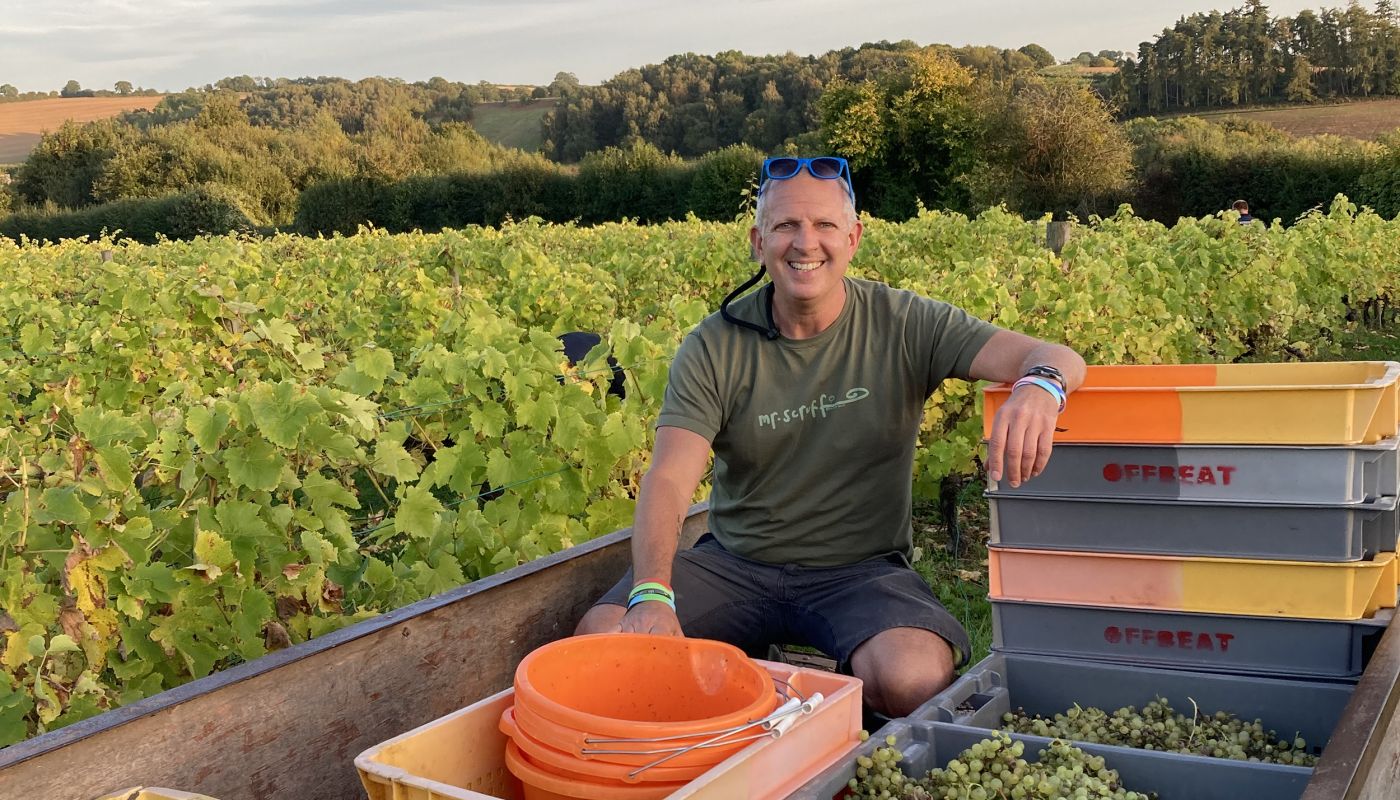
Names are so important, as Master of Wine Tim Wildman has already proved. The fact that the Australian pet-nat he makes is called Astro Bunny has done sales no harm at all. He has had such success that his Australian wine business is now big enough to be run from a distance and he recently moved back to the UK.
Congenitally loaded with energy and enthusiasm, he decided he’d make a pet-nat in Britain, branded Lost in a Field, and went in search of suitable grapes to put in it. For him the English wine scene has become boring. Too many similar copies of champagne made from the champagne grapes Chardonnay and Pinot by too few winemakers (contract winemaking is common for the produce of many of the new English vineyards). So he decided to concentrate on such other grape varieties as he could find.
This meant largely the grapes that were planted by the previous generation of English and Welsh vintners in the era before global warming, when summers were cooler. Typically these were early-ripening crosses and hybrids sent to England from Germany, where cool, short summers were also common – many of them bred deliberately to ripen fast. Wildman’s favourites among these are Reichensteiner, Schönburger and Madeleine Angevine.
Those of us familiar with the English wine scene in the 1970s and 1980s came to rather despise these grapes because they dominated plantings then and we associated them with what resulted from the uninspiring combination of cool summers and inexperienced winemakers. But Wildman, in a stroke of renaming genius, has transformed their image by rebranding them ‘heritage varieties’.
‘It’s an easier term to get across to the public than saying “German crosses and hybrids”’, he explains, ‘and is a useful catch-all term that saves having to list the actual varieties themselves. It also adds status, value and a certain prestige to varieties that have, until pretty recently, been sidelined or seen as underdogs, yet form the true story of the old-vine legacy in this country.’
He’s stressing old vines because they are increasingly valued in the wine world. While the quantity of grapes they produce may not be maximal, the quality is usually superior – perhaps because the vines’ roots are so deep and the plants themselves have had so long to adapt to their environment and come into balance.
But it wasn’t that easy to find these heritage varieties, so unfashionable have they become. Wildman started off last year with ‘some old databases from what was the Wine Standards Board [now subsumed into the Food Standards Agency], as well as some old websites I found on the internet’. He identified 200 vineyards that had at some point been planted with Madeleine Angevine, Reichensteiner or Schönburger and then spent two months last summer, district by district, trying to find them and their owners. His aim was to see whether his blessed heritage varieties were still planted there and whether he could buy the grapes from the 2021 harvest for his first English pet-nat, called Frolic.
‘There was quite a bit of time spent driving down country lanes, getting out every few hundred yards to look over a hedge to see if I could spot a vineyard. From the initial list of 200 I found just two that would sell me commercial quantities of grapes, three that would sell smaller quantities, mainly of red, and about a dozen abandoned vineyards.’
It is these abandoned vineyards that have inspired Wildman to embark on another, superficially hare-brained, scheme. Using his considerable Instagram presence, and another emotive phrase, Lost Under the Stars, in an emailed call for help from his Lost Vineyards Preservation Society, a club formed in time for the Real Wine Fair in London in May, he has managed to recruit volunteers to help him restore three of these abandoned vineyards to health by working during the day and camping out next to them. ‘We’ll fire up the BBQ, light the fire pit and enjoy good food, wine, music and company under the stars. Please be advised, facilities will be basic, there’ll be a Portaloo on site, but no showers. Think Glastonbury rather than glamping’, he warned prospective helpers.
His argument is that he is restoring Britain’s viticultural heritage. It would probably be picky to point out that this heritage is actually pretty recent – or at least seems so to this heritage wine writer. The first of these ‘heritage varieties’ to be planted in British soil was just after the Second World War, but then only experimentally. When the first commercial vineyard of the modern era was planted, at Hambledon in Hampshire in 1952, it was mainly the French hybrid Seyval Blanc, of which Wildman is not a fan, that went into the ground.
The grape variety known as Madeleine Angevine in England (technically in reality one of this table grape’s offspring – its proper name is Madeleine x Angevine 7672 but everyone calls it Madeleine Angevine) arrived in England in 1957, having been sent from Germany. Reichensteiner is a cross of Madeleine Angevine and the often-dreary Müller-Thurgau that had been bred in Germany in 1939. The German cross Schönburger was authorised for use only as recently as 1980. Whatever one’s views on what qualifies as ‘heritage’, Wildman has almost certainly picked the best of the bunch from the German crossings that are no longer popular in Germany and which dominated English vineyards in the 1970s and 1980s, rejecting the likes of Ortega and Siegerrebe that were just sugar-building machines.
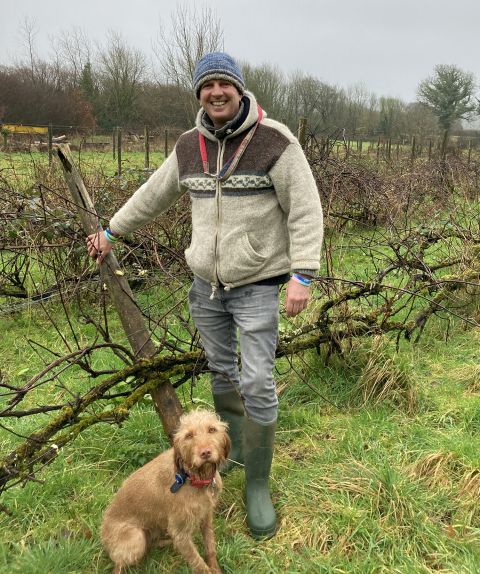
Wildman has made agreements, initially for three years, with the owners of three of the abandoned vineyards – in Hampshire, Devon (pictured above) and Powys in Wales – whereby he and his associate, vineyard consultant Darcy Gander, helped by the volunteers, do their best to bring the vineyard back to life in exchange for whatever crop it produces. The main ingredients in his Lost in a Field pet-nats are still likely to be the much bigger quantities of heritage varieties that he buys from commercial vineyards.
The first Lost Under the Stars adventure took place on 15 June in the Welsh vineyard near Oswestry about which Wildman is especially enthusiastic, particularly the bit on slate terraces. Volunteers included a voiceover artist who grew up in this part of north Wales and brought her parents along for the day to help, and Jen Scott, an NHS dietitian developing her wine career, having given up her role as restaurant director at mana in Manchester. She came across Wildman at the Real Wine Fair in London in May, attracted by the crowd round his table, and realised he was the producer of the Australian pet-nats she had enjoyed. She told me about her Welsh experience, ‘It was a hard day’s work, but I really enjoyed the sense of doing something to help, whilst learning so much about the vineyard management also. The vineyard was so overgrown, that you couldn’t actually see the vines when we arrived.’ She has volunteered to go back each month over the summer to help. The Devon vineyard near Okehampton was tackled with more volunteers on 29 June.
The Hampshire vineyard, called Court Lane, is in the village of Ropley and was started as a retirement project (as so many early English vineyards were) by Sarah Flook’s father. Up to 2014 his wines did well locally but as his health failed the vines became a liability. All that remained by August last year when Wildman contacted her were 0.75 acre (0.3 ha) of eight different varieties, including Reichensteiner and Madeleine Angevine.
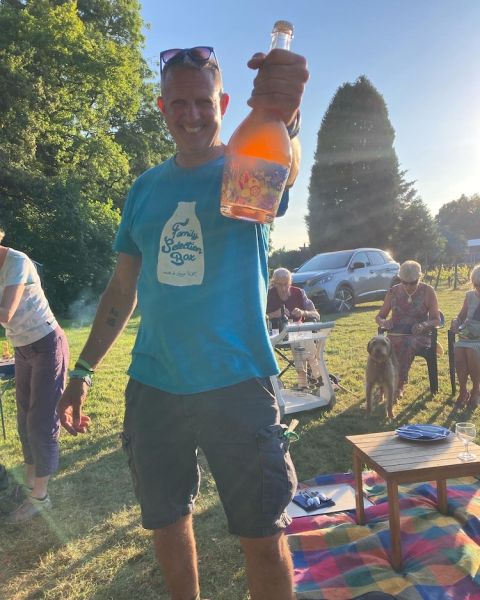
She and her mother were about to pull them out but, as she put it in an email to me, ‘Tim’s enthusiasm and energy for his Lost Vineyards project was infectious, and I soon started to realise that the direction in which the vines were heading could take a complete U-turn.’ On 22 June, together with volunteers including a graduate of Britain’s wine training ground at Plumpton, the manager of a local cafe and some neighbours who had once helped her father with the harvest, she spent what she described as ‘a joyous day of bud-rubbing and strimming followed by a BBQ, superbly organised by Tim’, adding, ‘I felt we were celebrating the rebirth of Court Lane Vineyard, with the baton being passed from the old watch to the new.’
If only for that, Wildman’s Lost Vineyards Preservation Society project, named with a nod to the Kinks’ 1968 album, The Village Green Preservation Society, surely deserves to succeed, however odd it may seem to choose early-ripening grapes in a warming climate.
I asked the VDP group of elite German wine growers whether there was any renewed interest in these varieties in Germany and got the following response: ‘Our board unanimously said that no one is focusing on early-ripening varieties. And why should they? Harvest is starting earlier and earlier because of climate change and all growers have their hands full to manage the canopy and all other relevant factors to prolong the ripening period…’.
I asked Wildman whether he wasn’t worried that the grapes would ripen too early to develop sufficient flavour. ‘The short answer is – we really don’t know yet!’ he replied. ‘However we really liked what the varieties gave to the wine, the aromatic qualities, and fruit salad mixture adding complexity seemed to work.’
He did point out that he doesn’t seem to be the only one interested in these varieties. ‘If last vintage was anything to go by, the fight is well and truly on for heritage varieties in the UK now. I was paying £2,500 [a ton] for Madeleine last year, and I expect that to go to £3,000 this year – that’s Pinot Noir prices.’
The best of luck to him.
Britain’s rich vine varietal heritage
The blend in the 1,512 bottles and 404 magnums of the first vintage, 2021, of Lost in a Field’s Frolic pet-nat gives some indication of what was planted in the UK before Chardonnay and the Pinots came along. Frolic is made from 21 grape varieties from eight vineyards across seven English and Welsh counties.
75% Madeleine Angevine – the majority from Meophams in Kent and Broadfield Court in Herefordshire.
10% Reichensteiner – from Broadfield Court (pictured in our main image, vines planted in 1973).
10% reds – approximately one-third each of Cabernet Noir (East Sussex), Triomphe d’Alsace (Wiltshire) and Rondo (Hampshire).
5% from the three abandoned vineyards:
- Powys – Seyval Blanc, Madeleine Angevine, Rondo, Frühburgunder, Ortega, Dornfelder, Solaris, Regent
- Hampshire – Reichensteiner, Seyval Blanc, Huxelrebe, Müller-Thurgau, Madeleine Angevine, Pinot Noir, Pinot Meunier and Phoenix
- Devon – Bacchus, Huxelrebe, Reichensteiner, Ortega, Dornfelder, Siegerrebe, Seyval Blanc, Schönburger, Madeleine Angevine, Madeleine Sylvaner, Léon Millot, Triomphe d’Alsace.
See Tam’s enthusiastic tasting note on Frolic (RRP £33 for bottles and £50 for magnums) and UK stockists here.