
Steven Spurrier has been extremely busy this year attending various 40th anniversary re-runs around the world of the famous Judgment of Paris tasting he instigated in 1976 that overturned so many preconceptions about California wine and put the collective French nose out of joint.
On Monday night he, and I, were at an adapted re-run organised and hosted by Michael Sager at Sager & Wilde restaurant in Bethnal Green in East London. In contrast to the original 1976 tasting (see Jancis’s account of the 30th-anniversary re-run in 2006 for a list of the original wines), this particular anniversary tasting was broader in scope but it remained true to the original intention: to see how California wines would show when compared blind with benchmark wines from France.
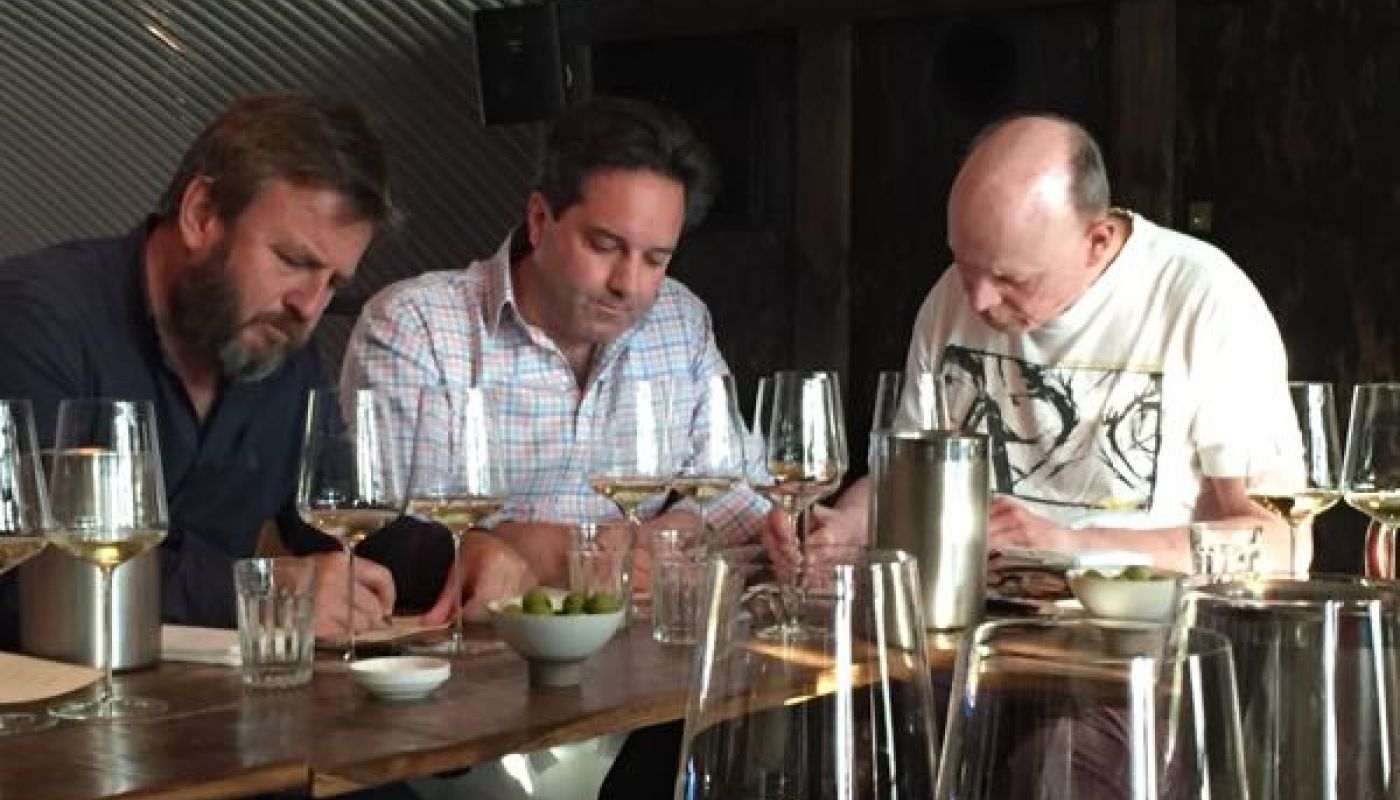
Also unlike the original, Monday's taste-off was a definitive win for France: the professional panel* voted for the French wine in four out of seven flights, with one flight tied. (Three of the professionals are pictured here, deep in thought, left to right: Stephen Browett of Farr Vintners and wine writers Will Lyons and Malcolm Gluck.) The ‘public’ tasters were even more unequivocal, voting for France in five out of seven flights.
Michael had chosen seven pairs of varietal wines, the California representatives from UK importer Roberson’s rather new-wave range and the French ones carefully chosen to match them. The California wine was always poured first, although of course we did not know that until later. It had not been possible to match the vintages in every pair but he had tried to get wines that were similar in other ways (for example, the use of oak and a reductive style for the Chardonnays, skin contact for the Sauvignons, inclusion of stems in the Pinots). These are the wines and the votes.
| Variety | Wine | Judges | Public |
| Riesling | Tatomer, Kick-on Ranch Riesling 2013 Santa Barbara County | 8 | 33 |
| André Ostertag, Heissenberg Riesling 2014 Alsace | 9 | 19 | |
| Chardonnay | Kutch Chardonnay 2014 Santa Cruz Mountains | 8 | 20 |
| Dom Guy Roulot 2012 Bourgogne Blanc | 9 | 33 | |
| Sauvignon Blanc | Scholium Project, Prince in his Caves 2014 Sonoma Mountain | 9 | 25 |
| Sébastien Riffault, Saulétas 2010 Sancerre | 6 | 24 | |
| Pinot Noir | Dom de la Côte, La Côte Pinot Noir 2012 Santa Rita Hills | 12 | 21 |
| Dom Dujac 2012 Morey-St-Denis | 5 | 30 | |
| Grenache | A Tribute to Grace Grenache 2013 Santa Barbara Highlands | 4 | 25 |
| Tardieu-Laurent, Cuvée Spéciale 2012 Châteauneuf du Pape | 13 | 28 | |
| Syrah | Wind Gap, Armagh Syrah 2013 Sonoma Coast | 7 | 18 |
| Stéphane Ogier 2010 Côte Rôtie | 10 | 33 | |
| Cabernet Sauvignon | Mayacamas Cabernet Sauvignon 2009 Mount Veeder | 8 | 19 |
| Ch Sociando-Mallet, Jean Gautreau 2010 Haut-Médoc | 8 | 32 |
The varieties chosen were classics, grown in classic regions of France: Riesling (Alsace), Chardonnay (Burgundy), Sauvignon Blanc (Loire), Pinot Noir (Burgundy), Grenache (Rhône), Syrah (Rhône) and Cabernet (Bordeaux). The least classic pair were the skin-fermented Sauvignon Blancs, orange wines, if you will, and this was the only pair for which I did not identify the variety (I suspected Chenin Blanc). Knowing the wine list of Sager & Wilde, I was surprised by how many tasters were perturbed by these wines. And some of the professional panel were also rather sceptical. As a fan of the best examples of this type of wine, I was delighted that Michael had included them – why not update the concept of the comparative tasting if it highlights the changes that have taken place on both sides of the Atlantic in the last 40 years?
I will be including my detailed tasting notes in the our forthcoming assemblages (North America, Loire, Rhône, etc, as appropriate) but what struck me was just how difficult it was to use the conventional cues such as ripeness, or fruit sweetness, to identify the place of origin if you did not recognise the specific wines. To me this points both to a careful selection by Michael of comparable wines and to the convergence of styles between winemaking regions that used to be so much more easily identifiable. I am glad it is not me who is sitting the MW tasting exams this week. Even 13 years ago when I took the exams, the distinctions were probably a bit clearer than they are now.
In the Riesling pair, both were relatively full-bodied and showing a slight hint of that kerosene-like aroma that comes with age but I thought the Tatomer was fresher and overall better balanced, with more precise citrus flavours, the Ostertag seeming more tropical and a little more developed despite it being a younger vintage, as it turned out. I put the Tatomer in Alsace. (I think it is relevant to point out that Graham Tatomer spent some time working at Weingut Knoll, his 'second family' in Austria's Wachau region, and this has influenced both his choice of varieties and the style of wines he makes.)
The Chardonnay pair caused a good deal of head-scratching as both had high acidity and were made in the smoky, struck-match mould. The Roulot wine was more extreme in this respect but also had a linear, steely focus and length that was really impressive and led me to put it in Burgundy.
The skin-fermented Sauvignons were the ones I had most difficulty in identifying in terms of variety, though I did put the Scholium wine in California because of the wonderfully rich apricot aromas and flavours. It was more intensely aromatic than the Riffault Sancerre, which seemed to have quite a bit of volatile acidity and be both reductive and oxidative at the same time. The higher acidity also kept me in France for this wine.
Moving on to the reds, I absolutely loved the fragrance and delicate persistence of the Dom de la Côte and pretty much recognised it, though I did not know which of the single-vineyards wines it was. Although it was pretty clear which was the burgundy of the two, I did not pick it out as Dujac and found it a little bit dry and lean on the finish, making me think that the whole-bunch fermentation had been less successful than for Sashi Moorman at La Côte, in this vintage at least.
I found the Grenache wines difficult to place though easy to identify as Grenache – both had plenty of sweet red fruit, notable alcohol and soft tannins, though the Châteauneuf texture was a little firmer and the colour was quite a bit deeper even though it was a year older. Overall I preferred the French wine but the Tribute to Grace was particularly supple, silky and sweet-fruited, the inclusion of stems seeming to have given it just enough structure.
The two Syrahs were both very good and I rated them similarly in terms of quality. I suspected the first (Wind Gap) was the California wine because it did have a touch more fruit sweetness than the more savoury Côte Rôtie but both showed fine peppery elegance and persistence. However, in our discussions afterwards, some judges, including Marco Pelletier, formerly head sommelier of Le Bristol in Paris and now setting up his own restaurant, felt the Ogier was too 'polished' and had to a certain extent lost its sense of place.
The final pair had caused some pre-tasting speculation: you couldn't do a re-run of the Judgment of Paris without a wine from Bordeaux but where to find a varietal Cabernet Sauvignon in the region typified by its blends? Atypically, Sociando-Mallet's Cuvée Jean Gautreau was 100% Cabernet Sauvignon in 2010 but it was still more obviously Bordeaux than the Mayacamas, which was more aromatic and open than the wine from the Haut-Médoc, even though both clearly have a long ageing potential. It was the texture of the tannins that made the identification of origin most obvious – drier and firmer in the Jean Gautreau.
While this event did not attempt to replicate the historic, mind-altering tasting of 1976, it was a fascinating if narrow glimpse into the today's wine styles. For what it's worth, my votes were not in line with the majority of the judges and I voted for the California wines in four out of the seven flights. I hope I won't be stopped at the French border.
*The professional judges were, in alphabetical order: Johan Agrell (Babette, Stockholm), Mark Andrews (Noble Rot), Stephen Browett (Farr Vintners), Gearoid Devaney MS (Flint Wines), Malcolm Gluck (Superplonk, etc), Julia Harding MW, Richard Hemming MW, Will Lyons (Wall Street Journal, Berry Bros), Marco Pelletier (Le Bristol, Paris), Raphael Rodriquez (Fera at Claridges), Willi Schögl (Cordobar, Berlin), Michael Schuster (World of Fine Wine, etc), Steven Spurrier (Decanter) and Matt Wilkin MS (H2Vin).













