Before listing some of those that make my heart beat faster, let me state quite unequivocally that I am certainly not anti any of the famous international varieties. There's a reason why both Cabernets, Chardonnay, Merlot, Syrah/Shiraz, Riesling and Sauvignon Blanc are planted all over the world. It’s because they are all capable of making heart-stopping wine.
But their fame means that they are also often traduced. It's not difficult to find boring examples of all these international varieties, which has presumably fuelled the growing worldwide interest in indigenous, heritage and alternative grape varieties. Mind you, grapes change their status all the time. It was not that long ago, for instance, that T'Gallant introduced Australian wine lovers to Pinot Gris/Grigio, but now it is deemed so mainstream that it is no longer allowed in the annual Australian Alternative Varieties Wine Show. Semillon, on the other hand, used to be so common that for years it was by far the most widely planted grape of either colour in South Africa as well as being the dominant white wine grape in Bordeaux and parts of Australia. But today it is, more's the pity, a relative rarity.
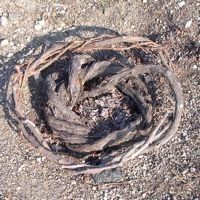
Whenever I'm asked to nominate an obviously great pale-skinned grape that deserves to be planted more widely, I always think first of Assyrtiko (pronounced, as far as I know, 'ass – ear – ticko'). This is by far the most widely planted vine on the beautiful Aegean island of Santorini and demonstrates the most admirable ability to make seriously characterful and refreshing wines even in a relatively warm climate. The wines, made from vines trained in low round basket-like shapes on the ground, as shown here, manage to combine both citrus and mineral elements somehow, as well as being quite full bodied. Furthermore, the wines can age in bottle for longer than most crisp, dry whites. I've had and much enjoyed four- and five-year-old Assyrtikos.
I have discovered rather late in the day that the south of France has some really interesting white wine grapes. When I wrote my first, 1986, book about wine grapes, Vines, Grapes & Wines, I was rather dismissive of southern French white wine grapes because at that stage white winemaking in southern France was pretty rustic. I assumed, wrongly, that the grapes themselves were inherently heavy and flabby. The old Languedoc variety Clairette was one of those I misjudged, having tasted some truly terrible Clairette du Languedoc. And I have also since learnt that, for example, the delightfully named Bourboulenc can yield really fine, fresh wines with some delicate floral aromas, On the rocky seaside mound of La Clape in the Languedoc, it can take on a decidedly marine note. Bourboulenc is an old Provençal variety (Provence is the cradle of many interesting grapes; Tibouren springs to mind) which, like Assyrtiko, is good at retaining its acidity in a warm climate, so could perhaps thrive in a distant wine-producing land.
But perhaps my favourite white wine grape disovery is Godello, the recently rescued Galician variety that is characteristic of Valdeorras in north-west Spain. Like Viognier, it was practically extinct within living memory (and just look how widely planted Viognier is now) but is enjoying a revival, based on cuttings from old vines belonging to the family behind the admirable Valdesil winery. Rafael Palacios, younger brother of the more famous Alvaro Palacios of L'Ermita, Priorat, fame, has also helped to put Godello on the map via a series of really excellent Valdeorras – firm, dry whites that deserve a few years in bottle. Not just in Valdeorras but also in Ribeiro, Ribeira Sacra, Monterrei and Bierzo, the best Godello tends to be planted on steep granite or schist slopes and – although I know there is not supposed to be any direct transference of soil types into wines – many of the best wines do seem to have very strong flavours that I'm afraid I can only describe as mineral. Godello is racier and sleeker than Assyrtiko, and denser somehow than the Albariño that is so common in Rias Baixas on the Galician coast just west of Godello-land. I did once have a fling with Albariño, I must admit.
I'm also mad about a red wine grape grown in this far west corner of Spain: Mencia, most commonly found in Bierzo. Mencia can also express the slate terraces it is grown on – notably in the top bottlings from another outfit owned by Palacios family, Descendientes J Palacios, but can also make lovely unoaked wines for relatively early drinking. There's an appealing aromatic, flirtatious quality to Mencia – so much so that for many years the locals were convinced it was related to Cabernet Franc. It is not, but it is identical to the variety the northern Portuguese know as Jaen (just as Godello goes under the name Gouveio in northern Portugal).
You might think from this selection so far that I am fixated on refreshing, light- to medium-bodied wines but I also love Aglianico, the late-ripening red wine grape grown in Campania and Basilicata and elsewhere in southern Italy. It is just so obvious from the dense, well-structured, firm, complex, ageworthy purple essences it makes that this is a very fine grape. The wines are notably concentrated yet the tannins are fine – there is no coarseness – and the aromas remind one agreeably of prunes and tar (more minerals, I admit). Because of the name, which sort of sounds like 'Hellenico', and because the Greeks are believed to have brought the vine to Italy, it was assumed for ages that Aglianico's roots were Greek, but no relationship has been found with any vine variety currently grown in Greece. Aglianico is even later-ripening than Bourboulenc, so can be grown only in relatively warm climates, but I for one very much look forward to seeing more examples from Australia, California and perhaps South Africa.
Those are some of the varieties I'd like to see more widely planted and think are ready for the spotlight of fashion. But I could also add the fruity southern French Cinsault, the earthy and cherry-flavoured Nerello Mascalese that is the great grape of the renascent wines grown on the slopes of Mount Etna in eastern Sicily, and many more.